Search

Sam van Zweden

Writer

Jane!

This semester I’m studying Jane Eyre for the second time in a 12-month period. Getting back into it, I’ve realised I do actually quite enjoy the text, as the more I read it the more I like it.

Released in the US on the 11th of March (I’m not sure of the Australian release date), is a new film version of Jane Eyre. I’ve watched two of the older versions of the film and was quite disappointed – they all seemed to fail at some pretty crucial point. Either the supernatural element wasn’t anywhere near as spooky as Bronte manages, or Jane wasn’t young or plain at all, or Rochester in the end didn’t lose as many body parts as he does in the book…

This morning I watched a trailer for the new film, and I have to say I’m impressed. It looks like the gothic and supernatural elements from Bronte’s novel are all there and intact, and Jane (played by Mia Wasikowska, who played Alice in Tim Burton’s film) seems suitably young and presented to be quite plain.

I’m a bit wary of Jamie Bell (Billy Elliot and Hallam Foe – two of my favourite films) playing St John, as St John of the novel is pretty deplorable to me, and I can’t imagine hating Jamie Bell at all. This clip also suggests that the St John of this film might be a bit different.

Either way, this new adaptation of Jane Eyre looks great!

Writer/Reviewers

I don’t have time or energy to do this discussion the justice it deserves today, but it is a topic I’m deeply interested in, not just as something that’s relevant to me, but as something that has pretty serious implications for reading and reviewing culture as a whole:

Should people who are writers also be reviewers? (Particularly in a literary scene as small and as close as Melbourne’s, where everyone knows everyone) Is a reviewer’s expression censored somewhat for fear of making enemies amongst their peers?

Over on Literary Life today, Megan has posted about her stress about this issue. The post (sorry, Megan, but…) is a bit of a stress-rant, but the discussion which follows is well worth a look-in.

The post comes at a particularly relevant time for me, as I’ve just submitted my next review for Catalyst, and it’s reasonably negatve. It’s of a book from a debut novelist, which is a category of writer who usually get softer reviews so as not to crush any dreams. But it’s also from a French/American, and I was a bit disgusted with myself when I was writing the review, finding myself thinking, “This woman won’t meet me.” Because of this, I somehow gave myself permission to say just what I was thinking – while I made sure all criticisms were grounded and just, I didn’t go to the pains that I would for a Melbournian or Australian writer to say these things very softly. Don’t get me wrong – I don’t generally censor myself in writing reviews about people I know or have the capacity to know in the future, and if there is an existing relationship I’ll always flag it for total disclosure. However, the way I deliver negative criticism is something I’m much more aware of for these people, than remote authors who are (in the case of classics) dead, or else so remote to my sheltered existence (as with the upcoming review of Elena Mauli Shapiro’s novel) that they probably won’t read the review or ever meet me.

Is this sort of self-preservation bias acceptable? Avoidable? Should writers be reviewers at all?

A Month of Reading

Sure, it’s a few days late, but better late than never, hey?

A MONTH OF READING: FEBRUARY 2011:

Books Bought:
The Secret History, by Donna Tartt
13, rue Therese, by Elena Mauli Shapiro
Total Nutrition Cooking, by Larrian Gillespie
Consolations of Philosophy, by Alain de Botton
Hide & Seek Melboure: Feeling Peckish? Edited by Melissa Krafchek

Books Borrowed/Received:
Library:
Exposure, by Joel Magarey

Gifted:
White Teeth, by Zadie Smith

Books Read:
Yellow Dog, by Martin Amis
13, Rue Therese, by Elena Mauli Shapiro

Reading:
Consolations of Philosophy, by Alain de Botton
The Bride Stripped Bare, by Nikki Gemmell

Missing Cogs

Over on Killings today is a wonderful article by Connor O’Brien about how as writers, we seem to think that getting from “emerging” to “wildly successful bedside companion for millions” is a well-oiled machine that we simply need to figure out the operation of. In reality, the machine is missing cogs.

Connor sheds some light on the ways that we become the missing cogs in that machine. *Extended rambly horrible metaphor fin*

He talks about “concrete actions we can take” to fix it – and I have to say how nice it is to see this article coming from someone whose own work reflects what they’re talking about – Connor’s latest work has a nifty social networking marketing scheme attached to it. Very smart, very smart indeed.

Reading this article has made me think about how much more of a role this kind of action should be playing in my own work, and how much more universities should be backing it. It’s out there, and a university will get behind it no doubt, but none of these newer marketing models are taught (or have been taught to me, at least) as serious, viable options for putting your work out there. Which obviously, from the examples Connor provides, they are.

Greatly admiring the ideas presented in Connor O’Brien’s article on Killings today and looking forward to being able to take on some of these ideas as I put my own work out into the world. With things the way there are in writing and publishing, it just makes sense.

(The discussion generated beneath this article is well worth a look-in also.)

Review: Best Australian Stories 2010

The Best Australian Stories 2010, edited by Cate Kennedy
Black Inc
Publication Date: November 2010
ISBN: 9781863954952
RRP: $29.95
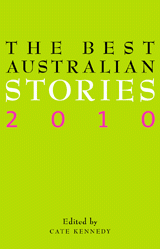
One of the chief advantages of The Best Australian Stories 2010 is that it shows that Australian writing is as varied as Australia’s population, as changeable as its weather and landscape.  This collection shows that Australian literature remains as enigmatic and indefinable as ever. Its content suggests that the cosmopolitanism that in the past has had amazing writers like Christina Stead shunned from the Australian fold, is now well and truly embraced along-side more colonial visions of cattle stations and bushfires, and that any effort to define “Australian writing” would necessarily involve all of these things.

The Best Australian Stories 2010 is comprised of twenty-nine short stories, both previously published and not before printed, from authors both well-established and emerging. Kennedy has struck an admirable balance between male and female authors without it feeling like a political exercise, and much thought has obviously gone into pacing the collection. While reading it’s hard not to say, “Just one more!” because of this attention to detail.

It’s also hard not to connect the stories to one another, as Kennedy’s ability to bring well-suited stories into a collection means that they gesture far beyond themselves into the other stories in the collection, but also into Australian writing as a whole.

While there are stories in here, such as Joanne Riccioni’s ‘Can’t Take the Country Out of the Boy’, and Fiona McFarlane’s ‘The Movie People’ that are concerned with more traditional Australian landscape and colonial values, other stories like Nam Le’s ‘The Yarra’ and Sherryl Clark’s ‘To The Other Side of the World’ speak to a very modern, very high-pressure metropolitan side of Australia. All the stories in this book carry notes of a haunting and tense Australia; its inhabitants torn between yearning to belong and to run. And while the stories in this collection can be broadly connected via themes, it is refreshing to see just how diverse the concerns of these stories are.

Chris Womersley’s ‘The Age of Terror’ actually made me yell. Nam Le’s ‘The Yarra’ made me yell and want to throw the book at something because it was so true, down to his depiction of a Melbourne which I could recognize down to the river bend. Ryan O’Neill’s ‘The Eunuch in the Harem’ is impressive and original and hilarious. Paddy O’Reilley’s story is one that stood out to me as hauntingly Australian. Marcus Clarke once typified Australian landscape as “weird melancholy” and many of the stories truly had that feel – Paddy O’Reilley brings it to suburbia.

By the end of The Best Australian Stories 2010, you feel like you know what Australian writing is about, and get an idea of some of what’s happening in our literary journals, but the collection is by no means tiresome – the diversity between these covers is more than admirable.

The Best Australian Stories 2010 is a collection that we can be proud of, and one whose attention to fine form and original ideas will leave you well and truly sated.


This review appeared in the first 2011 edition of RMIT’s magazine Catalyst.
Love Yourself Today

You should love yourself today.

I’ve been having a slow, tired, quiet, slightly sick day, and I’m about to cap it all off with work.

I just found this Randall Stephens poem which calmed me a little.

I hope it calms you too. Happy Monday.

Writing Research Brought Me This:

I’ve been writing a lot this morning, making headway on a piece I’ve been pottering around with for weeks. A deadline is looming, so I’ve knuckled down.

I’ve done a shuffle of the story to give it a snappy opening line, because they’re so important. New opening line:
“Hugh stares in horror at seven shopping bags full of soup and beans.”

This is subject to subsequent edits, but it’s much more engaging than previous beginnings.

HOWEVER, I’m posting today to show you this messed up thing that my research brought to me. I’ve been researching agoraphobia today, and that’s been fine. Then later I started researching canned foods, and a friend sent me this link. I think the silk worm pupae and the fish mouths get me the worst… Though the whole canned chicken is pretty vomitous.

Enjoy!

Red Lobster Appearance

I’ve just discovered that the final Spinning Room episodes of Red Lobster aired a few weeks ago, and episode 230, with me in it, is up online!

Isn’t it amazing how many faults you can see in your own performances when you watch them back? Even so, this did go down well and it was an amazing night.

My performance is just past the 5 minute mark, but do watch the whole thing – so many great poets!

The rest of the final Spinning Room episodes are up too.

Episode 229 features Amy Bodossian performing one of my favourites of hers, again with a bunch of great people on the open mic, a few familiar names like that man who appears regularly on this blog, Benjamin Solah.

Now, a very important note: You’re nothing until you’ve witnessed Santo Cazzati at full speed. He is most of episode 228. If you don’t watch any of the other episodes in this post, watch Santo. He’s a revelation.

Enter Sol on Verity La

Crack open a beer for me, my work has gone up today on the brilliant lit journal Verity La!

My poem, “Enter Sol” appears with an image by Danny Thomas. A big, huge thanks to editor Alec Patric for his help and support.

Verity La has featured some of my favourite writers and mentors, including Josephine Rowe, Nathan Curnow, Tiggy Johnson and Francesca Rendle-Short. I’m absolutely humbled to be joining those ranks.

Blog at WordPress.com.

Up ↑