Search

Sam van Zweden

Writer

Review: Street To Street, by Brian Castro

Brian Castro’s latest work, Street to Street, is based on the life of Australian poet, Christopher Brennan. No, not quite – it’s more about the life of Brennan’s biographer, Brendan Costa, and the ways that this man’s life paralleled with Brennan’s.

At the start of the book, Brennan and Costa don’t have heaps in common – they’re Australian men with academic flair. Throughout the story, however, Costa’s obsession with Brennan’s life pulls the two men’s stories together. Or is it the similarities between their stories that fuel Costa’s obsession?

Through Costa’s failures and increasing frustration with the institutional rigidity of academia, Costa and Brennan come to play out quite similar lives. While Brennan’s life is separated from Costa’s by some eighty years, Costa feels such an affinity with the older man that he sets his mind (consciously or unconsciously, or perhaps by chance) to immitating Brennan’s life. His eventual mirroring of the man’s life – his failures and dysfunctions, an intentional nose-dive – is something of a homage to a fiercely creative man. Is immitation the best way to honour people we admire? For Costa, yes.

There’s some lovely Borgesian stuff in Street to Street, where Costa’s single-minded immitation of Brennan reminded me of Borges’ Don Quixote story. In it, an author tries to recreate Don Quixote by living his life exactly as Cervantes had lived. Both this and Brian Castro here are asking: is greatness conditional? If we can recreate the right conditions, then is greatness a given, or is it more individual than that?

Street to Street seems to carry some judgement within it, reflecting pretty harshly on academia and creativity in general. Brian Castro does a beautiful job of considering the self-destructive impulses of creative people, but seems to take these as a given. Perhaps they are. The book also heavily criticizes institutions such as universities, and notions like “Australian literature”. Brennan and Costa seem representative of all creative types, where any ambition within their field really translates to an ambition to fail.

There’s so much happening in this slender volume, that it seems to prove impossible to write a very coherent review, or do the enormity of Castro’s mission with this work justice – but I have done my best. To really get your head around it, you’ll need to give it a look-in yourself. Just keep in mind, this one really requires an open and receptive reader. If that’s you, then this book will pay off.

As mentioned, Street to Street is a small book, and one that’s not afraid to call itself a novella. While it’s being suggested that digital reading primes the market for renewed interest in novellas, it’s really nice to see Giramondo doing their bit to continue the form in print. In true Giramondo style, the physical thing is a joy to hold, and a rewarding challenge to read.

On Killings

Today the lovely folk at Killings (the Kill Your Darlings blog) have been kind enough to publish an article of mine. It looks at the discomfort I felt when confronted by honest, humble musicians in a ridiculously large arena, and with a stupid amount of fame.

You can read that article here. Big thanks to Ronnie Sullivan for her eyes pre-publication, and to Imogen Kandel’s patience and commitment to providing quality editorial.

Teaser Tuesday

I feel like I’ve spent a few weeks falling down a rabbit hole, and only now am I beginning to emerge into the landscape that is my life. It all looks a little different without uni, and with me trying to find new ways to keep myself afloat (money and spirits), and to launch fully into my adjusted-routine writing life.

Enter: Teaser Tuesdays. If you’ve been following this blog for a while, you’ll remember Teaser Tuesdays.

Teaser Tuesday is hosted by MizB at Should Be Reading.

  • Grab your current read.
  • Let the book fall open to a random page.
  • Share with us two (2) “teaser” sentences from that page.
  • You also need to share the title of the book that you’re getting your “teaser” from … that way people can have some great book recommendations if they like the teaser you’ve given!

“Yet at the same time, Brennan was aware he was enacting a different reality, turning up in his cream flannel pyjama pants, under his overcoat, little red reindeer running up and down his legs as he spoke on French symbolist poetry. He was sure the double corrected him and made sense of everything.”

– Brian Castro, Street to Street, p130

A Month of Reading

NOVEMBER! How the hell did we get here so quickly?! If you’re anything like me, you’ll be feeling a bit panicky and freaked out that the year just whooshed by like that.

The last month has been a pretty active reading month, even though (or perhaps because) it’s been insanely busy. I finished my BA, handing in a 10,000 word manuscript and a 3,000 word exegesis. There’s so much stuff I’ve been putting off reading until those final assessments were in, so in the weeks since finishing I’ve been a bit of a reading machine.

The night that all the final pieces went in was also the night that some of my favourite people in the world celebrated their fantastic achievements writing for, editing, proofing, designing, forewording, etc etc, the RMIT Creative Writing Anthology, Little Spines. It’s super-professional looking, full of amazing, inspiring writing, and it’s available at Readings and the RMIT bookshop.

Along with all this, I was lucky enough to proofread for Karen Andrews’ new book, Crying In The Car, which launches early December. It’s a great collection of Karen’s essays, blog posts and pieces of fiction and poetry. I loved it, so be sure to pick up a copy when it’s out in December.

Books Bought:
Both Flesh and Not, by David Foster Wallace
Little Spines, RMIT Creative Writing Anthology

Reading Copies:
Street to Street, by Brian Castro

Borrowed:
Tell It Slant, by Brenda Miller
The Writer’s Idea Book, by Jack Heffron
The Lost Woman, by Sydney Smith
Are You My Mother? By Alison Bechdel

Books Read:
Crying in the Car, by Karen Andrews
The Missing Ink, by Philip Hensher
The Lost Woman, by Sydney Smith
Are You My Mother? By Alison Bechdel

Currently Reading:
Tell It Slant, by Brenda Miller
Little Spines, RMIT Creative Writing Anthology

NonFiction…NOW!

That’s not the official branding- the official branding is “NonFictioNow”. See what they did with the ‘N’ there? Tricky.

I’ve just registered for the 2012 NonFictioNow conference, which is coming up on November 21-24. The four-day conference is being hosted at my home away from home, RMIT. The original plan was to coast in on a ‘volunteer’ pass, but I realised that this would reduce the amount of time I could spend David Shields spotting (and leaping-upon), so I decided to register and ATTEND EVERYTHING.

Having just printed the program, I’m already having a small crisis. I’m hoping that a more in-depth program is released that explains beyond the names of the panels and its guests (“Picturing the Essay” versus “Swap Shop: Panel”?).

The main thing I have discovered about my writing self throughout my studies is that I love creative nonfiction, and that it’s what I ultimately want to be writing. The guests at 2012 NonFictioNow include some literary heavy weights such as David Shields (swoooooon), Robin Hemley and Helen Garner, but also some of my favourite locals – David Carlin (who also posted on NFN today on Overland), Francesca Rendle-Short and Jessica Wilkinson among them. Actually, that “favourite locals” list could be way longer, but I won’t bore you, you can look at the program yourself. Other than this, I know next to nothing about how the conference will operate. I attend RMIT and I don’t even know where one of the listed venues is. Will there be a book store involved? Will I end up spending as much as I did at MWF? Will I have an opportunity to blurt my admiration at Robin Hemley or David Shields, like I did at poor old Lee Gutkind?

I did just discover this brilliant collection of audio recordings from 2010, which will give an idea of the kinds of things that might be discussed at this year’s conference.

There’s nothing like a festival to get my creative juices flowing, and they’re a brilliant opportunity for so many things – to find something new to read, to get inspiration toward your own writing, and to meet like-minded writers. I hope I’ll see some of you there to share in the excitement with me. If you can’t find me, I’ll most likely be located hanging off David Shields’ pant-leg as he drags me behind like a small child, from panel to panel.

The Other Side

It’s over, and I’ve taken my week to fall in a heap. Yes, I am unreasonably hopeful that the one week is all it takes. Let’s not talk about other possibilities at this point.

In the last week, I handed in my manuscript and ‘contextual essay’ (for all intents and purposes, an exegesis). I partied reasonably hard that night. The following day I worked, and came home and vomited myself silly – I was knocked down for the remainder of the week with gastro. It was quite an unhappy week. Last night I panicked, because I felt myself falling into a very familiar hole. That place I find myself when a big milestone is passed, and I have to ask myself, “What now?”

Today, however, I came across two articles that really spoke to me, and which have helped me pull myself a little bit out of that hole.

Karen Andrews at Miscellaneous Mum posted her talk from the weekend’s Offset Arts Festival. In it, she talks about her very personal reasons for blogging, and how blogging acted as a distraction during recovery from a breakdown. Karen goes on to talk about how her continued blogging journey has been backed by passion – she kept going, and that’s how she discovered her voice. Karen’s successes (many and varied) have come because she has kept going – she loves what she’s doing, and that’s the motivator.

Another article about reading and writing in relation to emotional healing was posted at The Wheeler Centre website. In an interview with the beautiful Melinda Harvey, she talks about the relationship between reading and healing. For Melinda, at a certain point literature is useless to that process – I’m really struck by the bravery of refuting that idea of literature as a lifeline in times of crisis. At another point, however, reading and writing becomes instrumental in making sense of things – a sentiment I can certainly relate to, having just handed in 10,000 words of a memoir about my mother’s mental illness. Likewise, Melinda talks about how much of a mind-bending change it was for her to think of herself writing a memoir. It’s an uncomfortable kind of negotiation, thinking of yourself as a memoirist when it’s something you’d never considered previously.

Both Karen and Melinda’s words really touched me today, when I’m finding myself at a bit of a cross-roads. I don’t exactly know where life takes me to from here. But I am standing on the other side of a very big milestone, and for today at least, I have pulled myself out of a dark spot thanks to these ladies.

What Research Looks Like

It’s the end of semester, which, this time, means the end of my degree. Holy hell.

I’m up to my elbows in work, but I just caught myself having a bit of a giggle at what I’ve been looking up in the name of research in the last few days. So here’s a quick wrap-up of things I’ve had occasion to Google in the last day or so:

Chronic myeloid leukaemia [image]
Thesaurus – blow up
My house is made of mediocrity family guy 
(you’ve got to take a break some time…)
Sedimentation
Bone marrow biopsy
Peach fool recipe
Does masters have an apostrophe 
(Still unanswered… Any idea? Like, the degree?)
Corella
Twenty four seven in speech
Proofreaders’ marks


Yeah, make sense of that!

Happy doing-whatever, everyone. I finish uni on Monday, and will have a chance to breathe again, so I’ll see you on the other side!

A Month of Reading

Coming up to the end of my BA means that my reading has been very focussed. I’ve only really read what I needed to for school or writing. That’s not necessarily a bad thing, but the tower of things I’ll be reading on the “holidays” is growing.

“Holidays” – a term that loses all meaning when you graduate. Oh hell.

Here’s what I read in September:

Books Bought:
Going Down Swinging Issue 33

Reading Copies:
Bad, by Michael Duffy
Nine Days, by Toni Jordan
The Missing Ink: The Lost Art of Handwriting (and why it still matters), by Philip Hensher

Borrowed:
Speak, Memory: An Autobiography Revisited, by Vladimir Nabokov
Mindfulness: A practical guide to finding peace in a frantic world, by Mark Williams and Danny Penman

Books Read:
The Memory of Salt, by Alice Melike Ulgezer
The Engagement, by Chloe Hooper
Camera Lucida, by Roland Barthes
Gaysia, by Benjamin Law

Currently Reading:
On Photography, by Susan Sontag
Mindfulness: A practical guide to finding peace in a frantic world, by Mark Williams and Danny Penman

Goodbye, Old Friend

On Monday we had to say goodbye to Mac, our 12-year old Cavelier King Charles. As an old dog, Mac had a lot of health problems. Everything inside him was swollen and sore. He wouldn’t lay down in his last few days, because he found it too hard to breathe, his heart was working so fast overtime. It was cruel to keep him going.
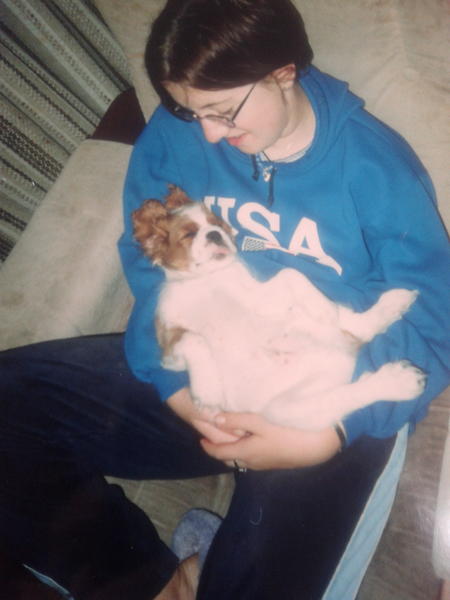
“They’re so easy to pick up,” said Dad, “But so hard to put away.”

Mac sat with me on the couch all afternoon on Monday, even managing to rest his head for a little while. He sat with each of us and let us say what we needed to. As always, he listened. He went outside and got some sun. He knew, I think, and he seemed to be saying goodbye at the same time as we were.

“Goodbye, front yard. Goodbye, favourite tree. Goodbye stone dog statue that I am jealous of. Goodbye cats. Goodbye Mum.”

I cried as he walked slowly inside, and he turned around to comfort me, leaning his whole body against my leg and offering up an ear for a scratch. Even though he seemed to know he was saying goodbye, he still needed to come and comfort me. He was always so good at that.

When we got in the car to go to the vet, he didn’t cry as he always had in cars. As we walked up to the door of the vet’s, he didn’t squirm in my arms. I wanted to turn around and run away with him. He wasn’t upset with me for carrying him in there though – he understood.

After the vet put the catheter in, Mac tucked his tail under his bum and lowered his head. He’d always done this head-hanging thing when he knew he was in trouble, looking up at you past his big old-man eyebrows, swallowing really slowly. His big brown eyes would look at you and say “sorry” in a really personal way. Only on Monday, we weren’t punishing him for anything. And his eyes weren’t the same brown any more, they’d been much darker for days.

The vet asked us to hold Mac when the injection was given. Mac buckled under the anesthetic, and sighed deeply as he lay down for the last time in the position we knew him for – front legs straight out under his big ears, head resting on the sides of his paws.

He didn’t close his eyes. Those eyes were always so full of expression, his eyebrows twitching away even as he slept, his eyes opening at any potential ‘walk’ or ‘food’ noises. But when I put my hand on his head to say goodbye, his eyes did nothing.

I’ve been thinking about what death does to memory, and what memory does to a life. In death, the final pain of life softens. This seems only partly natural, and partly a forced action of my mind: I am determined to focus less on the feeling of Mac’s bones through his baggy skin, and the way his breath didn’t even smell like dog food toward the end – he’d stopped eating the way he always had (WOOLF!) because of what food did to his insides. In the sentimental light of memory, I am in constant rewind. Mac has been coming back to me younger and younger this last week – when he was happiest, cheekiest, liveliest:

Mac looking up at me from the bath, peeking under wet eyebrows (the same as that final look – a very personal apology, despite his doing nothing wrong), those slow licks, and the way he was perfectly patient while he was in the bath. As soon as he was out though, it was a struggle to dry him before he was zooming around the lounge room nose-diving the length of the curtains to dry his long, flopsy ears.

Mac on my 18th birthday, when everyone was drunk and left plates of chocolate mud cake all over our house. Mac must have eaten every one of them, because we found him the next day at the back of the yard shaking. He was sad for a few days after that – dogs and chocolate just don’t mix. He loved a good sneaky-treat though. I have many “when-Mac-ate-that-dumb-shit” memories.

Mac as a puppy, right after he’d been neutered. He had one of those raised dog beds. He lay on it for days feeling sorry for himself – we had him sleeping in the bathroom at that stage, which was right across from my bedroom. I sat with him all weekend, and read to him. We got through all of Tomorrow When The War Began, and by then he was well enough to come sulk on my bed.

And less concrete memories: snuffles and snorts under the covers, as he ended up sleeping under my doona with me right through my adolescence. Just the word “Bed,” and he was all over it. The rising-pitch cry, along with the inability to park his bum firmly on the ground, when he wanted whatever you were eating.

One of the first memories I have of our puppy is when we got him home, and he was so utterly tired that he fell asleep on his feet and fell over, waking himself up. It matches one of the last memories I have of him, sitting on Dad’s couch, falling asleep on his feet and waking himself back up, because his body hadn’t let him sleep in days. My memory has softened this later memory though, because all the happy memories in between are so alive and real. They’re so much easier to recall. They’re the way I’d rather remember my friend.

RIP, Mac.

Blog at WordPress.com.

Up ↑