Search

Sam van Zweden

Writer

Category

Writers

EVENTS! My goodness, EVENTS!

There’s just SO much coming up – my credit card’s getting a decent workout. As is the bit of my brain that controls excitement. I’d almost go as far as saying I’m perpetually excited by all the tickets I’ve got and things that are coming up.

Broadly speaking – two festivals. Melbourne Writers Festival and Overload Poetry Festival. MWF starts tomorrow, and Overload runs from the 9-17th of September.

Excited about the following:

– Tomorrow night’s keynote speech and opening of Melbourne Writers Festival by Jonathan Franzen, and general opening frivolities and Melbourne Town Hall.

Liner Notes, 3rd September – always a thoroughly entertaining night where spoken word artists “cover” (write on the theme of) a particular album. I’m not a huge INXS fan, but I am a fan of the people involved in the event – Emilie Zoey Baker, Omar Musa, Catherine Deveny, Ben Pobjie… The list goes on. And The Toff in Town is a great venue for these kind of writing events, so it promises to be a great night.

–  Melbourne Poetry Map launch – 15th September, at Loop Bar. Last year’s event was really fun, they had a huge range of poets on places that were familiar, and some that weren’t so familiar. This year ten new poets have been commissioned to do ten new poems about ten new places around our fair city – poets include Luka Lesson, Amy Bodossian, Joel McKerrow, Geoff Lemon, and other boys and girls who kick poetry’s butt on a regular basis.

– This is the big one. Shane Koyczan. If you know the fellow and hadn’t yet heard, I apologize if I just made you wet yourself. He’s doing a few gigs in Melbourne – one is some sort of science and rationalism conference at Jeff’s Shed on the 18th, tickets are about $300 and his set is only half an hour. I’m sticking with the two other gigs he’s doing, with Overload. He’ll be at the Tell It Like It Is slam on Friday 16th September, and also at the Overload closing night at the Fitzroy Town Hall on the 17th. Tickets for the closing night are available online, so get onto it, you don’t want to miss this man – the closing event also has a huge lineup of our own Melbourne poets.

If you don’t know Shane Koyczan, try this on for size. Sorry about the uncontrollable crying you’re about to do. Let’s remedy that with some uncontrollable laughing from this one. And just for good measure, this one is one of my favourites. If you watch these and feel as strongly as I do about the man’s brilliance, I’ll catch you at the gigs on the 16th and 17th. (We can talk about how we *completely* dig Degrassi!)
A Perfect Day

Yeah, the sky’s blessedly blue outside for the first time in forever, but that’s not what I’m talking about.

It’s the end of the holidays for me – I’ve found them to be long, but productive. It’s only taken me about 7 weeks, but I’ve finally figured out how I would (try to) spend each and every working day if I were a full-time professional writer, in order to get shit done. For the last week or so, on days when I haven’t worked, this is what I’ve done.

I’d wake up early. Well, early for me: 8am, maybe 8.30. This still gives me two hours of quiet writing time before my boyfriend even thinks about consciousness. I check my email and Facebook, but only out of the neurological need – I don’t spend a long time on there. If there’s stuff to reply to, I do that later in the day. I update my GoodReads account with what I’d read the night before.

I read a short story. This week I’ve been chewing through the contents of Tiny Epics, which has been sitting on my shelf for over a year now. I regret not reading it earlier. Likewise with Bel Woods’ Get Smart which I read last week in page seventeen #8. That girl can write! What do your days look like to produce such brilliance, Bel?

After my short story, as per my writing goals, I read an essay. It’s not always pertinent to what I’m writing, but I’ve been learning an awful lot. Did you know that stabbing a lobster in the head doesn’t actually kill it? And that lobster deaths are a big point of concern for the RSPCA? And I never knew anything about Peter Porter, but now I do, thanks to Clive James – weird to read a dying great write about a dying great.

I write morning pages. These are at least three pages (so, for those of you who can’t convert longhand ideas into tech-speak, that’s about 750w) of whatever. They’re the pages where I supposedly get my brain warmed up to write my way into brilliance. Usually it’s just me pondering story ideas, brainstorming or bitching about how I can’t be arsed doing the dishes.

I do a writing exercise. Also, as per my writing goals, I’ve done one every day so far. It’s been fun. Out of six days, I’ve only had one day turn into something I feel I could follow up. But that’s still a higher hit-rate than when I wasn’t doing an exercise every day.

I work on a WIP.

I work on something that potentially can make me some money. I know that writing for money isn’t the point; I’m not trying to turn all my writing into a money-making scheme – that’s dumb, and would take the enjoyment out of it. I’m trying to find places that I can make money for doing something I enjoy more than my current job. I’ve been writing some copy for Weekendnotes, a guide to things you can do on weekends in Melbourne. It’s fun – it’s not exactly lucrative, but I’m enjoying the experience, and it’s really good exercise for banging things out on demand.

I do any business stuff I need to do. These last few weeks that’s involved getting an ABN, making an invoice template, posting submissions. Looking for comps and new publications I’d like to submit to happens during this time too.

Lastly, I catch up on my Google Reader feed (which is looking comparatively clean at the moment), and I blog, if I’ve got something worth saying or sharing.

Usually this whole routine takes up most of a day. Some days I don’t get around to all of it. As you can imagine, I sometimes get stuck in one piece or another – if it’s a good exercise, or a long story or essay, or if I find myself venting something worthwhile in Morning Pages…

But I feel like finally, after faffing about for six weeks, I’ve figured out how to execute a truly productive day. Now I go back to uni and that’ll jumble everything up a bit, but I’ll be trying to keep at least a few days a week like this.

What do your writing days look like?

Intersecting Lists (Inspired by Sarah Kay)

I’ve just watched Sarah Kay’s TED talk, and it was wonderful and inspiring. She’s so full of life, so eager. And such a confident woman.

She introduced an idea that I’d like to test, and to see whether anything comes out of it. I need your participation for this, so get ready to engage. Please.

She says that when she’s teaching kids how to write spoken word, the first thing she does is get them to write a list of ten things they know to be true. These can be anything – something about entertainment, technology, science, art, what you had for breakfast, someone you know – anything.

What happens from this list, she says, is that in a group when they’re shared, you find someone who has something the same as or very similar to something on yours. Someone else has the exact opposite. Someone else has a new take on something you thought you knew everything about. And someone else has something you’ve never even heard of. And this, she says, this intersection of these four points, is where great stories begin.

So I want to try this. STOP READING HERE! Go write your list of ten things. I’m posting mine below, but I don’t want yours to be influenced by mine. Post yours in the comments, and let’s see if we can find some great stories where our lists intersect. GO!

My List:
1. I had coffee for breakfast.
2. Ugg boots, though awfully ugly, are very warm, and acceptable around the home.
3. I am most of the way finished “New Moon” and it’s awful, but enjoyable. And it’s shameful.
4. Negativity breeds negativity.
5. There are too many books in the world for anyone to ever truly be “well read”.
6. I am 24.
7. It is easier for me to write with good equipment: fountain pen, laptop, comfy chairs. These make the job easier.
8. Tonight for dinner, left-overs.
9. Laptops are getting cheaper and better: a happy combination.
10. It has been raining all day.

I have high hopes for this, don’t disappoint me, Dear Reader! Post your list below.

The Facelessness of Writing

Writing is a weird business. The main part of what we do is faceless – we spend time alone, curled over keyboards or notebooks, looking inside ourselves and picking things apart. When we do send things out into the world, it rarely involves live-action relationships with editors and the like. Emails, forums, blogs. So much of what we do happens under layer after layer of facelessness.

I don’t know what many of my favourite authors look like, or how they present in person. I was shocked to find John Marsden is such a confronting mixture of crude and intelligent. I’ll admit that Camus’ theories are more palatable than Sartre’s based on their author pics. Last week at the Emerging Writers’ Festival I was surprised by how much Carmel Bird just looked like someone’s mum. I love Alan Bissett’s writing all the more for his outgoing personality, and I’m reading Death of a Ladies’ Man in his very attractive accent. The way authors look and present themselves in person, face-to-face, can be worlds away from how we imagine them through their writing.

This made the Emerging Writers’ Festival an amusing space to meet and greet. The main thing that struck me over and over again during the two weeks was how weird it is that the two sides of our job are such polar opposites. Absolute isolation versus schmooze-fest. I’m not saying that either is preferable – I love both. But when someone talked about me without knowing I was in the room, or when I had the “a-ha!” moment where I connected someone’s writing projects to that person I’d been talking to for the last hour, it really struck me how singularly bizarre writing is.

Miles Franklin Brouhaha

This morning the shortlist was announced for the 2011 Miles Franklin award. This award honours novels “portraying Australian life in any of its phases”. The award itself is a point of debate for the great Australian novels ignored due to its criteria – Christina Stead’s The Man Who Loved Children, despite being written by an Australian, composed of mainly autobiographical material, and maybe an Australian attitude, would be unable to contend for the prize because it was set in America – of course, this text was published before the award began, but it’s the most readily available example from my dead brain this morning. Many novels written by Australians would fit this same bill.

But this year there is talk for a different reason. The short list released this morning is very much that – short.

It is only three works long:
Bereft by Chris Womersley
That Deadman Dance by Kim Scott
When Colts Ran by Roger McDonald

For a comprehensive and updating run-down of said ‘brouhaha’ check out Angela Meyer’s post, which will also no doubt generate some decent discussion in its comment section.

The general unrest seems to be about the narrow scope of the definition of “Australian life”. As mentioned before, many great novels have been discounted from the running for this award in the past, but never before has the shortlist been as short as just 3 titles – and those three titles favour the rural male voice in a historical setting. The criteria for the award is narrow to begin with (and fair enough – it’s an important goal, to be writing about Australian life), but at what cost? This year’s shortlist might suggest that the preferred depiction of “Australian life” is narrowing still.

–> No judgement is being passed here on the texts themselves – I haven’t read any of them yet, but have heard they’re great. Speculation is on the nature of the award itself and this year’s incredibly short shortlist.

–> How great is the word “brouhaha”? Damn straight, I put it in a sentence!

LATER:

I just found this post by Jennifer Mills, which makes some interesting points in the debate, including this brilliant one:

“I think that the prevalence of such stories is a result of living in a colonising culture which still has fractures along its frontiers. Yeah, we need diversity in our voices. But we also like to scratch the itches of our culture and i don’t think writers are the sole determinants of where their cultures itch.”

The World’s Most Affordable Lit Festival

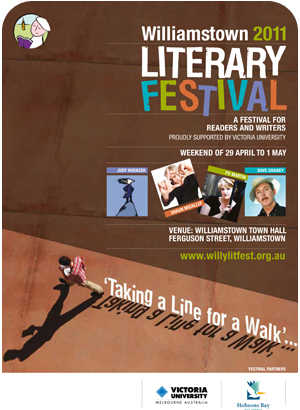
The program for the Willy Lit Fest has been released, and I’ve scoured and circled and am about to purchase tickets.

“But you’re a student!” you may exclaim, wondering how I can afford such things.

Here’s how: tickets to the Willy Lit Fest events are (mostly) $5.50 for concession, $7.70 full price. Isn’t that just nuts? I can’t afford NOT to go!

On my list of must-attend:

A panel with Steven Amsterdam (who, has anyone else noticed, was in the last Big Issue holding chickens?), Jon Bauer and Jonathan Griffiths, titled “Getting Your First Novel Across The Line”. Sure, I don’t have a first novel, yet. But school’s mentioned its importance to my graduation; it’s come up. They’ve even got me taking a course which hopefully insists on referring to “Your Novel” (capitals and all). So eventually, the advice from this panel will surely come in handy. And Steven Amsterdam makes me happy.

Carmel Bird is one of my favourite short-storyists, and she’s running a workshop on writing memoirs, which gets me excited also. Both time with Carmel and the memoir-writing tips.

And a session with Angela Meyer about blogging. As you may have noticed, this here blog has been receiving some re-vamping lately. I’ve been trying, world, I really have. So let’s hope Angela has some tips which will make me (blogger) and you (, dear reader) happy.

Willy Lit Fest, the world’s most affordable literary festival is happening on the final weekend of 30th April-1st May. For those of you who (like me) didn’t know, Williamstown is only 30 minutes train ride out of the city, so not only is this cheap, but accessible also. Write-ups of above events, of course, to follow.

Some Solid Advice

I’m a fan of Cate Kennedy. She’s a great writer, a wonderful editor (hey, Christmas is coming up! “The Best Australian…”? Anyone?), and I especially enjoy reading her columns and journal articles.

Having read some of her work before, I know that Cate Kennedy is a major proponent of turning the damn internet off when you’re working. She tells some harsh truths, she honestly gets to the crux of the problem, whether it’s time-wasting, or lying to yourself about what your work really is or wants to be…

Yesterday on The Inc. Blot (the Black Inc blog), Cate wrote her top ten tips for writers. Usually these lists are pretty gimmicky, or they take the piss. Mark Twain’s advice, “Use good grammar” and a very helpful BBC article telling me to “Get an agent!” are two such articles.

Cate’s list, however, is true to her usual form. She cuts through the crap, and gives real advice which talks to the real problems most writers face. Thinking about fame when what you need to do first is find somewhere to sit and write. Mucking around on Youtube. Self-editing before anything even reaches that page. Most importantly, just get the job done. Cate gives advice that helps you do that.

So head on over to The Inc. Blot and give her article a read.

Paying Off

One thing I’ve found essential in this writing game – a thick skin.

I’ve been submitting my work to magazines and journals for about a year now, and it’s a really bizarre process. Most times, you email off your submission and you don’t know whether they’ve received it or not, then you sit on your hands for the allotted amount of time before assuming you’re safe to send the piece off somewhere else.

Occasionally I’ll receive a “Thanks for your submission – we’ll get back to you shortly,” and when I do my heart bursts with joy at some (any!) sort of acknowledgement.

Only recently have I got entirely practical and a little bit anal about this thing, and made a spreadsheet which details which piece went where, when, and when I should hear expect to hear back from them – and then the contact details of who I plan to contact if I don’t hear back. That was one thing that became really clear to me throughout the EWF – if you don’t hear from an editor within the timeframe they give you (most submissions guidelines will tell you how long you can expect to wait), it’s absolutely okay to contact them to check what’s happened to your submission. Editors are people too. They get busy. They lose stuff. They experience technical cock-ups.

The last year has been a long haul of ‘submit/wait/submit somewhere else/wait again/maybe get an actual “no”/cry for a bit/submit somewhere else/wait … ” (ad infinitum). But after all this, I think I’ve finally gotten somewhere, folks!

Yesterday I received not one, but TWO emails that made my heart sing. One said, ‘yes, yes actually we would love to publish your piece!’… the other said they thought my piece had potential, made some suggestions for re-working, and encouraged me to re-submit it.

I won’t name names of publications here, because I have a feeling that’s not entirely kosher. Let me give you all a bit of a spoiler about your first acceptance letters though – they are ABSOLUTELY the opposite of rejection letters.

The rejection letters I’ve received thus far go something like: “Dear Sam, Thanks for your submission to ____. Due to the volume and quality of submissions we have received, and limited space in the publication, the editorial process has been difficult. We are sorry to inform you that we will not be including your piece in our next issue, however we encourage you to submit more work in the future. Regards, Editor.”

They’re so vague and soul-crushing. “BUT WHY!?” I’m screaming at my computer, “WHY!? What was wrong with the piece?”

Acceptance letters though? Nice. Lovely! None of this vagueness. They say yes, then they tell you exactly why they think you’re awesome. I kid you not. It’s such a just payoff for all the soul-crushing the last year has brought. Finally, finally, finally, I got something past an editor!

So keep your eyes peeled, kids, I’ll keep you updated as to WHERE my work will be appearing closer to publication date.

And maintain a thick skin. It’ll happen.

Cxxx

Last week I posted about Ex Calamus, the new webzine I’m involved in with fellow RMIT Creative Writing students.

The latest installment in Ex Calami glory is called “Cxxx” – don’t ask me the meaning, but I do think of that particular combination of letters quite fondly now.

Cxxx is attached to the E.C website, and is another writing project based on constraints. Cxxx is all about nanofiction or micropoetry within 130 characters. Unlike Ex Calamus’ Webzine, there is no theme or time-limit. I have some work up there, and the content seems to be added to almost daily. Check it out!

…and I promise, my blog will not continue to just be posts plugging my work. I’ll write some actual content in the next few days. Cross my heart.

Blog at WordPress.com.

Up ↑