The end of the year always prompts introspection and evaluation. Another year has passed, and what have I done with it? Have I acted the way I wanted to; have I achieved the things I intended; have I changed or grown as a person?
At the end of 2012, I graduated. I’d spent three years completing my BA (Creative Writing), and I graduated with Distinction, one of hundreds of other students and thousands of onlooking family and friends at Etihad stadium. They wouldn’t open the roof even though it was really hot and the robes didn’t help the situation, and they served us flat beer. It felt pretty good regardless.
I entered into 2013 with no solid plans, really. When asked, I told people I would use it to take as many writing-related opportunities as I could. “It’s a year off,” I said.
It’s turned out to be very much a year on. I did bugger all until February or March, and then my life exploded into a whirlwind of activity. I started an internship with Melbourne Writers Festival, and shortly after I started doing social media for Kill Your Darlings. And from there it all just rolled rapidly forwards. Toward the end of the year I joined the team at Writers Bloc as Online Editor.
I did reviews for The Big Issue, and I got my second feature published there. I wrote for the Emerging Writers’ Festival Online Journal, and for The Peach. I wrote bits for the City of Melbourne blog and the MWF blog.
I met more famous people than can really be good for anyone, but it did help me overcome my star-struckness. I dealt with last-minute problems and I fixed them, mainly. I learned new grammar rules (new to me, not to grammar). I clarified what I stand for, professionally. I met fantastic arts people.
I worked on stuff, and I re-worked it, and worked on it again. And then I submitted and got rejected and sometimes I got accepted. In that sense, it was a year like any other.
In every other sense, it was not. My “year off” turned out very much to be a “year on”. It’s been swell. Thanks, 2013.
I’m a bookseller. It’s Christmas. The last week or so has been hectic.
It has been:
The woman who thrust her credit card so hard into the machine that it rejected the card. She also grabbed the receipt while it was still being printed, trying to walk away with it before it even really existed.
The man who rang to put a book on hold, wondering if we’d perhaps be open 24-hours a day until Christmas eve. (We’re not. We’re a tiny shopping centre.)
The woman who asked if we had the first Heroes of Olympus book, and left the store in a huff before I’d even finished saying “No, I’m sorry, but I can check if another store has it in stock for you if you’d like.”
The man who stood in the middle of the store looking terribly lost and sad. “Do you need a hand?” “I need something for the girl.” “Okay, what’s she interested in?” “She likes the Dalai Lama.” …This was the only information he would give me. He ended up with a biography about an inspiring horse. This shit happens when you don’t work with your bookseller.
Someone’s Grandad who came in wearing a YOLO shirt. Amen, Grandad.
The woman who muscled through our closed doors.
“Where are your books about antique watches?”
The last customer of the day yesterday, who demonstrated exactly how all Christmas shopping should go down. He named the stereotype that his giftee most easily fit into, and I handed him books and loosely outlined themes. As such: “Conservative Mum.” (Handing him Walking on Trampolines), “Family drama, lady friendships.” “Done!” Him, holding up Eat Pray Love: “Single girl self-esteem?” “Mmmm, more divorcee self-esteem, empowerment.” “Okay yeah there’s one of those too. Done.” I’m not trying to imply that you shouldn’t put any thought into your Christmas presents. But if you’ve left it until December 22nd, chances are you’re not putting a huge amount of thought in anyway. And when it’s ten minutes past closing time and you don’t actually care whether this book contains a dying elderly person, or if that book covers Provence or Marseille too, then just trust us when we recommend something.
And finally, the sleep that happens at the end of these days. The sensation of my bones giving up beneath my flesh, when all of me seems to fall right through the mattress. To sleep like that every day of the year, without first putting in the work!
I’ve been building up hampers and foodstuffs for people I love for weeks now. It’s a gradual process, and takes a fair bit of planning, putting together, packaging. I thought I deserved a reward.
Well, no, really I think I was just looking for any excuse, and Christmas is here so that’s it. Anyway, I bought myself a subscription for The Lifted Brow. I love the Brow because they’re smart but not too smart, and they’re always tapping into mundane things and making them important in interesting ways.
Also, they’re running an INSANE give-away for subscribers, and that certainly helped. They’re giving away 52 books to ONE PERSON. As they say, “It’s actually a year of reading: 52 books; 52 weeks in a year; a book a week; how wonderful.”
What a reading challenge that would be. My fingers are crossed, but I also wanted to let you know it’s happening and you should probably subscribe to a great publication too, so here it is. Make it happen.
It’s almost 3pm, and I haven’t turned the television on today. I believe this is the key to today’s productivity levels (relatively high).
Some mornings I’ll wake and think, “Just with breakfast. I’ll just watch an episode of Whatever Shit I’m Addicted To with brekkie, then I’ll get into it.” I watch the episode, and I usually finish my breakfast by 15 minutes into the 45-minute episode. So I waste an extra half-hour seeing the episode out.
Recent perpetrators: Dracula, Masters of Sex, Boardwalk Empire, The Blacklist.
The problem is two-pronged.
1. I waste the extra half-hour, and then get to work. But my mindframe is shot. I’m in lounging-mode, not working-mode.
2. “Just one more”. All shows that I’m watching after-the-fact (that is, that I don’t see weekly as they’re aired) have the allure of just one more. What’s another 45 minutes and some narrative closure? The trap, of course, being that each episode has its own cliff-hanger, and I never get that closure. So always one more.
Fix: don’t turn the TV on at all, until the work day is done. It’ll ruin everything.
Share with us two (2) “teaser” sentences from that page.
You also need to share the title of the book that you’re getting your “teaser” from … that way people can have some great book recommendations if they like the teaser you’ve given!
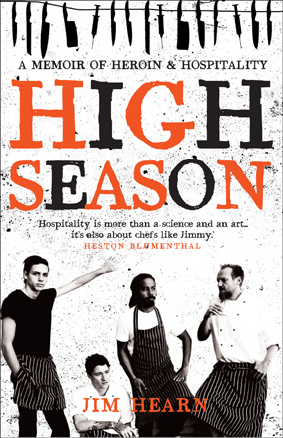
“So I’m standing in front of my six-burner stove at Rae’s on Watego’s in Byron Bay and our head waiter Scotty wants to know if I’ll cook a soft-shell crab for Paris Hilton that isn’t deep-fried. I’m no killjoy so I say sure, it’ll be wet and soggy but it’ll taste like crab.”
– from Jim Hearn’s High Season: A Memoir of Heroin and Hospitality, p. 1.
Slow reading month, November. I’ve started stitching Christmas cards and test-baking/cooking foodie gifts. I’m in the process of forcing some balance between editing Writers Bloc and my normal reading patterns. After a month of it, I feel like I’m starting to reach some kind of sweet spot. I also spent a large portion of November reading (but not finishing) Game of Thrones, in preparation for meeting George RR Martin. He was wonderful, and I pretended I’d read more than half of the first book of A Song of Ice and Fire.
I finished reading Murder In Mississippi for KYD Book Club. I’m not much of a true crime reader – in fact, I’ve got some on my shelf but I’ve never given it a shot, not even Truman Capote, which I know is something I should have read. Anyway, I jumped into Murder In Mississippi pretty innocent, I guess. And I loved it. I’ve always enjoyed watching John Safran on TV (in a hand-over-mouth, ‘Oh, he didn’t!’ type way), and probably brought a lot of this with me to the book. Safran makes a loveable, if highly self-conscious and flawed, guide through racist Mississippi. He looks into the murder of a white supremacist by a young black man, and I found myself in the palm of his hand. Red herrings, dead-ends, disappointments and surprises all got me. Murder in Mississippi is well worth a shot.
I also finished reading Marbles, by Ellen Forney. I’ll post a longer review of this one soon.
Loads of great books published this month, and I only bought the following few: Nick Hornby’s got a book out that talks about his books column, called Stuff I’ve Been Reading. I guess it’s kind of similar to what I do here. I look forward to reading it, and hopefully getting some insight to what could work better here.
Ruth Field’s Run Fat B!tch Run is a hilarious, no-nonsense approach to getting off the couch and into your runners, which came along at just the right time for me as I trained for my first 5km run last year. She’s got another one out now, Get Your Sh!t Together, which employs the same straight-talking Grit Doctor that the first book did. I look forward to abandoning multi-tasking and list-making, and getting my shit together. …When I actually get around to reading it.
The Best Australian series came out at the beginning of November, too. I’m chuffed to see mentor-man Laurie Steed’s story The Knife in this collection. He’s done amazing work this year, and Best Australian Stories really tops it off. BAS now sits next to my study chair, and I’ll be working through story-by-story before the end of the year.
I was pretty stoked to find a copy of HHhH by Laurent Binet at my local Salvos. (I’ve said it so many times, I’ll say it again: Kew Salvos for books. Do it.) Picked it up for $3.99, and as I walked out the door I noticed the “Reading Copy” notice down the side of the book. It looks like not everyone has the squirmy feeling about giving reading copies to op-shops that I do.
Speaking of reading copies – managed to swindle myself a copy of Eimear McBride’s A Girl Is a Half-Formed Thing. I’m really looking forward to this: on picking it up, it looks totally disjointed and unreadable. But then you start reading, and notice that half-sentences and fragmented thoughts kind of swirl and accumulate. No sentence by itself makes a great deal of sense, but working with all the words around it, the prose here makes deep impressions in a cumulative way. It’s a debut novel, and this is such a brave way for a debut novelist to write. It’s not safe at all. And I can’t wait.
I was also sent a copy of Kristen Krauth’s Just_a_girl, which has been getting good reviews.
McSweeny’s 44 finally emerged from my post-box too, after delays at the printers, then delays sending, then delays receiving. It’s mine now. Mine.
I got along to the Hardie Grant book sale last week, and managed to limit my spending to Christmas gifts for others, and one book for myself: Dave Eggers’ latest, The Circle.
So, the verdict for November: so much more came in than went out, and I didn’t really notice this until I started writing this post. But I feel excited about all the great reading I’ve got lined up!
We’re in the final week of NaNoWriMo, and my month hasn’t gone entirely to plan.
I decided (but apparently didn’t really commit) to undertake NaNo when we decided to do a heap of supportive content about it on Writers Bloc. That is, a couple of days before November began. I thought I wouldn’t be able to properly talk about the NaNoWriMo experience unless I had one myself.
If you’re unfamiliar with NaNoWriMo (National Novel Writing Month), the basic premise is to write 50,000 words toward your novel in 30 days. I’ve taken my own path a bit, in that I’m not working on a novel but using the time to tally up articles, essays, blog posts; drafts of all sorts. Today, on the 25th day of writing, and less than a week from the finish line, I’ve got only a fifth of what I was meant to aim for. I haven’t even written every day.
Why am I sharing this? Why am I not pretending I finished, or at least got a whole lot closer to 50,000 words than I actually have? I’m not entirely sure. I think it’s because I suspect there’s many more like me out there, who’ve done just a bit of a NaNo. And I think that’s okay, and not something to beat yourself up over.
NaNoWriMo’s a time for a heap of feels. Foremost is guilt, for having not written more, or having not spent every waking moment with my writing in mind, as I know many people do. On the other hand though, I do feel more creative having (almost) done this month of intensive writing. There’s something about the act of constantly throwing out ideas and running with them that unblocks your creativity. Instead of vetoing ideas before they make it to the page, as I normally would, my desperate-for-words mentality meant that everything got air time. Even ridiculous ideas.
I have found myself writing fiction, which I haven’t done in at least six months.
I’ve created a stockpile of projects to return to later.
I’ve unblocked, and am giving less heed to that nagging voice in my head which usually prevents those ideas from being actual pieces of writing.
How has NaNoWriMo gone for you? We’re still five days away from the finish line, but winners are beginning to announce themselves (HUGE APPLAUSE!) already. Have you reached the 50K already? Are you on your way? Or have you, like me, just gone with it and gotten something else out of the experience?
Today’s big news in the writing world is the Crikey bloggers’ open letter about non-payment of The Daily Review writers. The issue first got attention when Andrew Stafford published a piece with mUmBRELLA explaining why he had turned down an offer to write for The Daily Review – in short, it’s because they wouldn’t pay him, even though they can afford to. This morning three writers who blog for Crikey (Bethanie Blanchard, Byron Bache and Laurence Barber) published an open letter calling for freelancers to take the same stand that Stafford did, and refuse to write for The Daily Review for free. The publication can afford to pay its other staff, the letter states, but allows no budget (that’s $0) to commission work from writers.
My first published piece didn’t pay. Neither did the second one, or the third. To be honest, it’s only recently, almost four years after that initial publication, that I’ve actually started to think about payment for my work as an issue. The first few times I got paid, I felt very lucky – people wanted to publish my work and pay me for it?! Too many good things at once! Sometimes I still get that feeling.
Now that it is something that I think about, I feel like I’ve got a fairly considered view on it, though as I grow as a writer, my personal ‘policy’ on it is constantly refined. It’s a difficult issue, and one with so many nuances. I’ll attempt to tease some of it out here, acknowledging that there’s a lot to be said, and this is only my tiny contribution to a very long and ongoing larger discussion.
I agree with what the Crikey writers have done. I admire it. It takes a lot of guts to stand for something, especially when that involves standing up to people who employ you. There’s something at risk for these writers in telling the world that they think something is wrong here, and I can’t applaud that enough.
There’s been a heap of responses all over the internet today, and they’re fantastic too. This conversation is vibrant and impassioned, and we can all only hope that it’s the push that this argument needs to be paid some heed – by CEOs and chairs and boards and the people who create budgets.
Elmo Keep makes a great argument here. She simplifies what’s going on, and in doing so makes it sound ridiculous. Because it is:
“… working for free on behalf of someone else, in order to grow that person’s business. And you will not see a cent.”
For the case in point, this is spot-on. People are being asked to donate their significant skills to a for-profit business, and this is why it’s unbelievable. It’s kind of easy to look at the evidence and the argument and call it ridiculous.
What’s hard is the practice of saying no. For already-established writers with firm footholds, it’s relatively easy to refuse work without pay. For writers who are new to the game and desperate for publication, sometimes money isn’t a consideration. Getting work out trumps getting paid for it.
I’m okay with emerging writers working for varying levels of payment, provided it’s fair. I’ve written before about some of the many exceptions to getting paid in money, and things that I’ve done without pay that I’m comfortable to have done in order to learn and get experience under my belt. Often payment has been in forms that aren’t monetary – editorial patience and attention, learning opportunities. With each publication, I have taken the time to consider and weigh it up – if I’m not being paid in dollars, what am I being paid in? There’s always been something, even if it’s just the good feeling of helping a friend get their new publication off the ground.
That’s not the issue at hand here, though. The problem is with publications who have sufficient money behind them to pay their writers, but elect not to.
‘Fairness’ as a rule applies to everyone: whether it’s a zine or a major national or international website. Can you afford to pay your writers? Then do it.
The demand for there to be a blanket rate of payment across the industry is probably impractical. Smaller and younger publications can’t afford to pay their writers hundreds of dollars for work. What’s fair is to pay writers what can be afforded.
I’m proud to say that over at Writers Bloc, we pay our writers. It’s often a really small amount. It could be as little as $15 (this is what we pay for a review). We’re transparent about this. When I started this job, founding editor Geoff and I did a bit of talking about the issue and agreed that it’s important to tell writers that their work is worth money. They deserve to be financially rewarded for the time, heart, and skill that goes into their writing. I have to tip my hat here to Daniel Young (founding editor of Tincture Journal), who has made it clear that this model works. This is what we can afford to do, and so we do it.
I’m posting these thoughts because I support what the Crikey bloggers and Andrew Stafford have done to draw attention to this issue. I’m posting these thoughts because I want to call for fairness, too.
There are so many good, kind, and fair people in this industry. Be one of them.
A while back I made a post about the tools that save my life. In it, I talked about the useful tools which help me work efficiently. We’re all busy people. We all need bits and bobs that make our hectic lives easier to handle. And in this world of apps and websites and programs and shares, and being the organization geek that I am, I’m always trying to implement new systems.
Introducing:
Coffitivity I’ve long known that it’s impossible to work in silence. The more silent my writing space is, the louder it gets. My head takes over, criticising every word I write, until I can no longer put anything down on the page. This is lessened a little by handwriting, possibly because the motor skill of writing by hand is somehow (whyyy?!) less automatic than typing. But either way, I can’t work in silence.
Coffitivity is the answer. It’s a nifty website that plays café sounds in the background while you work. You know the cliché of writers in cafes not writing, just pretending? If you’re an actual writer, I imagine this image makes you a bit squeamish. And so Coffitivity will allow you to take the useful noise levels home with you. If it’s the act of getting out of your house that helps… Sorry. I can’t help you with that one. Maybe on the next post.
This has really solved the problem of working when my boyfriend’s home too. He watches TV loudly, and I can no longer work…unless I put headphones in and Coffitivity my way through!
Nature Sounds You’re on the tram, and there’s a bogan on the phone screaming about last Friday’s rager. You don’t care; you’re trying to concentrate on your book. Reading at the tram stop you got into a fantastic scene, but now Bogan Lady’s screaming in your ear and it’s a bit hard to concentrate. Other commuters are wearing headphones to block her out, but they’re just staring out the window. Listening to music while reading might be hard for you, because taking in two different streams of words is confusing and not helpful for concentration.
So? Nature Sounds! There’s chirping birds and whatnot, which are as bad as music. But I like to listen to heavy rain or waterfalls. It allows me to focus on my book, and turn an otherwise kind of pissed-off tram ride into reading time.
For more information about ambient noise, how it works, and other programs you can use, try here. Seriously, it’s changed things for me.
Evernote I have so many problems that are solved by Evernote, and only one that isn’t.
Evernote is a digital folder. It allows you to take notes, and organize them. You can categorize into ‘notebooks’, and order and view your notes however is most useful for you. You can tag your notes for easy finding later.
In motion: I have a Writers Bloc notebook, which contains a note with logins, a note with a to-do list, a note with contacts, a note with a blog schedule, a note with payment details, etc etc. I have a Quotes notebook, in which I log any quotes I want to save. I tag them, so that when I remember a vague “thing” later that I’d like to use somehow, I can just look it up.
Evernote does not contain a calendar. For my blog schedules, I just type out dates and separate weeks by dividers. So it’s not impossible, it’s just not TOTALLY streamlined.
What IS streamlined is multi-platform use. I use this on my phone and my laptop, and it syncs constantly so that all my content is always up to date.
Windows Live Mail I have a big problem with push notifications. They’re great, because I have everything with me all the time!
But they also mean that I have everything with me all the time.
There’s no switching off from work, because it’s all mixed up with the things that aren’t work. Pushing all my emails means also pushing work mail. Until Windows Live Mail! This is probably too specific to my circumstances to be useful, but I’m sharing it anyway.
The majority of my Writers Bloc email now goes through a separate mail account, which goes through a separate email client, which I can turn notifications OFF – on my computer I need to open a separate program to access it, and on my phone I’ve usually got the notifications off so that I don’t get alerts when an email’s there. I don’t feel compelled to do everything NOW because I don’t know it exists now, and that’s really the best thing for me.
What organization and efficiency tools save your life?





 Sam van Zweden