Search

Sam van Zweden

Writer

Tag

reading

The Numbers: A Study in Reading Habits

Early last year, I did a little analysis of the numbers around my reading, inspired by a post of Chris Flynn’s. I thought it might be interesting to do the same sort of break-down of my reading for the whole of 2010.

Here goes:

30 men. 52 women. 1 combined.
22 Australian. 31 non-Australian.
1 literary journal*. 2 graphic novels. 7 non-fiction. 43 fiction.

I have to say, I’m surprised by how close the numbers are between men:women and Australian:non-Australian, I thought both these areas would be pretty highly skewed in favour of non-Australian men. There’s definitely room for improvement, to read more women, more Australian writing, but I’m pretty pleased with the effort for 2010.

Next year I’ll start counting literary journals and include that in my tally. My non-fiction:fiction count isn’t quite what I’d like it to be – I’ll be aiming to read more non-fiction in 2011.

*I read many, many more than 1 lit journal during 2010, but I only included KYD in my list. In 2011, lit journals that I’ve read cover-to-cover will be included in my count.

A Month Of Reading

I found this meme in “The Victorian Writer”, the Victorian Writer’s Centre magazine.

“A Month Of Reading” outlines what’s gone on on my bookshelf and in my reading time this month. I must say, I find it scary that this is a pretty typical month, acquiring 18 books and reading 3 of them. No wonder I panic about not having time to read “everything”!

What was your month of reading like?

DECEMBER:

Books Bought:
“The Little Prince” by Antoine de Saint-Exupery
“Ham on Rye” by Charles Bukowski
“Perfume” by Patrick Suskind
“Humpty Dumpty in Oakland” by Philip K. Dick
“The Irresponsible Self: On Laughter and The Novel” by James Wood
“Reheated Cabbage” by Irvine Welsh
“The View From Castle Rock” by Alice Munro
“Our Story Begins” by Tobias Wolff

Books Borrowed/Received:
Library:
“The Family Law” by Benjamin Law
“Winning By Losing” by Jillian Michaels
“Black Swan Green” by David Mitchell
“Poemcrazy” by Susan Goldsmith-Woodridge

Gifted:
“The Crying of Lot 49” by Thomas Pynchon
“Yellow Dog” Martin Amis
“Unreliable Memoirs” Clive James
“Flying Visits” Clive James
“Brilliant Creatures” Clive James
“Reliable Essays – the best of Clive James” by Clive James

Books Read:
“The Man Who Mistook His Wife for a Hat” by Oliver Sacks
“The Family Law” by Benjamin Law
“Black Swan Green” by David Mitchell

Books Reading:
“Winning by Losing” by Jillian Michaels
“The Best Australian Poems 2010” ed. Robert Adamson
“The Best Australian Stories 2010” ed. Cate Kennedy
“The Reader”, ed. Aden Rolfe


An Emergency In The Form of a Bright Blue Box Set

There’s many book shop loyalty programs. They all basically work on the idea that as you buy books, you get “rewards” (points of some sort which can be redeemed at that book store for more books).

A quick scan through my wallet shows the following book-store loyalty cards:
BORDERS: One stamp for every book you buy over $20. When you get to a certain amount (I think it’s 7), you get a free book of a value under $20. It’s pretty rare for Borders to charge under $20 for anything decent, plus this is only valid if you earn those rewards within a three-month time frame. No thanks.
ANGUS & ROBERTSON REWARDS: One point for every dollar you spend. Good deal, no? No. It takes 100 points (that’s $100, kids) to earn your “reward” – a $5 A&R voucher. That’s a lot of money for little payoff. Really.
DYMOCKS BOOKLOVER: I’ve been a member of is for such a long time, and it’s still not such a bad deal. Dymocks give you 5 points for every $1 you spend. Every 100 points equates to $1 credit on your card. As I said, not such a bad deal.
VWC MEMBERSHIP: This is an inappropriate plug for how great it is being a member of the Victorian Writer’s Centre. For those of us on concession cards, it’s only $45 a year, and that pays itself off SO quickly. Not only do you get sent special publications all about the writing industry, and get cheaper tickets to workshops etc AND access to the kick-ass library they’ve got up at the Wheeler Centre, but you also get 10% off at Paperback Books on Bourke Street. The Paperback is one of my favourite book shops in Melbourne, and this 10% off makes it so much better shopping there. Rant Fin.

My favourite rewards card though? Easily
READER’S FEAST PRIVILEGED READER: You know those book guides that Reader’s Feast put out each season? That gets sent to you in the mail. Along with invites to special events, such as discount shopping evenings and writers’ appearances. On top of this, every dollar that you spend at Reader’s Feast gets tracked on your card, and twice a year 10% of the amount you’ve spent gets reimbursed as a Reader’s Feast book voucher. If that amount is under $5, they send you a $5 voucher anyway. Forgot to bring your card? No worries, they’ll look you up on the computer.

So, all that being said, I know my top two choices for Christmas shopping!

Last week in the mail I received the above mentioned seasonal book catalogue. In the same envelope were two invitations. One to a special evening where you partook in “Christmas cheer”, “light refreshments”, shopped, and received a $5 voucher just for coming. Unfortunately, I was working that night and missed it. However, the other invitation was for “End of Year Bonus Time”. Between the 21st of November and the 5th of December, Readers Feast are boosting the Privileged Reader’s rewards to 20% credit, rather than the usual 10%.

Today I headed in. I’ve been eagerly awaiting having enough cash to buy the whole Black Inc. “Best Australian…” box set, containing the collected essays, short stories and poetry. I’ve been unreasonably excited about this – when I received this “20%!” invite, I had to have in. I had the cash, I had the time, I went and got my box set. The box set, worth $70, is now sitting next to me on my couch waiting to be cracked open. Not only do I own this box set, but $14 of the purchase price will soon come back to me in the form of a Reader’s Feast book voucher. $14! That’s SO MUCH!

I’m proud of myself, folks. And I’m giving you a kind heads-up. Things you should take from this post:
– Join Reader’s Feast Privileged Readers reward program. It’s free, and so very awesome.
– Join VWC. They’re so plain awesome that they snuck into this post uninvited!
– Buy the “Best Australian…”  collection. In a box-set this year! It’s so pretty. So very, very pretty.

SO pretty, in fact, that I’m settling down with a coffee to get stuck into them right now. Boss, if you’re reading this, I may not be in to work tonight, I might have “an emergency”…in the form of a bright blue box set.

The Wild Things by Dave Eggers Review

I never read Maurice Sendak’s Where The Wild Things Are as a kid. I can recognize the book, and I knew it was popular, but somehow it was a title that I just never had much to do with.

Recently this book was turned into a film, which expanded on Sendak’s original picture-book story. There was much discussion about the film being too adult, and not in the general feel of the children’s story. I saw the film, and I agree, it’s not appropriate for children – but I don’t think it should have been. The kids about my age and older who grew up reading Where The Wild Things Are are the people who watched the film, and it was appropriate for that age group.

Lesser known is the fact that at around the same time, the picture-book was adapted to a novel, written by Dave Eggers, who also wrote the screenplay. The novel diverges from the story of the film in parts, but generally feels the same and has the same message – it’s not as dark as the film though, and I think you could almost read this novel to a kid (probably about 8yo+) and have them understand it and get something out of it.

The story is about Max, a young boy whose parents have not long divorced. Max is having trouble with his sister not caring about him any more, and his mum giving her attention to a new man, Gary. Max plays up and causes trouble – his mum tells him he’s caused “permanent damage”. While she’s referring to the house, Max sees it as emotional damage, and runs away from home in confusion. He gets in his boat and tries to steer toward the city, where his father is. Somehow though, Max drifts out to sea and lands on an island full of creatures who are as wild as Max. They make him their king, and during his time on the island, Max learns that it’s impossible to please everyone all the time, and that there are very real consequences for the things he decides to do. By leaving his home, Max learns to see the wild thing inside himself.

Written in a very simple style, Dave Eggers has written a touching story which could speak equally to adults and older children. Though the language is uncomplicated, the story is by no means one-dimensional. Eggers here absolutely disproves the rule of “writing what you know” as being the most effective way to write a moving story. He makes utterly unreal creatures more human than many of the characters I’ve read elsewhere, showing that all you really need to have is a point. And a way with words – oh, Lordy! Has Dave Eggers got a way with words! (The idea of Max being “half boy, half wind” just kills me!) He paints beautiful imagery, and is consistent with it. Metaphors appear and re-appear , ideas weave their way seamlessly through the narrative as character motivators (such as Carol’s attachment to the idea of the sun dying).

Even though the story is set in an unnamed land, inhabited by unreal wild creatures, I found myself on the verge of tears by the end of the book. Each character had an absolute purpose in the same way that real people do. I felt like I’d wandered into a firmly established and very real situation in much the same way as Max had, and there was no point in the story when I didn’t believe or care about what was happening.

I’m a bit of a Dave Eggers fan, having recently read How We Are Hungry and just about wetting myself over its brilliance, and having a fairly obsessive attachment to A Heartbreaking Work Of Staggering Genius. A children’s book adaptation though? Really?

Yes, really. Don’t let the premise put you off. Dave Eggers has written in a super-tight way, true to his usual form, and has turned fantastical characters into something very real that will stick with you.

Brain-work on a Monday?!

Usually I manage to structure my Mondays so they involve as little brain-work as is humanly possible. I just put chutney on some toast – usually that’s about as tough as my Mondays get. That, and turning pages of trashy novels.

Not this Monday! This Monday I’m doing all sorts of brain-work, and I’m not sure I’m OK with it quite yet.

There are decisions to be made today. I’m going to a slam tomorrow night to perform at their open mic in preparation for the State Library’s Australian Poetry Slam on Wednesday at the Balwyn heat. Both these events are quite big and scary for me – I haven’t done any poetry performance outside uni events, so while I’m not nervous just yet, I have a feeling I very much will be later. I have two pieces that I feel are quite strong, and I need to choose which is stronger. One has some humour. The other is a bit pretty.

I need to practice these pieces more so they’re totally drummed into my brain (brain-work…).

When that decision’s been made, I need to decide on an extract from Hold On, the story which is appearing in Page Seventeen, being launched on Saturday. I’ll be reading an extract at the launch, up to 3 minutes… I haven’t decided which three minutes yet. I think most logical is from the start of the story, because the chronological story is intercepted by flash-backs. But is that the strongest part of the story?

The following piece of brain-work involves writing up a pitch for a workshop I’ll be running before the end of the year in Northcote, through Express Media.

By the end of the day, I think I’ll be happy to head off to work and only think about filling fridges. By far too much brain-work for a Monday!

Book-lending Etiquette

I’m feeling nervous today. I’ve just lent out another book – I always do this with very mixed feelings. I want someone to read this book so very much that I give it to them, I say “Just get it back to me whenever you’re done”. At the same time, I know that I loved this book, and that it could all go wrong.

I once lent a book about stealing to a friend, who stole it. I once lent the stupidly expensive and very smart “House Of Leaves” to a friend who didn’t read a lot, for some reason I took him as more interested and respectful than he was. That one came back with half a cover and pages dog-eared.  I lent “A Hundred Years of Solitude” to someone I worked with, who later denied I ever gave it to him.

So now when I lend people books, I’m worried about what might happen. I only ever lend, now, to people who I trust very much. It’s been going well recently, but I haven’t been burned in a while.

What is the expected etiquette when borrowing a book?

For me, I don’t dog-ear other people’s books. I can dog-ear my own, but unless there’s a seriously clear history of dog-earring, I don’t do it to anyone else’s books.

Natural wear-and-tear is to be expected, and I can make room for that. But I make sure I put other people’s books in my bag very carefully. They don’t get put next to abrasive substances. I don’t put it anywhere that the cover will get ripped off.

Above all else, though – I make sure they get their book back. It’s a simple process – I read, I let them know that I’m reading to quiet any fears they may have about never getting their book back, and then when I’m done reading I return the book.

In the same condition it was in when it was lent to me.

Surely that’s not so hard!

So this is why I’m feeling nervous. I’ve got multiple books out in the world with multiple people – I worry for their safety. Some of them I know are entirely safe. Others, I have no idea.

Coming home and The End Point

That’s it. Semester over! This semester was big. Really big. Fourteen novels for just two of my subjects and that’s only the stuff with covers. At least two reams of paper, lots of ink, hours and hours of reading off my screen because I couldn’t afford to print any more. Twelve weeks of sacrificing the reading I actually wanted to do, to make room for things that were mostly worth reading, but not always what I wanted to do.

But that’s over now! It’s holidays! It’s lovely weather! The real reading can begin. I can cross billions of things off my “to-do” list, and work through the huge stacks of books that I’ve been buying but not had space or time to read. I can make sense of my writing desk, make some narratives happen, rather than torturous essays comparing texts which should never, ever be compared (Camus’ The Outsider and Jean Rhys’ Wide Sargasso Sea being the most recent hideousness).

So here I am, back at home in the blogosphere. I can blog whenever I like, I can dedicate that section of my brain to planning posts as I live. I can work my way through my poor, neglected Google Reader feed! Oh poor Google Reader…

Today I read a piece that really got my attention, which was re-tweeted by Angela Meyer. The article, “Where Did The Web Go?“, talks about a lot of things that got my attention.

First point of interest: A quote from Stephen Mitchelmore: “Finding a way to talk about the reading experience is, I’ve realised, the greatest pleasure of writing; where it ends is of no importance.” I love this quote. Stephen’s talking about how it doesn’t matter if your online literary efforts never really take off, because that’s not the point. The point is to find a way to talk about your “reading experience”. Reading is a strange thing in a similar way to writing – it’s a necessarily lonely activity, but there’s a definite pleasure in finding ways to share that loneliness. For me, LGWABP is a major way that I do that. I’m not sure that I always (…ever) provide insightful contributions, but I enjoy doing what I do. Stephen’s right – it is “the greatest pleasure”.

Second point of interest: “Choose what you want your site to be, and then do it” – I like this. Sometimes I feel like my blog misses the mark because I’m not sure what I’m doing with it. Successful blogs have something that is specifically theirs, whether that’s a layout, a tone, a bunch of memes, whatever. They own it.

Other than these two superficial things that caught my eye, the article itself is actually a great contribution to the discussion of the role of online media, in particular online literary criticism. Check it out.

Teaser Tuesday

Teaser Tuesday is hosted by MizB at Should Be Reading.

  • Grab your current read.
  • Let the book fall open to a random page.
  • Share with us two (2) “teaser” sentences from that page.
  •  You also need to share the title of the book that you’re getting your “teaser” from … that way people can have some great book recommendations if they like the teaser you’ve given!

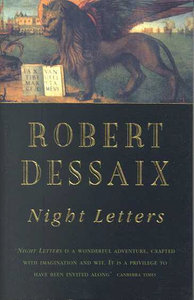
“It’s a temptation, but I refuse tostart crating a neat ending to my life, as if I were some minor short story. The more loose ends the better.”

from Robert Dessaix’s Night Letters (1996, p105)

You Are Being Judged

Public transport is rife with things worth judging. Clothing, one-sided phone conversations, the extent of end-of-the-day pit stains. What you’re playing on your iPhone – whether you have an iPhone at all! Personally, I like to look at business-men’s socks and judge them by the prints –the more ridiculous the better. My favourite were black ones with cigarettes on them. With all this judging going on, you’d think that surely people would be aware that they’re being judged by their commuting books. But from what I see people reading, perhaps not.

A friend recently told me that he covers “embarrassing” books with brown paper, in order to not be judged while reading on public transport. I laughed at first, but then realised that there’s certain things I don’t read in public either. By this I don’t just mean that I prefer things that can be consumed comfortably on five-stop trips. I also mean that I refuse to be seen reading any self-help or dieting books on the tram. I won’t be caught with Twilight, or Dan Brown, or a well-thumbed copy of “Eat, Pray, Love”.

Don’t get me wrong – I read bad books. I’m a firm believer in knowing what it is that you hate, and this has meant I’ve read a lot of crap. It helps to know how not to write. Never, never in public though. I read Dan Brown at very private moments, where I could snigger and blurt offensive things, and throw the book at the wall whenever I needed to. I never risked my reputation by taking it on a train, tram or bus. Greasy hair I can do, but if someone saw me wrapped up in YA vampire stories, I’d never forgive myself.

I can delight in the more bizarre – I used to constantly see Alan Brough on the 1 or the 8, reading maths books. I respect this, because not only was I baffled by how smart he is, but also by the fact that he was able to be that smart while rocking around on a tram! Flaunting your intelligence, especially if you’re Alan Brough – winner! Flaunting your stupidity? Not so much.

People of Melbourne, THINK before shoving the latest Stephanie Meyer book in your bag. Please don’t expect me to sit next to you while you wish you could overcome adversity as successfully as the latest Jodi Piccoult heroine. Don’t think I won’t scoff if you’re busy learning exactly how they cracked the Da Vinci Code. If you’re brushing up on foreign affairs a’la “Zoo” I am judging you, and harshly. If you then try to talk to me about what I’m reading, you just can’t – it’s too late. I’m already convinced you’re utterly vapid, totally air-headed. A fool of the highest order.

Not because you’re reading Mills and Boon, but because you have so little self-respect that you did it on public transport.

Blog at WordPress.com.

Up ↑