Search

Sam van Zweden

Writer

It’s Not Romance, It’s Erotica. Awful Erotica.

I’ve recently been struck by the realization that Fifty Shades of Grey might actually be the thing that saves book-stores – for the time being, anyhow. I know this is a pretty big thing to say, but I actually kind of mean it. Looking at the figures just for Dymocks book stores, approximately 12,000 more units have been sold while Fifty Shades tops the charts than when anything else topped the charts in a comparable week last year. I’m baffled by the sudden frenzy of non-readers seeking out these books, and I’ve been meaning to post about my thoughts on this for some time… After reading Helen Razer’s immensely enjoyable “Product Review”, I decided I’d better sit down and write my thoughts.

It’s really weird to watch this all happening. For the last two or three weeks, just about every second item I sell has been a Fifty Shades book. It’s now officially the fastest-selling paperback book in history, surpassing Harry Potter and Twilight, even this year’s earlier boom of The Hunger Games. It’s most weird because of the kinds of customers buying the book, its genre, and the feedback I’ve been getting from those customers.

Case in point #1:
Have you read it? Is it any good?”
I started to – but I had to stop. I got up to page three, before I started thinking that if I continued reading I’d have to try even harder not to be scornful of customers who enjoy these books. I can go with bad writing – I gobbled up the first two Twilight books and quite enjoyed them, despite all the “topaz eyes” and the way that everyone in Forks “lopes” everywhere. The pages kept turning, the action kept me going, the pacing was good. What I did read of Fifty Shades felt so mechanical that I just had to stop.

So no, Customer. I have not read Fifty Shades. “It’s just not for me, but it’s incredibly popular!” Aaaand smile, don’t frown, don’t judge, just sell the thing. It’s what’s keeping you in a job.

Case in point #2:
“What’s it about? I don’t even know, I just know everyone’s reading it!”
This is said at the check-out, when they’re buying the book. I don’t think I’ve ever, in my life, bought a book that I know nothing about.

Case in point #3:
Customer: “Do you have that… Hundred something… Everyone’s talking about it?”
Me: “Fifty Shades of Grey? The erotica?”
At the word ‘erotica’, customer gets flustered and embarrassed.
Yeah, it’s erotica. On the back of the book, the spot that we put price stickers over, it says “erotica/romance”. The general readership that buys the book seems far more comfortable with the word “romance”. But flicking through the book (as I’ve done many times), you’ll find a lot of passages about penetration, and the “rules” of BDSM. I have no problem with erotica. In fact, I quite enjoy reading erotica. The Bride Stripped Bare was really enjoyable, because it was well-written, plus it was brave: a second-person narrative based around the parallel stories of an old women’s guide to being a good wife, and a woman negotiating her own married life. I like the secrecy and indulgence of erotica – it’s fun.

What baffles me the most about the Fifty Shades phenomenon is that “erotica” a’la some Mills & Boon etc is generally frowned-upon by the same people who are so enthusiastic about Fifty Shades. The flustered ladies who can’t stomach the word “erotica” and who ask for a bag before leaving the store are pretty representative of the readership of this wildly popular trilogy. It appears to me that the key to the books’ success lies in the fact that someone (WHO?!) said that this particular erotica is acceptable. Or that this particular erotica is not erotica at all. Women en masse are indulging the secret fun that I love about erotica, because someone made it acceptable in this case.

There’s a lot of questions about what happens going forward.

Question 1 – Is this self-contained? Will the customers who came into the store to buy Fifty Shades re-discover the enjoyment of reading and keep coming back for other books? Many of these books are being bought by themselves, but some customers buy other things. Last weekend there were many couples – she with Fifty Shades and he with Fev. More than a few told me that they’re not generally readers. Can booksellers hold any real hope that these people will realise the enriching experience that reading can be, and return when they finish these books? While Fifty Shades has boosted sales a lot during its time at the top of the charts, can we look forward to higher sales after the series loses its top-10 status?

Question 2 – Will there be many more books like these? If this smartly-marketed erotica is permissible, is there perhaps a whole genre of permissible erotica on its way? A co-worker and I discussed this question recently. I worried that if there is a whole genre of this kind coming, then would the quality of the writing improve at all? She laughed, asking if I would read these books if they were high literature.

And Yes, I probably would.

I’m not a total literature snob. I enjoyed Hunger Games, I’m okay with the fact that there is often a reason that things become as successful as these books have been. I’m curious to find out what that thing is. In the case of Fifty Shades though, whatever it is doesn’t lay in the first few pages, and I couldn’t bring myself to read further. The rabid need that people have to read this book is beyond me. I don’t understand.
A Month of Reading

A few days late this month, because 1st of July was my birthday, then yesterday I spent the day starting to tidy up my house. It’s not a one-day kind of job, but when I woke this morning I realised it’s July! And I’d not yet posted my Month of Reading!

Half of June was taken up by the Future Bookshop residency and winding-up of Emerging Writers Festival. I’m on university holidays, and I should have had lots of time to read (and write!), but I honestly don’t know what I’ve been doing with my time!

I did re-discover the magical place that is Kew Salvos though, and so I came out with all the “books bought” below for just $10.

Anyway, here’s the books I spent time with this month. What did you read?

Books Bought:
Grave Secret, by Charlaine Harris
Dead to the World, by Charlaine Harris
Eat, Pray, Love, by Elizabeth Gilbert
The Eyre Affair, by Jasper Fforde
The Hours, by Michael Cunningham

Gifted:
The Emerging Writer, ed. Karen Pickering

Books Read:
The Summer Without Men, by Siri Hustvedt
Bite Your tongue, by Francesca Rendle-Short

Currently Reading:
The Confidence Gap, by Russ Harris
Wabi Sabi Love, by Arielle Ford
Love and Hunger, by Charlotte Wood

On The Importance of Planning

This is a delayed post from my time at the Future Bookshop. Written during my 10,000 word day, this post took me to the finish line, and was the exhausted pinnacle of a day where I learned an awful lot about myself and my writing process.

I’ve just spent a whole day (10am-10pm) writing. I’ve written a combination of my novel/memoir, blog posts, and a first draft for a future article I’ve got an idea for. I’ve never spent this kind of a stretch of time writing before, and I’m absolutely stuffed. I expect to spend a fair amount of time just staring at a blank wall when I get home. I’m now in my final fifty minutes of writing, and I want to reflect on how badly I’ve planned my day, and how much more smoothly my day might have gone if I’d planned it effectively.

Indeed, this blog post is the result of hitting a dead-end after running my well of ideas dry for my manuscript and blog post and article ideas. True, I didn’t have a lot.

Before today’s writing session, I wrote down about five or six scenes I thought I’d like to write for my book. I just wrote down one sentence reminders of what the scenes were (“Hospital glass window”, etc). I also wrote down some blog post ideas (“Review: Summer Without Men, Hustvedt”). What I failed to take into account, however, was that I just might not feel like writing these things. As we all, no doubt, know from writing classes or workshops, it’s really incredibly hard to write something you’re not interested in. In fact, even if you’re not a writer – you probably know this feeling from your history of writing essays and papers when you’ve been given a list of topics that are all pretty boring.

What I’m trying to say here is that it can prove invaluable to plan out your time effectively. When you lose steam on one scene, move to the next one: and have a list that will be difficult to exhaust. If you’ve got a really long list, it’s unlikely that you’ll hit the end of it.

I also looked at my Now Write: Non-Fiction book last night. I thought about writing down some of the exercises, but I didn’t. I also thought about bringing the book in with me, in case I got stuck. I thought that would be just too naff, and so I also didn’t put the book in my bag. I just wrote my little list composed of a handful of ideas, and when I started writing I ran that list out pretty quickly.

One piece of advice I really should’ve thought about is Patrick O’Duffy’s idea of reaching 30,000 words by breaking the novel/book/piece of work down into 30 x 1000 word chapters. Write the skeletons of those chapters. If all you need to do (all, like it’s nothing) is pad out the prose, flesh out characters with detail and emotion, your job becomes a whole lot easier. Patrick outlines a heap of great ways to keep the words coming in his post, Welcome To Write Club.

However, I did not do this. My five or six scene ideas ran dry. I remembered one particular idea from Now Write: Non-Fiction, and I ran with this for quite a while. I got almost a thousand words from that exercise.

I considered googling “Now Write: Non-fiction prompts”. In fact, I tried to do this. But the great irony of the Future Bookshop is that there’s no or very patchy, dodgy wifi here. It drops out constantly, and today it’s been on the blink far worse than any other day I’ve spent at Future Bookshop. Of course! The one day I wanted to use the powers of the interwebs for good, to further my productivity, it decides to not work at all. Every other day when I’ve wanted to find a lolcat or read about some useless fact or other, or check my email twenty times in twenty minutes, or Tweet furiously about the security guards here at NGV (a singularly interesting/boring breed, by the way. Interesting/boring being a strange tension). And so I counted on my imagination to prompt where my writing went to next.

The imagination is a fickle beast. “The Muse”, as some might call it. It comes and goes. So when I put lots of flowery prose into something to fill up time or words, and I still came out dry, then I had to change tack. I had to move to another project, another way of writing, another scene. I had a document running in the background just to keep me writing. By the end of the day this document was at almost 1,800 words. My usual Morning Pages measure at about 750 words of faffing about, getting cobwebs out of my head in order to start the day fresh and clear. Today’s document acted as both a palate cleanser and a KEEP-WRITING! prompt.

Effectively planning comes in handy not just for marathon writing days, but for all writing days. I am currently about two weeks into my school holidays for Winter. They’re seven or eight weeks long. I haven’t fallen into a routine yet, but when I get time I know how it goes.

I wake up, and I read something inspiring. I read something non-fiction, so that I’m constantly learning, even when I’m not in classes that force me to learn (or not). I follow this up with some fiction, because you get better at writing by exposing yourself to lots of awesome things and just… absorbing. So that’s what I do, I absorb the work of someone far better than myself and hope that it wears off on my own work.

I then write for a few hours. I engage in what Aden Rolfe calls “Speculative Administration” (in his Business of Writing speech for EWF) – planning markets for my work, planning where I’d need or like to be in future, scoping out how much time I realistically need and what kinds of work I need to do to get to where I’d like to be at the end of the year. Or whatever the goal may be. Short-term and long-term planning. Both are important.

But lest I sit around staring at a blank page or end up writing a blog post about how important it is to plan your writing days constructively (even factoring in this “speculative administration” – planned pondering), I’m putting it out there, backed up by two weeks of largely unproductive holidays and a 10,000 word day that relies on this blog post.

Plan your days well, young scribe. Plan them well.

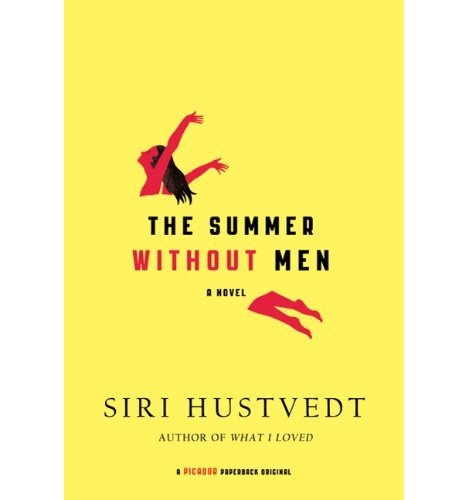
Review: The Summer Without Men, by Siri Hustvedt

Having been cheated on, poet Mia retreats first to “temporary psychosis”, and then to the small town of Bonden. This is where her mother lives in a retirement home, and where Mia comes to know and love the small community’s members.

The characters we meet in Bonden are fully-formed, convincing people who live lives outside the pages of the novel. The doubled-over Abigail, whose “secret amusements” buoy Mia’s spirit. The group of seven young poetesses that Mia teaches to express themselves, and eventually to understand one other. Lola and Flora, mother and daughter under the tyrannous rule of husband/father (and Mia’s next-door neighbour) Pete. The connections that Mia makes with these people during her stay in Bonden are what holds this book together, but they’re not all the book is.

Siri Hustvedt is clearly a well-educated woman with a very active and working brain. She casts a wide net with her protagonist’s musings, from Neitzsche and Husserl, to the male/female divide and the nature of memory. Mia’s ponderings are of a specific sort, and it’s clear that Hustvedt has given thought to her protagonist’s concerns, thinking about Mia’s life experiences and where she is currently in her life, and how this would affect the things she particularly relates to. Indeed, Mia’s thoughts aren’t just from the point of view of a poet, but from a poet who is married to a neuroscientist and mother to a now-grown young woman.

Quite intellectually challenging ideas are presented accessibly, but also appropriately. At no stage do the characters become mouthpieces for Siri Hustvedt to show off her smarts, nor do said smarts stick out from the narrative as inappropriate – the characters and the theory stuff always work hand-in-hand, commenting on one another, strengthening each other’s credibility and aliveness.

The emotional content of the book sings just as much as the intellectual – the two are not mutually exclusive and they wind together in the prettiest way. In particular, Mia’s thoughts on her time in a psychiatric ward are considered and insightful.

Siri Hustvedt’s prose is beautiful. When I read passages I particularly enjoy in a book, I tend to write them down. I started doing this in The Summer Without Men, but a few pages in I realized that if I kept this up, I would just end up transcribing the entire novel into my notebook, so I might as well just sit down and enjoy the damn thing for what it is. It is beautiful.

A 10,000 Word Day

Having watched many amazing people participate in The Rabbit Hole during the Emerging Writers’ Festival, I’ve no shortage of respect for those who can write large amounts in relatively short periods of time. Part of it is about the ability to continue producing work continuously, so the brain-power, but the other part is something else entirely, it’s about being able to sit still and do one thing for that long. It’s admirable, and I’d like to join the club of people who challenged themselves and surprised themselves with what they could do. I joined in for a few hours during The Rabbit Hole, but I’d like to give a really long haul a shot.

So here I am today, at the Future Bookshop (at NGV Studio) from 10am to 10pm. There will be a break in the middle for a meeting at 12.30, then straight back into it. The aim: 10,000 words in 12 hours. Possible, right? That’s 833 words an hour. Minus the time I’ll be at this meeting, so let’s count on just over a thousand words an hour. That’s achievable.

…Or is it?

I’m starting the day at the work table – not letting the posture go to shit until at least after lunch. Later in the day I’m allowed to crash in a beanbag or couch, but for right now – posture’s the bomb. There’s a lot of foot traffic coming and going through the Atrium, where the freakin’ huge Saturday Book Market is on. I’ve already started making deals with myself – at 5,000 words, I can go buy books. I’ve put a sheet of paper up on the ideas wall to track my progress, with check-in times for my wordcounts throughout the day.

I have troops on side, Lisa Dempster currently in a couch by the window, and Karen Andrews working furiously on an iPad beside me. No doubt they’ll help keep me going, and vice versa.

I’ll keep you updated via Twitter and Facebook, and I’ll do another post about the experience tonight or tomorrow!

The Many, Changing Faces of the Future Bookshop

Tuesday:
The first day I came to Future Bookshop, it was quiet and cold. I snuggled down into a bean-bag, glad for somewhere so comfortable to kick back and write. I was surrounded by people I know, working on projects I know about. I felt well and truly embraced in a creative womb.

Saturday:
I came down to the Future Bookshop on Saturday night to try and get some serious writing done. And the really awful weather means that I can sit in this big, glass space and look at the outside and be glad I’m not out there. I was expecting the same quiet space that I’d chilled out in during the week, but when I walked in there were about fifteen people between the ages of fifteen and sixty-five. This troupe had with them a guitar, and they all sat very close together. Occasionally two or three would break off and come sit at the table with me, and brainstorm. I gave little smiles to them, but nobody smiled back or introduced themselves. They were all happy enough doing their brainstorming.

This circus-creativity was big and interesting, and it made me think – is this the future of the bookshop? If content is all moving online, does the space of the bookshop become a place where people meet to discuss that content? Or to plan it? Does bouncing ideas work as affectively online, or is face-to-face still the best way to do it?

Tuesday:
Another Tuesday, another Future Bookshop stint. Today there are four writers in residence in the NGV Studio space, all working together at the tables.

Megan‘s writing a blog post, and asking us for input. It’s nice to be able to contribute in real-time, without having to wait between emails or inboxes. It’s nice to be able to connect with a blogger, but not via their comment section. In Future Bookshop, Real Life and blogosphere mingle.

There are lots of children walking through the space – we’re next to the Kids’ Corner here – and looking around in wonder. I can’t imagine what the QR code wall looks like to a child – I’m supposing something like one of those Magic Eye puzzles made up of colours and patches of pattern.

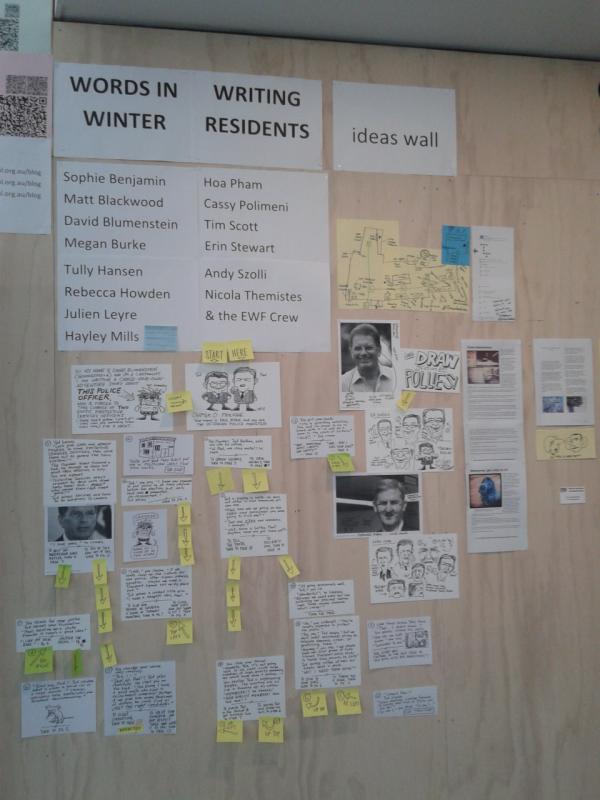
The work wall keeps growing every time I’m here. It now contains a choose-your-own-adventure comic, blog posts, an interactive fiction gaming map and the beginnings of a discussion of self-publishing.

The Future Bookshop is an ever-changing beast, Bookshop 2.0, where the people inside it shape its content. Just like the digital space.

Review: The Amazing Adventures of Diet Girl, by Shauna Reid

The Amazing Adventures of Diet Girl is exactly what it sounds like. Shauna Reid finds herself standing under a pair of size 26 cottontails and thinks, “Shit. They don’t get any bigger than 26.” This is where her adventures begin.

This is Shauna’s wake-up call, and this is when she decides to hit Weight Watchers. The day she starts to make changes, she also starts a blog, and The Amazing Adventures… is an edited collection of her blog posts.

Shauna’s writing is hilarious. This book works so well because while weight loss stories aren’t exactly thin on the ground, Shauna Reid gives a very familiar subject a very, very funny angle. She recalls her weight loss ups and downs with huge lashings of hyperbole and self-deprecating humour. The self-deprecating humour gets a little stale in the book’s final chapters – Shauna learns to love herself, but cannot seem to stop undermining herself in the name of a laugh. However, Shauna’s relationship with perspective provides both the hilarity and the gravity that the book needs to stay on the rails. For example, “The Vampire Method”. Shauna can see herself through an outsider’s eyes, but doesn’t let that stop her from achieving her goals. And so she starts exercising in the dark (either very early or very late) so that nobody can ever see her doing it. On the flip-side of this insight is her absolute blindness to how her beloved feels in return to her feelings, or her belief that revealing her former weight to new acquaintances will change their relationship.

Shauna’s weight-loss journey is inspirational, because it’s so realistic. She has hiccups along the way. She quits Weight Watchers, she gets a membership at a Fancy Gym and stops going for a while. She tucks into a giant jar of Nutella that she finds in her boyfriend’s pantry – and gets through all of it. It takes Shauna six years to lose enough weight to feel happy and comfortable in herself. Life’s not linear (or very rarely) in that “forward-march!” way, and the honesty of Shauna’s story is what makes this book enjoyable.

In fact, if you head to Shauna’s blog and read a more recent entry, you’ll find that her story’s still going, and still in a not-entirely-“forward-march!” way. She’s put some weight back on, and she’s now really trying to figure out how to live a well-balanced life, whether that means her “goal weight”, or a bit higher than what the BMI would have her believe. (Before anyone comments – yes, the BMI is crap.)

Honesty in memoir can end in one of two things – an overly gushy confessional, or a strong piece of work. Shauna’s book belongs in the latter category.

Rabbit Hole Wrap-Up

Having taken a few days to sleep and get back into the rhythm of everyday life (still not quite there yet), I’m feeling ready to look back at the Rabbit Hole experience.

For those who don’t know (WHO ARE YOU PEOPLE?!?!?!), the Rabbit Hole was a three-day writing marathon, in which participants aimed to write 30,000 words each, run as part of the 2012 Emerging Writers’ Festival. With four teams (Brisbane, Melbourne, Hobart and online), plus people playing along from home, we had upwards of 80 people all furiously writing between the 1st and 3rd of June.

As intern for the Emerging Writers’ Festival, I managed the Melbourne and online teams. For me this meant lots of work prior to the event: finding hosts, writing copy for programs and participant call-outs for blogs, figuring out a budget, organizing venues and websites/groups/emails, finding writers crazy enough to participate (surprisingly, we had waiting lists for both teams as long as my arm!), organizing milestone marker bonuses and catering. Plus the event was being run in Queensland (the Queensland Writers’ Centre are the creators of the event, the EWF were lucky enough to collaborate on the event) and Tasmania too, so there was a lot of emails between the three states to get everything running smoothly.

Enough about my awesome internship which gave me lots of opportunities and responsibilities and skills… Oh, there I go again!

Team Melbourne hunkered down with Jason Nahrung, who was well dedicated and not only kept up the banter online and within the room (see: explosions of applause for writers, initiation of #haveapencil, participants showered with chocolate) but he also joined in the writing and had his head down and fingers flying across the keyboard just like the participants. The glow of laptop screens lit up the Wheeler Centre workshop space (apart from Nicola Opt’Hoog, who did the challenge longhand!), and healthy rivalry between participants meant that everyone chased everyone else’s word-counts as they went up on the whiteboard.

Team Melbourne had a cheer squad composed of writers from other teams, states, and people around the EWF who weren’t even participating in the Rabbit Hole. One such writer (Owen Vandenberg, bless his heart) even cooked biscuits, vegan ones, in his home, and dropped them off to help fuel the writing bunnies. (Example Tweet from the moment of realization of said cookies: “Oh my god… there are oreos INSIDE these goddamn choc chip cookies. What kind of magical genius is this??? Who is responsible? #rabbithole”). Too cool.

The Melbourne weekend finished with two writers crossing the 30K mark. Even those with word-counts on the lower end of the scale had around 10,000 words – I don’t remember the last time I wrote that much toward any one project. I sat myself next to the snacks desk (it was the only available seat, I swear!) and got to overhear all the great water-cooler conversations about strategy (Pomodoro, biscuits, chapter outlines), and what everyone was working on. Aside from the amazing amounts of work produced, the networking and sharing of creative excitement was what made the event so great.

The online team (who called themselves Team Awesome until the 2nd of June, when it was changed to Team Amazeface in light of smashing goals and word-counts) was led by Patrick O’Duffy, whose intense energy and never-ending supply of writing-related lolcatz kept everyone enthusiastic.

Events that are run entirely in a digital space are becoming more common – the EWF ran Twitter Fest again this year, which included daily panels on a range of subjects, plus EWF digital was a whole side-festival in itself. I’m part of “The Subcommittee”, an online writers’ group of sorts. I’m getting more and more comfortable with things happening entirely in digital space, but it never gets any less cool. So as you would imagine: Team Awesome/Amazeface was cool for its digital novelty. It was also cool for its bunch of amazing writers, who managed to make some exciting organic stuff happen, similar to the water-cooler sharing in the face-to-face team.

In planning an event, there’s only a certain amount of planning you can do, and then the event happens. In its happening, it takes over and… well, it just happens. Without prompting, the online team started sharing their words at regular intervals during the day. They also shared bits of their lives, and so the team-members got to know one another and  sympathize with things like cravings for heat packs: one member got one, and then everyone did. I couldn’t plan that kind of closeness.

The sharing of work fit nicely into the blog that Patrick and I set up for the online team as a milestone reward for hitting the 20,000 word mark. Hopefully it gives you, dear Reader, a taste of what was being produced over the weekend.

Probably the most rewarding thing to come out of the weekend was how many people commented that they’d achieved more than they expected to, or thought they could. People surprised themselves – isn’t that freakin’ awesome?!

Mine isn’t the only wrap-up post or reflection on the Rabbit Hole experience, so here are a heap more, if you care to check them out. They’re from Rabbit Hole participants all over the country.
– Megan Burke at Literary Life live blogging Day 2
– Patrick O’Duffy blogs his experience of the Rabbit Hole
– Duncan Felton blogged his first 1000 words and keep-going strategy
– Miriam Zolin blogged her preparations for the Rabbit Hole
– Phill English (Toothsoup Phill) reflected on his experience
– Jodi Cleghorn shared her planning process and tips
– Amanda Druck updated us on her progress

Thanks once again to the Queensland Writers’ Centre for letting us in on such an exciting event – writers all over the country got so much out of the weekend, and I had a blast being involved!

…And of course, thanks for EWF for having me on board as an intern – I’ve made amazing friends, learned a lot about myself and gained a heap of new skills (making badges! spreadsheets! QR codes!). I’m sure this won’t be my last post about the EWF experience though, so more gushing in later posts.

Live from Future Bookshop!

The Future Bookshop exhibition is in the studio space at NGV. The sound of school groups bounces off the high ceiling and stone tiled, as it’s connected to the NGV foyer where they gather to collect chairs and debrief before moving on to the next cultural experience.

The Future Bookshop is amazing. When you walk in the door (just inside the atrium) there are two big armchairs to your left, with a bookshelf containing a bunch of interesting things to read.

Right in front of the door is a wall, plastered with more QR codes than you’ve ever seen together in one place, all of which link to a different article/podcast/video/collection of thoughts about the future of writing and reading. There are also big copies of articles from The Emerging Writer, the EWF publication, which talk about interwebz and writingz.

In the middle of this QR code wall is a panel with USB sticks poking out of it. Hook whatever USB-friendly device you’ve got up to these and download free ebooks, as well as loving words from the artists’ collective behind the USB installation.

Next to this is an “ideas wall”, and under this is a table with paper and pens. You’re invited to participate by sharing your ideas about the future of books and writing and putting them up on the wall.

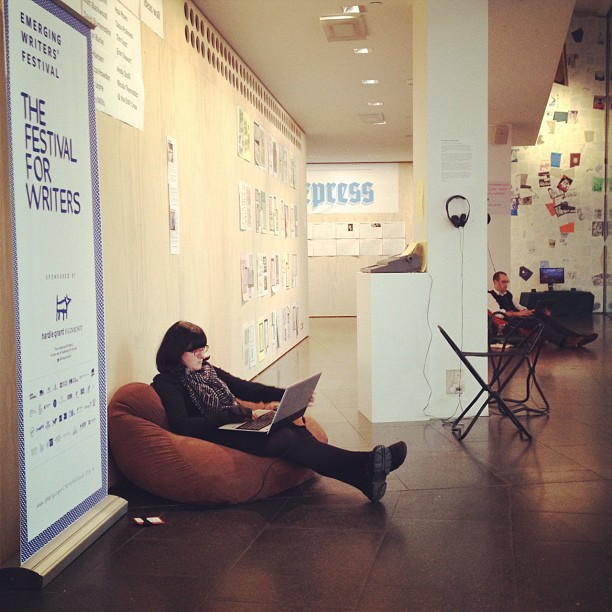
In the middle of the room is a table, where you can sit down and join the writers in residence as they create. Of course, not all writers in residence make use of the table. I ditched it pretty quickly in favour of a beanbag (see below – photo via @lisadempster), and another writer is currently kicking back in one of the armchairs. May I say – ALL writing places should have beanbags. It might just be an exhaustion hangover from the Festival, but the ability to sit equal parts vertical and horizontal in a squishy surface is really relaxing me and making the creative juices flow more easily.

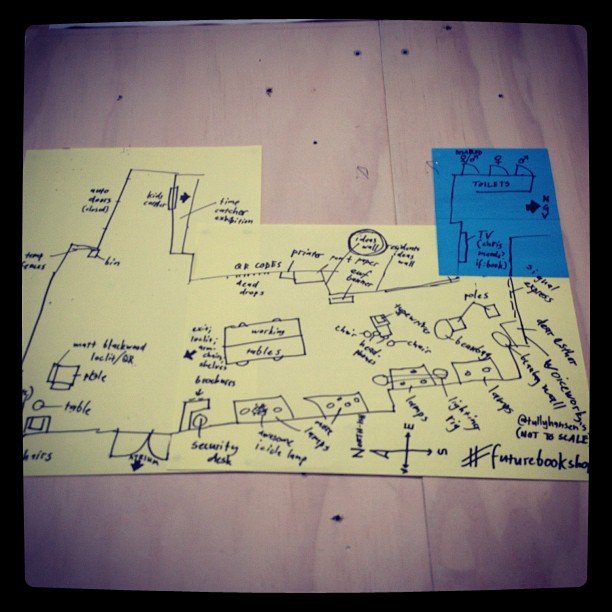
Another section of the front wall houses works-in-progress from the writers in residence. Up there so far: Tully Hansen‘s room-plan (see below), blog posts from Sophie Benjamin, and Julien Leyre had stuck something up right before I left.

In the middle of the room also is a pole intended for structural integrity, which the Future Bookshop makes use of. There are headphones hooked up to looping podcasts, which visitors can sit down and listen to. Not just any podcasts, but Paper Radio podcasts – these guys podcast stories, with really nice sound things happening in the background.

Next to the residents’ work-wall is a wall with book designs, and an interesting statement about the weirdness of books being super-accessible with free content around, but also becoming really expensive moving forward as they become obsolete.

The back wall has copies off all the Signal Express, the EWF/Signal Express daily newspaper from during the festival. They did an amazing job, pumping out two articles and Twitter highlights every day throughout the festival.

Tucked around the corner is a screen with looping vlogs with thoughts about the future of bookshops, books, reading and writing.

Along the glass wall that faces the atrium are lots of lamps, all switched on. The future looks bright. But we don’t want to make light of the future either. They’re just lightening the atmosphere. We’re trying to shed some light on where we’re headed. Hopefully people are smart in the future too, and just as switched on. Puns finished.

So that’s the space. Check out Tully Hansen’s floor-plan (relevant to his very cool work – photo via @lisadempster) to help you envisage it.

Even better, come down and visit to get a REAL idea of what’s happening.

During my time at the NGV studio, I’ll be blogging. I’ll be doing posts about the future of the book, and what it means to be writing and reading in the digital age. I’ll also be drafting blog posts for after the residency, and saving up a little back-log of stuff. Talking with Angela Meyer last week reinforced that this is something I should do continuously – if I’d had more posts/drafts on hand during the end of semester, I wouldn’t have gone silent when my workload grew. And so that’s what I’m doing at NGV. Making Little Girl With a Big Pen happen.

One fellow writing resident, Julien Leyre (who was one of the amazing writers who crossed that 30K mark at the Rabbit Hole!) is spending his time here translating a blog into French and Chinese. So maybe the future of books and writing is a place where things are more accessible.

The thing I love most about working in digital spaces is the way that readers are able to feed back. The ways that readers become creators. This is reflected really well in Future Bookshop, and that’s what excites me most about the space. The audience is also the creator, those who are watching feed back into the space, and by having people in the space it becomes something else. It’s evolving. That’s what the future of the book is all about.

Blog at WordPress.com.

Up ↑