Search

Sam van Zweden

Writer

Category

Uncategorized

Thinking About Process

Thinking about process never fails to interest me. I’ve been learning a lot about my own process lately.

I’ve tried many different ways of writing. Long-hand only. Typing only. Thinking up almost the majority of a piece before committing it in any way to black-and-white…

What I’ve discovered works for me, is long-handing first drafts. Then typing, and re-drafng as I type. Then reading aloud to help edit. Then pondering and re-editing. Then letting it torture me for a few days: take a comma out, put a comma back in. No, take the comma back out…

It’s taken me a really long time to get to the point where I know what the most effective way for me to write is.

The way I write also helps heaps with the “blank page” problem. That gripping terror that overcomes a writer staring at a blank page with only tenuous, if any, ideas floating around in their wordy brain… I long-hand everything in my notebook. I’m now at the stage where that notebook has a fair few other stories or poems that have been long-handed. I take heart from looking back at them, seeing how utterly terrible the first draft was, and knowing that I worked past the crap to produce pieces I’ve been really happy with.

“The first draft of anything is shit.” – Ernest Hemmingway

Taking to the Streats

It’s a few days late, I’ve been busy. Coming up to the first round of uni assessments.

On Friday, I took to the streets to meet the people from Streat , an opportunity offered thanks to RMIT.

These guys are pretty amazing (Streat…RMIT are too though). Streat is an endeavour to give disadvantaged and homeless young people access to training they would otherwise have a hell of a lot of trouble getting, fees being what they are.

Streat trainees gain a Cert II in Hospitality, with on-the-job training at Streat’s food cart at Federation Square, as well as “ensuring holistic care and well‐being to trainees within its programs.”
…and their food is amaaaaaazing. Healthy, filling, and genuinely interesting.

We spent the day exploring the city and responding to it in our own ways. I got my pen on it, and what came out actually really surprised me. I didn’t get a chance to spend time with one of the Streat trainees apart from the initial meet-and-greet and the debriefing afterwards. From what other people bought back, they really had some stories to tell, and sometimes those stories weren’t that far from our own.

Throughout the day, we text-messaged our bite-sized stories back to a central Streat number. There were about 25 people participating, and they got 87 texts by the end of the day.

They’ve already posted a few of these on the Streat Blog. One of mine is there; the one about the alley.

What I thought was really nice was how spontaneous all these little stories feel, and how they’re absolutely anonymous – you can’t tell an RMIT student’s story from a Streat trainee’s story.

I also found it refreshing to realise that I can pull satisfying images out of memories.

Streat are in discussions with Fed Square as to the final presentation of these stories, will keep you updated on what happens with them.

In the mean time, get down and eat some of Streat’s food, support an awesome cause!

Edgy Gritty Realism from Normal Happy People: Irvine Welsh at the Wheeler Centre

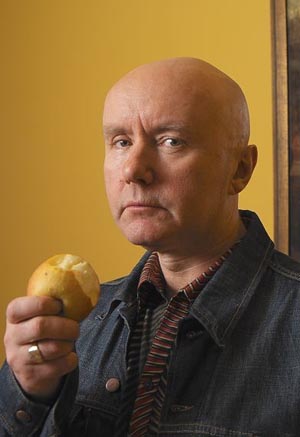
Light dances and refracts off the shiny bald dome of Irvine Welsh’s head. Some two hundred people perch on the edge of their uncomfortable seats as he shares a story. There’s laughter, there’s bits where nobody’s sure if they should laugh but then they do anyway, there’s plenty of “cunts” and “fuckers”. A four-year-old in the corner plays with the power-points, his mother not entirely fussed as she gets to hang out with Irvine Welsh. He reads as if he’s sharing an anecdote, shifting naturally from foot to foot, speeding up and slowing down perfectly; Irvine Welsh is a captivating reader, so much so that we forget that he’s reading at all.

Last night began with a reading of “A Fault In The Line,” from his latest book, Reheated Cabbage. The name for the collection comes from an old Italian saying which refers to relationships which split up, then get back together again: “it’s never a good idea”. Welsh thought this phrase an apt title for this collection, a reprinting of older work and previously published stories.

We all know the man, even if we don’t know the man. The man who wrote Trainspotting and The Acid House, author of cult novels Glue and Filth, life-lover and curiosity connoisseur.

Welsh himself attributes his immense fame to something he called “Scotchploitation” – “there was about five minutes in the 90’s,” he says, “where it was vogue to be Scottish.” Caught up in this, Trainspotting became a massive cult hit, and Welsh became an accidental expert on all matters “Scotland” and “drugs”.

There seems to be two sides to Irvine Welsh. There’s the present-day working-man side, which tells host Alan Brough that he’s “generally a happy person,” but there’s also the side which is linked to all the hardship that appears over and over in his writing.

The characters in Welsh’s novels are always intensely Scottish. Caricatures, yet absolutely believable in some absurd way. This idea of Scottishness and globalization seems to be a terribly important issue for Welsh. At last night’s event, he expressed concern about the “one-dimensional”ism of globalization leading to boredom, and a loss of the kind of culture that is so prominent in his writing, saying that “culture needs a place to be, and it doesn’t really get that now.”

Welsh’s writing, then, is an attempt to stop his culture from slipping through the cracks, and also a way of bringing to a wider audience the grittiness that goes with it. Welsh reflected on the “epidemic” of knife-crimes in the areas he grew up, which was never there when he was a child, upset that funerals are now more common than graduations in these areas. Welsh writes his gritty realism as a way of “trying to make sense of an epidemic”.

Welsh’s own experiences with drugs and making bad decisions seems, at this point in his life, to not be such a firm basis for his writing, while pure curiosity seems to be the starting point for the most entertaining and involving parts of his work.

As for his writing life, Welsh regards this with a bit of curiosity too. He says he has a regime, involving an early rise, exercise, breakfast – all the things that a normal functioning person does. But while his writing is “much better in the morning… I always seem to gravitate towards the evening,” which is when he violently pounds out his ideas until he collapses, and his wife scoops him up off the floor and into bed.

“I don’t really have a healthy relationship with writing,” he says. “I write til I drop.”

Welsh puts his novels into the “literary fiction” category, as opposed to genre fiction, saying that the former concentrates on characters and their psychology. His own psychology is also an interesting point, as he describes his writing habits.

He tells us about the inherent complications of “spending all this time alone with people who don’t exist,” and those moments when he looks as his work and thinks it’s “kinda nonsense,” resulting is “massive mood swings” between being picked up by his wife and telling everyone how fantastic his work is. He says he now prefers to spend time working on films as the close proximity with real people helps to ground him.

Irvine Welsh’s work is, and will continue to be, an incredibly intense combination of what he himself has been through, and what he finds “interesting”. Listening to the man speak, you know he’s in exactly the place he should be, able to regard the world with his writerly awe, and so absolutely able to connect with people when he feeds that back to us, no matter how far-fetched or foreign the situation.
Some folks like to get away…

And that is just what I’ll do.

A few green-bags of school work packed, I’m off to a family reunion with my partner’s family this weekend… I shan’t be home, I shall be curled up in a tent trying to finish Homer’s “The Odyssey” by next Tuesday. Wish me luck.

And so there’ll be no posts from me, not a comment or link in sight.

This doesn’t mean I don’t love you. It’s not you, it’s me.

See you Tuesday.

Twitter Button Fixed

Dear whoever tried to hit the “follow me” button,

I am a bit slow, and left the link as “twitter.com/yourlink” instead of putting my acual link. I’ve fixed this.

Sorry.

Sam.

Gettin the Blues

This has been giving me the blues all morning…

1000 hits!

Today my blog reached a total of 1000 hits. AHHH!!! I know it’s not huge, but it is a milestone for me.

Thanks to all those people who have read me since September 2009, especially those still reading, and those who come back …

Infloox?

I recently found an incredible website.

http://www.infloox.com/home

Infloox asks the question: “what are famous people’s favourite books? …today and throughout history?”

At the homepage of Infloox, you can type in the name of an author, a famous person, or the title of a work.  This then takes you to a page which provides a short biography of this person, or work. Under this is where it gets interesting…

Infloox lists (and wiki-style, allows feedback on) this person’s “infloox” (things that were influential upon that person’s life and work), and “outfloox” (the same idea but outwards – so things and people that were influenced by this person). Not only this, but Infloox is expanding what it lists… It now also lists “affinities”; giving details such as “people who liked this person also liked…”
I’m a sucker for these types of lists. I love being able to link ideas, works, people.

I’m blogging about this because I like to think about influences. Anyone who thinks that idea about not reading for fear of being overly influenced has any merit, is crazy. You need to be a good reader to be a good writer. Infloox is proof of that.

I’m also blogging about this because I like this site, and would like to see it grow. So click the link, send it to friends, help the database of Infloox grow so I can learn more…

If there was an Infloox page about me right now, it would have on it:

INFLOOX: John Marsden. Chuck Palahniuk. Robert Adamson. Raymond Carver.

OUTFLOOX: perhaps one of my musician-friends? Or my partner’s photography, that’d be nice.

What would your Infloox page look like?

In!

On Friday morning I received the best news I have received in quite some time…

I got into the university I applied for!

No more Swinburne, with its grossly under-funded arts faculty and disgusting treatment of an education institution as merely a business… Onto RMIT, where money is kept flowing into the arts in the same way as any other “more profitable” degree, where my love of writing and sharing and learning will be welcomed and given a big warm hug.

No more creative writing classes full of psych or engineering students who “needed an easy HD”… Writing can be hard work, and the people I will be learning with next year will understand this.

I’m almost positive that my current image of the splendour RMIT has to offer is not quite what the reality will be, but I am also positive that the coursework is what I want from a university, and the attitude of the institution is what I would actually expect from a place of learning.

For those of you interested, here’s a link.

Blog at WordPress.com.

Up ↑