Search

Sam van Zweden

Writer

Author

Sam van Zweden

What was, what will be

The customary end-of-year, start-of-year post

While these reflection and resolution posts are everywhere, I think it’s useful to look back and consider what’s been, and look forward to what’s yet to come. It feels foolish to move all the way through with eyes closed. This is probably the kind of post that benefits me more than it benefits you, the reader, but some element of public engagement usually helps with accountability. And I know I’ve been enjoying everyone else’s posts about their resolutions, so maybe you will too.

206950948_6c822f621f_z

What was

2014 was Honours – I wrote a project and exegesis about food and memory. I worked harder than I have on anything before, and I said no to so much in order to finish the year with a piece of work I’m happy with. I travelled more in 2014 than I ever have as an adult, and got along to more festivals and events outside of Melbourne. I jumped the desk, speaking and presenting at a writers’ festival. I applied for a lot of things, and got knocked back a lot. I picked myself back up. I finished the year deeply uncertain of my readiness to move into full-time writing, a bit bummed about being rejected lots in a short time frame, and in need of a big break but really bad at ‘doing nothing’.

Last year there wasn’t much blogging here, because I was blogging elsewhere. In blogging the progress of a project, I found that I was able to reflect better on my work – what had succeeded, what hadn’t, what I’d learned, where I’d gone wrong. It’s changing the way I’m blogging here – I’m trying to move toward more of a scrap-booking model, pulling in bits of inspiration and interest as well as the longer things I’ve normally done like reviews. I also got a lot out of reading Austin Kleon’s Show Your Work recently, and mean to share more often.

In 2014, my working habits changed. I learned a heap about organisation and time-management, and these things have stuck. I’m now a super warrior of getting shit done (particularly useful habits acquired: bullet journalling and pomodoros). This is lucky, because for a large part of 2014 I held down two part-time jobs and did Honours full-time. In August, I dropped one of the jobs, but still never really had two spare minutes to rub together. I loved it, as I never had time to agonise or procrastinate, but I did need to be particular about how I got everything done. I’m looking forward to 2015 being a more productive year than ever.

If you look at my reading list of books completed in 2014, it looks pretty dismal – I finished 12 books, two of which were for review. The gender split of authors is even, and I feel like what I read covered a pretty broad variety of books. However, those 12 books represent such a piddling portion of what I read in 2014. The majority of 2014’s reading came from articles (and chapters). So. Many. Articles. I actually really enjoyed what this did for my reading though, I felt like I was more connected to ideas – in 2015 I’ll be sharing more of the short things I’ve enjoyed.

I also learned that research continues – writing is research. Rather than reading, making my mind up, and beginning to write incorporating what I’ve learned, I now read and write alongside one another, in a cyclical way. The writing I end up with is better, more considered, genuine.

What will be

I’ve always kind of poo-pooed mantras as being too new age for me – telling yourself something over and over doesn’t make it real. However, I do think that having some guiding principles helps to set up a true north for the ways that you act, and the things that you value. So for 2015 I’ve got a mantra.

Use it up. Say yes. Stop.

I’m surrounded by stuff. A lot of my stress-releases last year were about acquiring stuff – little stuff, most often. Nail polishes, cook books, stitching gear. Looking around myself now, I’ve noticed that I really have a lot, and I use very little. In 2015 I will use what I have. I will share more. I will have good nails and make good craft and cook the recipes I’ve got, and when I end up with too much good food I’ll share it with the people I love. I won’t sit on ideas, I’ll execute them as soon as I can. Speed, kindness, productivity, less wastefulness and hoarding.

I also want to ‘use up’ the unfinished project that Honours has left me with. While it’s self-contained as-is, I’d like to see it somewhere. I’d like to keep working on it. I’ll ‘use it up’ too, rather than letting it sit in a drawer.

I’ve missed saying yes to things in 2014, so 2015 is my space to stretch my wings again. I’ve realised in the last month or two that while I’ve been working hard, I also need to reacquaint myself with freelancing work and get back in the groove of writing more varied things regularly. I’ve also wilfully said no to a lot of things I regret – social things, mainly. I need to get back in the world after my year of being a hermit. I need to say yes.

And finally, I need to stop. I’m making more of a priority of meditating regularly, and of being mindful before making snap decisions, judgements, or communicating anything I’ll later regret. I’m promoting calm and slowness.

What did you learn in 2014, and what are your resolutions for the new year?
Holiday stories and food

I’m having a go at writing something to submit to Brevity‘s Holiday Smile” competition.

I’ve been keeping an eye on the entries that’ve gone up so far, and so many revolve around food. Special foods that are unique to this time of year. It’s the same story I’m trying to write in my attempt – I guess I knew that foods were important to people at Christmas, because gathering around a meal is the focal point of the day. But to see how many memories are particular to the food is surprising. (Mine is jam. Things in jars. A more recent holiday tradition in my family).

I also thought that a ‘smile’ themed prompt would result in almost entirely photograph-centred memories. The times when we turn and break from ourselves, putting a smile on for prosterity.

My Own Little Wishes

Today over on Writers Bloc, we’re publishing the Christmas wish lists of a bunch of great bookish people (with giveaways attached to a few of them, so check ’em out for some free Christmas swag!). There’s some great stuff on those lists, and they’ve got me thinking about what I’d put on my own.

1. Renewing my Headspace subscription. This is the best $90 I’ve spent in the last year. Headspace contains 365 days worth of unique meditations, plus SOS resources to help steer you away from panic attacks and other confronting feelings that stop you from doing the things that matter to you.

2. Short reading material subscriptions. A number of publishers have a great selection of short reads, including the Review of Australian Fiction, the Spineless Wonders book clubthe Galley Beggars Singles Club. Next year I want to make a priority of reading more of these length works – novellas, long short stories, long essays. This is the length of stuff that I want to publish, and reading these works both gives me more of an idea how to tackle such a length of work, and supports the market I’m writing into.

Not short but certainly desirable is a subscription to the Nervous Breakdown book club, the books in which get talked about on Brad Listi’s OtherPpl podcast.

3. A new desk chair. Mine has one leg tucked slightly under itself like a shy child, making it unstable. Recently I lifted the chair and found that its peeling paint is made out of some kind of metal and is actually really sharp. So my current chair is both dangerous and dangerous. I want a new desk chair.

BONUS EXISTENTIAL REQUEST:

Direction. Stability. Clarity.

Distracted listening

I wonder whether podcasts are designed for distracted listening. I doubt it. I feel guilty about losing focus on the audio to tie a knot in the thread I’m using to bind a book. Am I meant to dip in and out like this? I feel a great amount of love for serendipity and chance right now, and I wonder whether distracted listening to podcasts means that I’ll drop in on some little gem of information by chance. I wonder if, in fact, it improves my experience of the podcast.

Image source: Flickr / artiseverywhere

Austin Kleon’s episode of Reading Lives is great. They talk about visits to the library as a kid. I pass the needle into one paper signature and out another. They talk about literary roots, Austin speaks about the texts that were formative for him as a child. I knot the thread at its end. I apply a layer of glue to the book’s spine. Austin’s talking about a middle school teacher who forced him to write, who now only remembers his love of the Beatles. I’m no longer distracted outside of the podcast but within it. My thoughts are stuck a few minutes ago – what were my formative texts?

I walk to the bathroom and wash my hands, thinking about Enid Blyton. I wonder if that was formative. I fast-forward to Sweet Valley High, Sweet Valley University, the terribly traumatic one about a rape on campus which I was far too young to read. I think about John Marsden. I want to read the Tomorrow… series again for the first time. They were formative.

I return to the podcast and I’ve missed half of it because I’ve been elsewhere physically and mentally. I think maybe that’s okay. I think about the times that I cook while listening to podcasts but can’t hear them for a minute because I’m too close to the frying pan noise. But then I come back and accidentally drop in on a half-thought – it sticks more that way. It burrows in my mind. Yeah, maybe distracted listening is okay.

While I feel bad for the people who made the podcast, I also feel like it’s embracing chance and accident.

Dreaming of New Habits

I have pretty good organisational and tracking habits. I’m a big (BIIIIIG) fan of analogue tracking – yes, there’s an app for that. There’s twenty apps for that. I like analogue.

I just got sent this amazing Japanese organisation system, which is kind of like creating an index, but much better. This system visually places markers against certain topics, habits, etc, making them easily reviewed at a glance. I’m thinking of all the things I can use it for.

Tracking habits (reading, eating, sticking to various goals), indexing bullet journal, recipes (as the post suggests)… Watch this space.

Brief Thoughts Regarding Susan Sontag

Image via the film's website
Image via the film’s website

Last week I was lucky enough to go along to see Regarding Susan Sontag, a documentary about the critic at the Jewish International Film Festival, after winning tickets from The Good Copy newsletter (this is why you should enter things, yes? Thanks, Good Copy!)

The film is a beautiful collage built from archived footage, documents, interviews and the detritus of Sontag’s life.  Speaking with figures from her life between childhood and her death to cancer in 2004, a picture builds of a fiercely intelligent, outspoken and charismatic women. While her intellect was formidable, there’s no doubt about it – she was a captivating woman.

I know Sontag’s work from On Photography, and greatly admire her writing. On Photography in particular speaks to my preoccupation with truth in memory. Sontag meditates on the many ways that photographs can be read, stressing the place of the viewer in the creation of meaning. As an object, a photograph is much more (and not even) a record of time past.

I found the film engaging, and it made me think critically. Sontag’s assertion that a writer is someone who is interested in everything was mentioned a few times, and I found myself jolted back into action, remembering that everything I do is research. Everything I come into contact with in the world is worth discussion. This is the way that Sontag approached her life and writing, and the reason that her work varied so widely. From illness, to photography, to gay culture, and so much in between. She was an expert in nothing and everything, simply willing to engage at every opportunity. The film was inspiring in this way.

I felt that the importance of Sontag’s sexuality was overstated, and she was painted as a colder woman than she might have been. From the film we are to understand her as flirtatious, changeable and selfish. Her past lovers speak about their time together, and by the end of the film I felt overwhelmed by the amount of people who had moved through Sontag’s life and bed. While gay culture formed part of Sontag’s work and interests and is relevant for that fact, I felt like interviews with past lovers were weighted too heavily, taking up space in the film that might have been dedicated to less superficial readings of her other works, and her life experiences’ impact on them. From my own readings of Sontag’s diaries, she seemed to hold more closely to relationships than the film portrayed, too. While it’s unfair to say that either is conclusively truthful, I didn’t see reflected in the film what I understood of Sontag from her own diary writing.

Like any biopic, the drive seems primarily to be to humanise its subject, and Regarding Susan Sontag succeeds in this. Despite what felt like uneven weighting that reduced much of Sontag’s life to her sexuality, it was a good documentary. It was enjoyable to watch, with a huge amount of archived material sewn together skillfully. Regarding Susan Sontag is an effective reminder of how alive and stunning Sontag was, placing her work into broader world contexts and explaining how her life and work fit together.

On asserting my identity

2014-10-23 16.12.09

It’s done. Honours has been amazing, and it’s now done. (You can read my research notes and journey on this blog, where I documented my year).

I learned:
Writing is researching. Reading isn’t the thing you do before working, you do it always. Meaning isn’t in any way determined or planned, it’s something that appears suddenly when you look backwards after a whole lot of hard work. Bullet journal. Manage time. Sleep. Being kind to myself often involves letting housework go first. Wardrobe next. I can ask for help. I should show work often and freely. I have people around me who are brilliant. Creativity is collaborative.

I had to tell myself all year that taking a year “off” or “away” wouldn’t kill my career. I managed to use some of my writing during the year to publishable ends, but for the most part I’ve slipped off the face of the earth for 8 months. Instead of feeling guilty about this, I had to have faith that putting in some hard work when I’d finished meant that relationships could be rekindled, and I could get back into the swing of everything I’d been doing previously. Freelancing, pitching work, blogging regularly – engaging with things outside of my research question.

Now that I’m a week and a half out from handing my last assignment in, I feel like I’ve relaxed as much as I can bare. I’m now looking down the barrel of ‘starting again’. It feels huge, almost unachievable. The more I try to decide how to tackle the task, the bigger it seems.

On Friday night I saw a great panel talking about nonfiction writing, at the announcement for the Scribe Nonfiction Prize shortlist (which is an amazing shortlist – congratulations, all!). Rosanna Stevens talked, at one point, about how she asserts her identity through her work. This is how I feel about writing, too. Particularly about blogging. Having put all this on hold for uni over the last eight months, I’ve lacked this outlet for asserting my identity. So coming back to it all, I feel like I don’t know what I even have to say – I’ve been talking only about one tiny thing for almost a year.

I’m realising that I now get to make use of the ways of working that I’ve been learning this year. Rather than finding something ground-breaking to write about here, I’m writing my difficulties out. I’m writing towards meaning. The more I write, the more I will write: it’s always been like this. When I figure out what I have to say, I will have lots to say. I’ll be asserting things about myself and the world – how people make things, how it all works, thinking through my obsessions.

Going forward, I want this blog to be more documentary. I will be writing about news, events and books as I always have. But I’ll also be documenting my own creative process. I loved the Honours blog’s ability to trace the trajectory of my work. This blog will be both the meaning and the working-towards: I’ll be sharing my magpie moments, my little connections, with you. Transparent creativity.

Thanks for waiting for me, hey. It’s nice to be home.

Patatje Flip & JUMBLE

Jumble is a collection of food-themed personal essays from first, second and third-generation migrants, edited by the team at rip publishing – Zoya Patel, Farz Edraki and Yasmin Masri. It includes stories from Rafael Kabo, Adam Ridwan and Yen Eriksen. It’s beautifully produced, and has a foreword by Benjamin Law.

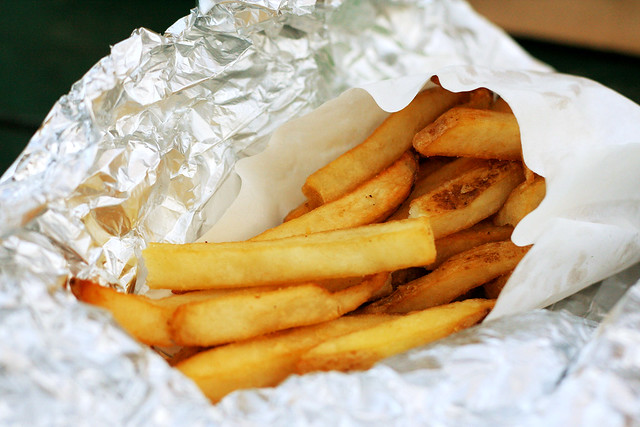
It also includes the story, reproduced below, from me. All stories in this collection are accompanied by a recipe for their dish. The recipe that goes with my story is simple: potato chips. Jimmy’s satay sauce. Whole-egg mayo. Job done.
fries


I can’t even pronounce it correctly. Every time I try, the vowels slip around in my mouth and come out mangled. The memory of patatje flip lives in the failure of my speech, and in the taste I have for something that isn’t actually a real dish.

“Patatje flip”.

Patatje flip is potato fries with thick mayonnaise and a peanut satay sauce. Nightly, Dad would come up with new variations on sauce combinations, which never quite resulted in what he was searching for. His sauce-mixing experiments fascinated and entertained me, and I felt a kind of kinship in our search for The Sauce.

For 26 years I have watched Dad attempt to recreate those sauces at the dinner table. A Dutch table features condiments proudly in the middle, and whatever else might appear, mayonnaise is never missed. Not the sweet, runny commercial mayonnaise Australians favour, but thick, whole-egg mayo. The kind that peaks on the plate and dries clear if left on un-rinsed dishes overnight.

Jimmy Paste is an Asian, fish-based peanut satay sauce. The closest Dad got to patatje flip was to combine Jimmy paste with whole-egg mayonnaise. The two sauces would sit side-by-side, with a little ooze section in the middle where the two touched. The mixing was done by chip, picking up a little of both sauces from the swirl of satay and mayo.

Lord of the Fries was a revelation. Their fries are fries, and nothing particularly special, but their sauce selections are the stuff of magic. I took Dad and introduced him to the Asian fries, which combine Belgian mayo with satay sauce. This is it, by another name! I thought.

Dad chewed and tilted his head from side to side for a while.

“They’re nice.”

“Are they it?” I asked with a smile in my voice, because I was so sure that I’d given my father a connection with his homeland – so sure that I’d found the end-point to all the sauce-mixing and searching.

“Nup.”

I realise now that even if I did find the right sauces for patatje flip, this isn’t what Dad’s looking for.

I can point to all kinds of Dutch food as evidence of my heritage. The only member of my family born in Australia, and the only one who’s never been to Holland, I have still inherited Dad’s foreign palate.

Mayonnaise belongs on: steak, chicken, fish… all protein, really. And chips, steamed vegetables, or salads. And anything that doesn’t have a strong flavour of its own. And some things that do. My brother went through a thing with mint slice biscuits and mayonnaise.

I felt personally affronted and outraged when Gloria Jean’s introduced their “Coffee topper”. That’s not a coffee topper; that’s a stroopwafel.

How novel is apple sauce as a condiment? It’s not. That’s appelmous, which is similar to mayonnaise as a Dutch condiment that’s appropriate on everything.

Dad’s experiments with recreating pataatje flip weren’t the only thing he experimented with. He also bought a heap of large sandwich presses (like, you’d be able to do four sandwiches at a time if you wanted), and created stroopwafels which were much more cinnamon-y than the packet ones, and lacked the distinctive waffle print. At least with stroopwafels I had tasted the real thing, and I could judge that these were not the same.

I haven’t tasted the original versions of much of the Dutch food that I know and love. My palate is full of weird impostors; even if you gave me real patatje flip, I probably wouldn’t enjoy it. I’d rather Jimmy and mayo.

Then there’s the food that I don’t know the origin of. There are some confirmed strange foods – salty, fatty herring, chocolate sprinkles that are eaten on toast for breakfast, liquorice that tastes more like salt than like sugar. But there are also foods that could be blamed on my father’s weird, nation-less palate. Fresh strawberries on sandwiches (must be very, very fresh bread). Leftover rice microwaved with brown sugar and butter to make pudding. Lashings of butter and a thick layer of brown sugar on sandwiches after lunch, like a dessert sandwich.

Are these Dutch foods? Are they foods anywhere?

Chips with Jimmy paste and whole-egg mayo is not patatje flip. But they are my patatje flip, and they are the thing I picture when those words are spoken. They’re not the thing Dad pictures, and Jimmy and mayo are never ‘it’, just an attempt to go back. My father’s failed attempts at recreating the foods that remind him of where he comes from are my memories of home.


With many thanks to the Jumble team for their fantastic work on this publication. You can purchase a copy of Jumble here.

This piece is also part of my Honours work, which is about food and memory, particularly within my family.

What’s Making Me Happy

I’m still alive, and I am engaging. The longer I am away from this blog, the bigger a deal it seems to post anything here. It’s like when I forget to cut my fringe for ages, and then when it gets to the point that I can’t deny how badly my hair is dangling in my eyes, I can’t do it. I’ve lost my nerve.

Anyway, I’m still here. I am engaging. These are the things I have been engaging with – a tiny, curated slice of my life.
 
– The extract of Lena Dunham’s book, which appeared on The New Yorker last week. 
 
– I recently read Ronnie Scott’s Salad Days and loved it. He writes lyrically (beautiful, punch-to-the-gut nonfiction) about whether we can really ever justify our consumption of incredibly expensive food. A few notes from my reading (and notes on my WIP on food and memory, hence this is what the notes lean towards) here.
 
– And this dance made me cry – I still find it surprising every time I watch it. A clearer but incomplete version is here
 
– Today I reached 26,000 words of Honours work, and finished my first draft of both exegesis and creative components. Let the redrafting begin! 
 
– Finally, I’m happy about Austin Kleon’s book Show Your Work. In it, he encourages creative people to share their work. No matter what it is. And so here I am, showing. These are the things that are driving me right now. 

Blog at WordPress.com.

Up ↑