Search

Sam van Zweden

Writer

Author

Sam van Zweden

Killing It

Busy life is busy! The Melbourne Writers Festival office is experiencing a population explosion, the book store still stands and sells books, and KYD social media is busy as always – I’m currently diving into Jill Stark’s High Sobriety in preparation for next Wednesday’s #kydbookclub discussion. If you’d like to take part in it, I’ll be chairing the book club with Jessica Alice on Twitter, on the @kyd_journal account from 1-2pm.

In between all this business I have, however, found time to write a post for Killings, about recent awards given to short story writers, and whether we might be heading into a boom for short stories. 

You can read the piece here.

Research and Relish

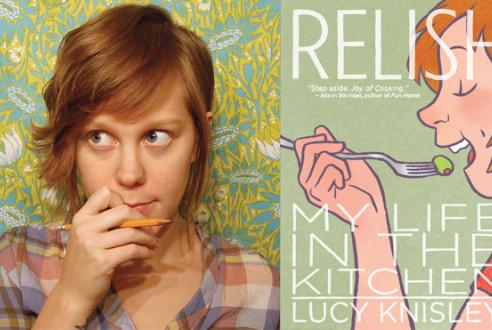
I have just finished reading Lucy Knisley‘s Relish. It’s a gorgeously drawn graphic memoir.

Last year at MWF, Estelle Tang waved Alison Bechdel’s Are You My Mother around before a panel, and when I chased that up, I discovered that graphic memoirs are amazing things. I loved Bechdel’s work, so when I heard about Knisley’s graphic memoir, I couldn’t say no. I love Knisley’s book. I’m not an avid comic reader, so I’m not judging with any kind of criteria other than, “it spoke to me”. 

ImageRelish is a collection of Knisley’s memories that are tied to food. The daughter of two foodies, she’s grown up around a lot of tasty things, but food functions here as something way more than sustenence or source of wonder. Food, for Knisley, provides a trigger for memories, and a framework through which she can understand her life. Experiences can be categorized by their food allegiances – Mexican sweets and coming of age. Choc-chip cookies and comforting rituals. French jammy croissants and losing her mind in pursuit of recreation. Many of Lucy’s food triggers are tied to family members, like her pearl-wearing grandmother, “the pickle whisperer”. 

Also scattered throughout the book are recipes and cooking tips. Last week I made carbonara according to Knisley’s graphic recipe and it was delicious. Books that pair recipes with memories are delightful (I was also a big fan of Charlotte Woods’ Love and Hunger), and Knisley’s consistently beautiful, funny drawings make this book a warm and welcoming reading experience. 

I’m currently (sporadically) working on a memoir project which looks at the connections between food and words. My father and brother are both chefs, and food has played a big part in our relationships. As a writer, I constantly look for the places where food and words meet – these are the things that potentially be exciting to all three of us; a meeting-point of sorts.

In researching for this project, I’ve had no trouble finding memoirs written by chefs, or by people who’ve stumbled across cooking and food as some kind of saviour. There are far fewer books that are closer to what I’m trying to do. Knisley’s Relish has been a thunderbolt moment for me – I’ve found someone who’s done what I’m trying to do, talking about family relationships with foodies, from the perspective of someone who’s not a great gastronome, but a perfectly adequate cook. 

I had this point with my memoir work about my mum, too. Reading Sandy Jeffs’ Flying With Paper Wings showed me that there is space for intellectual ideas in mental illness memoirs, and that a balance can be struck between the personal and the broader world of ideas. Similarly, Knisley has shown me that a memoir concerned with food can be about much more than direct experiences involving food, and that there is a way to combine my own non-foodie interests with the foodie stuff that has shaped me.

By combining her growing-up and food stories with a love for art and drawing, Knisley has produced an honest, non-food-porn-y memoir. I love her. I love this book. Thanks, Lucy Knisley, for your amazing work and for helping my research along at just the right time!

On Ideal Circumstances

Image
Photo from Odalaigh on Flickr Creative Commons

Occasionally two entirely unrelated pieces of reading will clash, and they result in wonderful breakthroughs, ideas, or realizations. The other day I bought myself a copy of A Year of Writing Dangerously by Barbara Abercrombie. It’s a bit of an awesome book.

The first entry in the 365 Days of Writing section of the book talks about Abercrombie’s attachment to this little cabin she’s got up on a mountain. She loves to go out to that sacred space, cosy herself up in it, and get her work done.

On the same day that I read this, while going through my Feedly content I came across a new post from Ruth Fields. Fields is the author of the fantastic guide for baby runners like myself, Run Fat Bitch, Run! She’s more recently published a new book called Get Your Shit Together, which is about organization and working efficiently. As promotion for the new book, “Grit Bombs” have been going up on her blog, which give a taste of what the book offers.

This grit bomb appeared on last week: the basic message is that we need to stop making excuses about having the ideal circumstances, and just get on with things.

Fields and Abercrombie connected in my mind. I think that I too often wait for is the ideal circumstances to write, and unfortunately they’re rare.

My week is currently (and for foreseeable future) structured so that I don’t have two days off together. I always aim to spend my Wednesday writing, but often it gets spent catching up on washing and dishes, cooking and TV. Sleeping. I get home on work days and only have an hour or two before my partner’s home – he’s pretty loud when he’s home, and I struggle to concentrate when there’s noise. But that hour or two after work isn’t ideal – I’d rather relax, check emails, or watch the news.

Okay, so it’s not ideal, but what the Fields/Abercrombie mash-up made me realize is that it’s never going to be ideal. What matters is that the time is there, and I can use it if I pull my finger out. It’s nice to dream about cabins in the woods, or my ideal, home alone for a whole day with no other commitments, but it just doesn’t happen.

We’re all busy people. How do you make your writing work despite your other commitments?

The Echo-Echo of Failing Better

This is a wrap-up of Day 1 of the Emerging Writers’ Festival Town Hall Writers’ Conference

#1:     It was said in the first event of the day, Seven Enviable Lines, though I can’t remember who by – that famous Samuel Beckett quote: “Ever try. Ever fail. No matter – try again. Fail again. Fail better.” It’s one of my favourite quotes, one that I try to keep foremost in my mind as I wade through desk-days and while cursors flash at me accusingly.

It came up again in the second panel I attended, Critical Conditions, this time from Nick Tapper. The echo made it stick.

#2:    Melinda Harvey, in Critical Conditions, urges us to think of criticism as a creative act. She mentions Post Secret, and says something vague and aspirational enough to be exciting, about the possibility of new forms of criticism. Fellow panelist, Ella O’Keefe: ditto. 

#3:     John Safran says that “pride and sloth” are the sins of the creative. We have one stupid idea, and we cling to it and are too lazy to go out and be crazy about having ideas. “Here’s what’s wrong with you,” he says. “You’re lazy, and too in love with your one stupid idea.”

In Writing the Personal, Walter Mason tells us that he recently sent his editor 125,000 words. His editor has slashed and burnt it down to 75,000 words. This is just the process. Between Safran and Mason, the message is to be creative in a ravenous way – your brilliance isn’t limited, numbers are what they are and if you create more, the numbers are on your side. 

#4:      Walter Mason again, in Writing the Personal. He talks about Twitter and Instagram, and how he’s over people’s objection that they don’t want to see what everyone’s eating. It’s relevant, he says. It’s the most personal, and the most interesting. I agree.

Two years ago at this conference, at an ‘in conversation’ in the Melbourne room, Philip Thiel talked about the way that people do want to know what you had for breakfast, and that it’s what gives a blog flavour. That night I went home and wrote about what I had for breakfast


I forget points that are made, quotes that I love, possibilities that exist, until events like these. The EWF provides a space full of echoed reminders, and I am buoyed; enthusiasm renewed. I come home to write, with abandon and without restrictions.
Hologram Heads-Up

Just a quick heads-up! The good people at Express Media have just started up this HOLOGRAM publishing venture, and they’re looking for long-form manuscripts – ie 20-60,000 words. Even better, this opportunity is only open to writers under 30 years of age. I know everyone missed out on the Vogel this year, so don’t let this one pass you by.

I love Express Media – over the years, they’ve given me many opportunities. They’ve had me along for their workshop workshops (where we learned how to run workshops – meta!), writing workshops with some of my favourite writers ever, had me nominated for an award, and published a poem of mine. They’re a very active organization giving opportunities to young people in a business where it’s often confusing and difficult to know where to start.

I personally know more than one reader of this blog who has a manuscript lying dormant in their bottom drawer. Don’t let it just sit there – send it in!

The Only Weapon

image

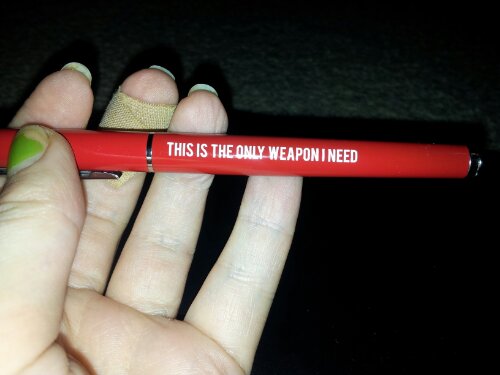
Last night I got home to a gift from a friend: the pen pictured above.

I’ve been in a bit of an awful place lately… Sometimes small things make a huge difference, and this is one of them. It’s the only weapon I need – thanks for the reminder.

The Tools That Save My Life

toolspicI’m a busy person. I only manage to get everything done because of some very handy tools, and I thought I’d do a post to share those tools with you. Technology could easily get in the way – between Twitter and Facebook, YouTube and Candy Crush Saga, it would be easy to lose whole days without getting anything productive done. That’s why I have the following things in my artillery:

HootSuite: Hootsuite lets you put all your social media outlets in one place. I’ve currently got four different pages connected via Hootsuite – each page has a tab of its own, and I can write status updates or tweets, and chose which of those pages it will be published on. If I like, I can schedule the same post for both Twitter and Facebook, or only one of the two. I can schedule posts ahead of time, which means that even while I’m at work, I can be letting  people know what’s happening on the blog, or in my life.

FeedlyWith the impending closure of Google Reader, I’ve had to start shopping around for a new RSS host. The first program I’m trying is Feedly and it seems to be doing the trick. RSS readers are basically an aggregate feed that pulls together all the websites that you want to follow, and any new content that goes up on those sites appears in the reader like a new email would appear in your inbox. Feedly allows me to organize blogs into groups, so that if I’m looking for a particular sort of news (or more likely, looking to SKIP a particular type of news), I can do it easily. I don’t have to visit sites individually anymore. Any the phone app syncs easily with the online service, allowing me to read my feed on public transport, too.

Flickr Creative CommonsThere are things about blogging that you aren’t told when you start. For example, copyright – if you use a photograph, you need permission to do that. And even with permission, you most often have to say where the photo comes from. It’s not like you’ll get your pants sued off if you use unattributed photos without permission, but the potential is always there, and it’s just good form to find stuff elsewhere…
Enter: Creative Commons. ‘Creative Commons’ is the name for stuff you can use without paying any royalties or worrying about people getting pissed off about you using their work. Most of the pictures I use for this blog come from the Flickr Creative Commons resource. This means I usually end up with something pretty retro-looking, because a lot of it comes from library historical archives etc, but luckily this matches my own tastes. Without Creative Commons, I’d have a lot less pictures.

I hope you can start using these tools to make your life easier. I’d also love to hear about any tools you’ve got that make your life easier!

Review: Burial Rites, by Hannah Kent

ImageI’ve just finished Hannah Kent’s much-anticipated debut novel, Burial RitesI read the acknowledgements, and the author’s note; I even flick to the publication details to see if there’s anything else in there – the literary equivalent of licking the bowl. I wipe away the tears I shed during the final pages, and I sit still for a while, because this is a book that has moved me.

Burial Rites is the story of Agnes Magnusdottir, the last woman to be executed in Iceland, in 1829. After it is deemed too expensive to keep Agnes in a proper prison, she is sent to the valley in which she grew up, to be kept in the home of the District Officer until her execution date. She elects a young clergyman, Toti, to help her prepare to meet death, and it is through a combination of conversations with Toti, fragmented memories, and eventual conversation with Margret, the lady of the house, that we come to know Agnes’ story.

This story is based on fact. As Kent discusses in her piece in the latest Kill Your Darlingsthe facts available about Agnes Magnusdottir and her alleged crime were sparse, and the research required to create the skeleton of this book was quite arduous and demanding. The way that that skeleton has been fleshed out and fully clothed makes for an enjoyable and moving read. While I knew that the story had to end with Agnes’ execution, by the time I’d spent a few hundred pages with this character, I really felt wronged by her eventual arrival at the chopping block.

The writing is fantastic – right from the prologue, the chill of Iceland can be felt. The prose is pared right back, but this doesn’t make the story any less visceral. Kent also manages the distinguish between three different voices, right throughout the novel.

Hannah Kent’s project here is admirable, and it speaks to my own interests and priorities. There are gaps in histories, in legends and tales that get handed down through ages. As stated in Burial Rites’ author’s note, Agnes Magnusdottir was commonly seen “as ‘an inhumane witch, stirring up murder.'” Kent wrote Burial Rites “to supply a more ambiguous portrayal of this woman”, and I feel that she well and truly delivered in that aim. She has given a voice to a woman who has threatened to disappear in history as one-sided: bad.

This book is currently in the Dymocks Top 10 Bestsellers, and I’ll certainly be making an effort to get it out to as many people as possible. It’s a page-turner, it’s literary and well written, and it does an important job: it reconsiders history, and gives a voice to the unheard.

Hannah Kent will also be appearing at Readings in Hawthorn on Monday night, in conversation with Angela Meyer.

Approaching Deadlines You Won’t Want to Miss!

Image

As a baby-writer, I’ve noticed that sometimes there are HEAPS of opportunities that are perfect for me, and at other times there are heaps of opportunities that are perfect for everyone else: those people who have books published, or higher education qualifications I can only dream of… Right now is a time when there are heaps of opportunities around for emerging writers, and I’d hate them to fly under the radar for people in the same position, so here are some of the big exciting ones.

SOYA are a great initiative funded by Qantas. SOYA stands for “Spirit of Youth Awards”, and is a scheme that gives writers under 30 years old the opportunity to be mentored, and fly anywhere they want under the guise of research. This year’s mentor is none other than Lisa Dempster (most busy lady in the world). There’s only two days left to apply for this, so you might have to pull an all-nighter, but it’s not impossible.

Another not-to-be-sneezed-at chance comes from the good people at the Australian Book Review, who have the coolest internship (after EWF and MWF, of course!) going round. Most internships are unpaid, but ABR are looking for a part-time intern who will be paid a wage which includes super and leave entitlements. The job involves “digitising” ABR – from the job description, this seems to include a bit of everything. An awesome foot in the door at a great publication.

Finally, I had my attention called to this one a few days ago, and while it’s not quite right for my interests, I know a lot of people a bit cooler than me will swoon at this one. Meanjin are offering $3000 to early career and emerging arts critics, to write extended pieces about “new arts” – meaning all the very cool things that exist because of digitisation. This 3-4 months mentorship will also contribute to the forthcoming Meanjin podcasts. Meanjin is a publication that strikes a beautiful balance between intellect and fun, and is a fantastic place to get yourself heard. 

So don’t say that it’s hard to catch a break. People are throwing cash at us; go chase it.

Blog at WordPress.com.

Up ↑