Search

Sam van Zweden

Writer

Tag

writing

The Accidental Discoveries

picture property of MWFSome of the best discoveries in life are the accidental ones. Cf:

1) My reading chair. It’s being delivered on Wednesday, and I happened upon it completely by accident. We were on the way home from the furniture stores we had intended to go to, and we saw this place and pulled in. Luckily, because it’s the most comfortable thing I’ve ever sat on.

2) Peanut butter sticks lunch wraps closed beautifully. Practical and delicious.

3) Many unheard-of support bands over the years. Come for the headline, decide to rock up early for a drink and the support and discover someone brilliant. Oops…yay!

4) Creative Non-Fiction. Before studying at RMIT, I didn’t know this existed. I’d written things in this style before, but I didn’t know it. The brilliant David Carlin got me really excited about it, and helped me start writing it in a focused, intentional way. And ever since, I have kept leaning further and further toward it.

In one of Sunday’s sessions at the Melbourne Writers Festival, I was lucky enough to see David Grann. I didn’t know I was lucky enough to start with – I saw a New Yorker session while I had spare time, and managed to squeeze in. I’d never heard of David Grann, not being a regular New Yorker reader.

David Grann’s one of those super-lucky people called “Staff Writers” who are funded by magazines with money (rare enough in itself) to write long form non-fiction. They’re paid to really research things, by travelling and interviewing and really immersing themselves in what they’re writing. I’m endlessly jealous of these people – I want to be them. David Foster Wallace was paid to go on cruise ships and to lobster festivals. I want that job. Then again, a MWF pass is a kind of similar idea, is it not? It’s a good start, at least.

The MWF panel looked at the idea that obsessions are really good for literary non-fiction (excuse the shifting genre name, it’s got so many!), and that magazines like The New Yorker are willing to indulge the obsessions of writers who prove themselves. David Grann proved himself, and was allowed to go bashing about in the Amazon to research some obscure explorer that nobody had ever heard of. Again –  I want that job.

What I liked most about Grann’s session was that he mentioned that he hadn’t always meant to be a non-fiction writer. In face, he tried really hard for a while to be a fiction writer, but when he came across creative non-fiction (employing literary techniques to tell true stories), it just made so much sense. “It solved many of my problems as a fiction writer,” he said. By bringing together fiction techniques and true material, Grann found his niche.

I’ve been feeling this way. For such a long time I fought the idea of primarily writing non-fiction. The creativity of being a fiction writer seemed to be absent from journalism and the like – but it doesn’t have to be. The accidental discovery of creative non-fiction has been one of the happiest accidental discoveries of my life. And it’s encouraging to know that a well-respected New Yorker staff writer like David Grann went through the same thing to get to where he now is.
Penguin Specials Launch

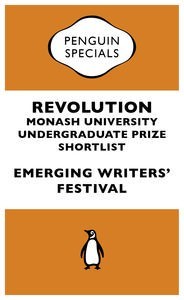
Last night I was lucky enough to ride on the coat-tails of my more successful friends (congratulations again, Jo Day, Veronica Sullivan and Tully Hansen!) into the launch of the latest Penguin Specials range of ebooks. The launch was for a whole bunch of new shorts available in digital form. The good people at Penguin have included the shortlisted and winner of the Monash Prize as part of the Specials range, and it’s available on Amazon, Kobo, iTunes, etc etc – all the platforms. Of course, you’d expect a company the size of Penguin to be inclusive of all the relevant platforms when they publish digitally. Less expected is the fact that they’ve given this awesome opportunity to emerging writers – nice work, Penguin!

I’m starting to get used to the faces at the writing events I go to, but when I left the Moat last night I was feeling a little star-struck and small fry. The launch included readings from Sonya Hartnett (tiny! Who knew?!), Robert Drewe, and Tully Hansen. With some familiar faces, many I hadn’t met yet (like… famous people), and the sampler of the publications doing the rounds on iPads, it was a really fun night. Free wine helped. It’s also really nice to know that being published digitally doesn’t mean the publishing company won’t splash out and celebrate your awesome achievement. The writers included in this series of Penguin Specials have a lot to be proud of.

Penguin seem to have their heads screwed on about what the strengths of ebooks are with their new and upcoming releases. There’s a new imprint coming for romance books, which is a smart move – there’s a huge market there, because it allows all the things ebooks do well anyway (cheap, portable collection), but also opens up the possibility for people to read romance/erotica in public, or to read around family and friends without having reading choices scrutinized. Also, the readers I know who are into romance are pretty voracious about it, and finish one book needing to slip straight into the next one. Ebooks make this a little easier than a trip to the book store. I’m not super-excited for myself about the romance imprint, but I certainly think that Penguin are onto where the money’s at, rather than just making their entire catalogue available and hoping for the best. (Though… I think perhaps for the most part they do this anyway?)

What’s relevant for me as a writer, and for all writers of short stories, is that short stories are now being published in single volumes, per story. Portability is a great strength of eReaders, and to make short stories available for this platform plays to this strength. A short story is a great way to spend time on public transport, and unlike a novel, you can possibly finish it in one sitting. For a long time people have been mourning the lack of publishing opportunities for short stories outside of journals – collections just don’t sell the way that novels do. Hopefully this (and, of course, things like Smashwords, where many authors publish single stories) are a way for short story writers to regain those opportunities.

The Specials are available now, and for a short time the sampler (including Tully’s amazing work, and extracts from others) is available for free.

On The Importance of Planning

This is a delayed post from my time at the Future Bookshop. Written during my 10,000 word day, this post took me to the finish line, and was the exhausted pinnacle of a day where I learned an awful lot about myself and my writing process.

I’ve just spent a whole day (10am-10pm) writing. I’ve written a combination of my novel/memoir, blog posts, and a first draft for a future article I’ve got an idea for. I’ve never spent this kind of a stretch of time writing before, and I’m absolutely stuffed. I expect to spend a fair amount of time just staring at a blank wall when I get home. I’m now in my final fifty minutes of writing, and I want to reflect on how badly I’ve planned my day, and how much more smoothly my day might have gone if I’d planned it effectively.

Indeed, this blog post is the result of hitting a dead-end after running my well of ideas dry for my manuscript and blog post and article ideas. True, I didn’t have a lot.

Before today’s writing session, I wrote down about five or six scenes I thought I’d like to write for my book. I just wrote down one sentence reminders of what the scenes were (“Hospital glass window”, etc). I also wrote down some blog post ideas (“Review: Summer Without Men, Hustvedt”). What I failed to take into account, however, was that I just might not feel like writing these things. As we all, no doubt, know from writing classes or workshops, it’s really incredibly hard to write something you’re not interested in. In fact, even if you’re not a writer – you probably know this feeling from your history of writing essays and papers when you’ve been given a list of topics that are all pretty boring.

What I’m trying to say here is that it can prove invaluable to plan out your time effectively. When you lose steam on one scene, move to the next one: and have a list that will be difficult to exhaust. If you’ve got a really long list, it’s unlikely that you’ll hit the end of it.

I also looked at my Now Write: Non-Fiction book last night. I thought about writing down some of the exercises, but I didn’t. I also thought about bringing the book in with me, in case I got stuck. I thought that would be just too naff, and so I also didn’t put the book in my bag. I just wrote my little list composed of a handful of ideas, and when I started writing I ran that list out pretty quickly.

One piece of advice I really should’ve thought about is Patrick O’Duffy’s idea of reaching 30,000 words by breaking the novel/book/piece of work down into 30 x 1000 word chapters. Write the skeletons of those chapters. If all you need to do (all, like it’s nothing) is pad out the prose, flesh out characters with detail and emotion, your job becomes a whole lot easier. Patrick outlines a heap of great ways to keep the words coming in his post, Welcome To Write Club.

However, I did not do this. My five or six scene ideas ran dry. I remembered one particular idea from Now Write: Non-Fiction, and I ran with this for quite a while. I got almost a thousand words from that exercise.

I considered googling “Now Write: Non-fiction prompts”. In fact, I tried to do this. But the great irony of the Future Bookshop is that there’s no or very patchy, dodgy wifi here. It drops out constantly, and today it’s been on the blink far worse than any other day I’ve spent at Future Bookshop. Of course! The one day I wanted to use the powers of the interwebs for good, to further my productivity, it decides to not work at all. Every other day when I’ve wanted to find a lolcat or read about some useless fact or other, or check my email twenty times in twenty minutes, or Tweet furiously about the security guards here at NGV (a singularly interesting/boring breed, by the way. Interesting/boring being a strange tension). And so I counted on my imagination to prompt where my writing went to next.

The imagination is a fickle beast. “The Muse”, as some might call it. It comes and goes. So when I put lots of flowery prose into something to fill up time or words, and I still came out dry, then I had to change tack. I had to move to another project, another way of writing, another scene. I had a document running in the background just to keep me writing. By the end of the day this document was at almost 1,800 words. My usual Morning Pages measure at about 750 words of faffing about, getting cobwebs out of my head in order to start the day fresh and clear. Today’s document acted as both a palate cleanser and a KEEP-WRITING! prompt.

Effectively planning comes in handy not just for marathon writing days, but for all writing days. I am currently about two weeks into my school holidays for Winter. They’re seven or eight weeks long. I haven’t fallen into a routine yet, but when I get time I know how it goes.

I wake up, and I read something inspiring. I read something non-fiction, so that I’m constantly learning, even when I’m not in classes that force me to learn (or not). I follow this up with some fiction, because you get better at writing by exposing yourself to lots of awesome things and just… absorbing. So that’s what I do, I absorb the work of someone far better than myself and hope that it wears off on my own work.

I then write for a few hours. I engage in what Aden Rolfe calls “Speculative Administration” (in his Business of Writing speech for EWF) – planning markets for my work, planning where I’d need or like to be in future, scoping out how much time I realistically need and what kinds of work I need to do to get to where I’d like to be at the end of the year. Or whatever the goal may be. Short-term and long-term planning. Both are important.

But lest I sit around staring at a blank page or end up writing a blog post about how important it is to plan your writing days constructively (even factoring in this “speculative administration” – planned pondering), I’m putting it out there, backed up by two weeks of largely unproductive holidays and a 10,000 word day that relies on this blog post.

Plan your days well, young scribe. Plan them well.

The Many, Changing Faces of the Future Bookshop

Tuesday:
The first day I came to Future Bookshop, it was quiet and cold. I snuggled down into a bean-bag, glad for somewhere so comfortable to kick back and write. I was surrounded by people I know, working on projects I know about. I felt well and truly embraced in a creative womb.

Saturday:
I came down to the Future Bookshop on Saturday night to try and get some serious writing done. And the really awful weather means that I can sit in this big, glass space and look at the outside and be glad I’m not out there. I was expecting the same quiet space that I’d chilled out in during the week, but when I walked in there were about fifteen people between the ages of fifteen and sixty-five. This troupe had with them a guitar, and they all sat very close together. Occasionally two or three would break off and come sit at the table with me, and brainstorm. I gave little smiles to them, but nobody smiled back or introduced themselves. They were all happy enough doing their brainstorming.

This circus-creativity was big and interesting, and it made me think – is this the future of the bookshop? If content is all moving online, does the space of the bookshop become a place where people meet to discuss that content? Or to plan it? Does bouncing ideas work as affectively online, or is face-to-face still the best way to do it?

Tuesday:
Another Tuesday, another Future Bookshop stint. Today there are four writers in residence in the NGV Studio space, all working together at the tables.

Megan‘s writing a blog post, and asking us for input. It’s nice to be able to contribute in real-time, without having to wait between emails or inboxes. It’s nice to be able to connect with a blogger, but not via their comment section. In Future Bookshop, Real Life and blogosphere mingle.

There are lots of children walking through the space – we’re next to the Kids’ Corner here – and looking around in wonder. I can’t imagine what the QR code wall looks like to a child – I’m supposing something like one of those Magic Eye puzzles made up of colours and patches of pattern.

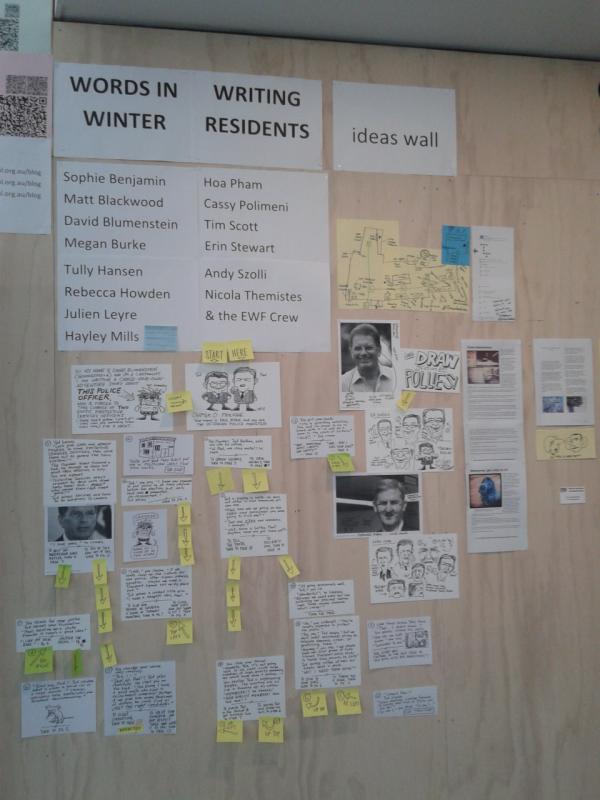
The work wall keeps growing every time I’m here. It now contains a choose-your-own-adventure comic, blog posts, an interactive fiction gaming map and the beginnings of a discussion of self-publishing.

The Future Bookshop is an ever-changing beast, Bookshop 2.0, where the people inside it shape its content. Just like the digital space.

But WHY does it WORK?

Last night I joined in writing for the Rabbit Hole for about 3 hours. Today I’ve been largely pottering around with the online team on Facebook and Twitter, providing munchy provisions for Melbourne, and coffee for myself. Sitting so close to the snacks table again today is dangerous, dangerous stuff.

Last night I managed to write over 2,900 words. Given that this was in three interrupted hours (catering wench is most important in this venue!), I’m really happy with my output. And I managed to write some scenes I’d been avoiding or struggling with for ages.

Last night I woke at 3am, and lay in bed thinking for a while. Almost 3000 words in three hours is really good for me. I wrote more in three hours than I have in the last week. So why does the Rabbit Hole work?

Possible answers:
– No procrastination tools. There’s no housework to be done,  no TV to watch and no to-do lists to make you feel guilty. The things that normally crop up to help writers avoid their writing are all stripped away.
– Public Censure. In a room full of people pounding away at the keys, you feel a bit shit for not doing the same when you know very well that you’ve got no excuse, and you signed up for this.
– Competitiveness. That girl just hit 3,000 words. What?! Yeah. Right. Need to get there too.
– What you owe to yourself. Knowing that you’ve got this opportunity, and that these opportunities are rare helps drive home the fact that you owe this to yourself.

These are my top theories. If you took part in the Rabbit Hole, or you have in the past, and you can think of other reasons, let me know. I’m interested in nutting out why I can write this amount here, but not at home alone. Am I just lacking discipline?

Down the Rabbit Hole…

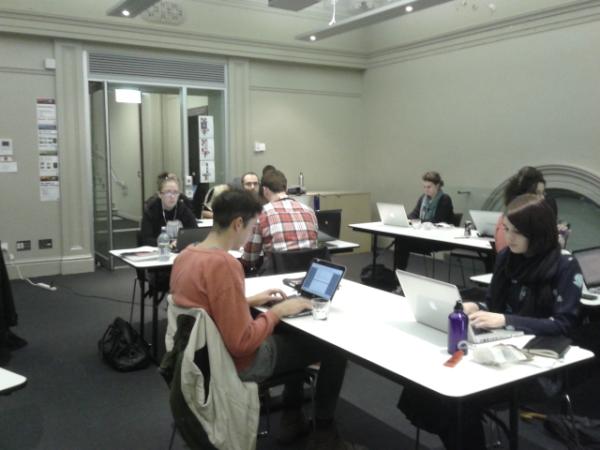
It’s been pretty busy here at the Wheeler Centre. At 6pm last night, 20 writers came together in the workshop space upstairs and sat down to write.

This is The Rabbit Hole, where the goal is to write 30,000 words in 22 hours. The numbers have been crunched, and it’s something like 1,300 words per hour. There are four teams, each of 20 people. There’s a Facebook group and a #rabbithole hashtag, plenty of tea, coffee, and snacks. Little incentives and lots of sharing of lollies.

These guys are dedicated, and the room sounds AMAZING. Yeah, sounds. The sound of twenty people typing in unison is a glorious thing! It’s like standing at an indoor pool, where plashing waves take over any other sounds and it sort of ebbs around you. That’s what the tapping of keys sounds like in the workshop space at the Wheeler Centre.

It’s now 4:08 on day 2, and I’m just jumping down the Rabbit Hole myself. Up until this point I’ve been hanging out on the online forum, manning the Twitter hashtag (#rabbithole), which has been plagued by a bunch of spam which has required lots of “report @… for spam” clicks. The good thing, though, is that even with the spammy stuff in the stream, we’re still dominating the #rabbithole hashtag! Reports are flooding in from Brisbane, Hobart, online and Melbourne.

I thought I’d start my jump down the Rabbit Hole with this post, to let people know how it’s going.

Scratch that, 4:21. A lot of my job so far has involved making sure we’re in supply of mugs and that the urn is full. This sounds easy, but somehow 20 people go through a LOT of coffee and tea. You’ve got to fuel 1,300 words and hour with something!

Other than the catering stuff, I’ve been playing with the online team on their Facebook page.

When we first jumped into this endeavour, I heard that Queensland Writers’ Centre (brilliant originators of this initiative) had challenged writers to chalk up 30,000 words in a weekend. “Nuh. No way!”

But it’s been done, and it’s a LOT of fun to see it being done in front of my eyes here. One of our writers just hit the 15,000 word mark (!!!) – we’re now 8 and a half hours in. That’s not even half way.

It’s also really nice to be the contact point for lots of people – I’m getting to hear about new projects that are in the pipe line, and what people plan to do with their work when it’s done.

So. This is 400-something words toward the Rabbit Hole. Sorry it’s a mostly unedited gush, I thought I’d just keep ya’ll in the loop.

See you when I surface!

S

Opportunities a Plenty

Being involved with EWF more closely this year has opened my eyes to the amazing amount of opportunities they have available for writers, outside the festival itself. There’s a bunch of deadlines coming up, so I thought I’d just do a heads-up for anyone that might be interested in these opportunities. I’d encourage people to apply, because EWF’s a fanastically supportive atmosphere, and a wonderful starting point. Having this stuff on your resume is so helpful, and in terms of experience it’s priceless. And some of these are lucrative. Woot.

–> The Monash University Undergraduate Prize for Creative Writing. Most prizes are almost impossible for an undergraduate emerging writer to win. They either require a publication history, or a whole book, or a completed manuscript, or… a bunch of stuff a lot of undergrads just don’t have. The Monash Prize has a large bundle of money to give to its winners, it’s for previously unpublished writers (see website for specs on this), and entries are reasonably short pieces of writing. Winners are also being published as an ebook by Penguin. Entries close April 23rd.

–> Words In Winter Writer’s Residency. A two-week writing residency at “a high-profile CBD location”. The theme is a future of writing, which is a pretty hot topic at the moment. If you’re concerned with digital story-telling, blogging, ebooks, self-publishing, or anything that’s wrapped up in the idea of the “future of writing”, then apply for this residency. There’s ten spots available, and EWF’s offering a publishing opportunity post-residency. Applications close April 20th.

–> Australian Poetry’s fantastic Cafe Poets program is launching their next round as part of the EWF in May. The program puts poets in cafes as writers-in-residence, giving the poet a space to work, free coffee, and an outlet: contact with the public. Applications close April 24th.

With all these opporunities available, you’ve got no excuse not to make stuff happen. Give it a go! Entries for all these close very soon, so get writing!

Did ya see me?

Did ya see me? Did ya? Over on the Emerging Writers’ Festival blog. That’s me, there, interning!

I’ve not mentioned it here before, but I’m one of the three interns on board at EWF this year. I’m super-duper excited – this is a genuinely ass-kicking position. As part of the internship I get given an event to run. So I’m instrumental in making the festival happen. And I’m an “Associate Producer” – great title, hey? And I’m SO FREAKIN EXCITED!

No doubt you can expect much more festival love and happiness from me between now and the wrap-up in July.

Reading As A Priority

In his essay, Why Literature, Mario Vargas Llosa talks about how it’s a bit disgusting that reading is regarded as an indulgent pass-time. Literature is important, says Llosa, not just as a means of escape or relaxation (though these are still some of the many great functions of reading), but as a tool which promotes an engaged and lively society. And for writers, reading is especially important – how can we expect to be great writers if we aren’t also great readers?

As at the start of every year, there’s been a lot of goal-setting happening over the last few days. My online writing group has seen everyone’s goals updated, and one person’s goals in particular really interested me. It involved adding more structure to their writing day – something I’m always trying to do. I was inspired by the fact that a full writing day for them involved three hours of reading and four hours of writing on any given day. This struck me as similar to the “Writer’s Diet” (which I saw attributed to John Birmingham, but now can’t find anywhere) – this involved four hours’ reading and four hours’ writing daily. Ambitious, yes, but a totally worthy goal. I’m not saying that to be a good writer you need to read for x hours, and write for x hours, or you’re falling short. I’m just saying that for me, and for a lot of people I know, these kind of goals usually result in tangible improvements in our work.

So part of my writing goal this year is to make reading a priority again. Toward the end of 2012 it became something I did in spare time, on public transport or lunch breaks, or to unwind before bed. While all these things are still optional and will probably still be good reading time for me, I’m making reading an important part of my writing day.

Having read about 60 pages this morning in two hours (slow reader, yes), 100+ Books seems more achievable than ever, my “to be read” pile is cowering in terror, and I will be the most informed writer I can possibly be. Without understanding writing from both perspectives (reader and writer), I can hardly expect to get any better.

Blog at WordPress.com.

Up ↑