Search

Sam van Zweden

Writer

Tag

review

Jane Eyre film review

JANE EYRE
Released: March 11, 2011
120 mins
Directed by Cory Fukunaga

On what terms can we judge a film adaptation of a well-loved book?  Surely the film is an artistic work in itself and should be judged on its own merits? However much I like this sentiment, I think that there’s no way of utterly separating the source text, and that to judge a film adaptation of a book on its own terms means, at least partly, to judge it in reference to that book. Cory Fukunaga’s 2011 adaptation of Charlotte Bronte’s (1847) Jane Eyre is certainly a decent film, but when placed in the context of the much-loved book and the many, many film and television adaptations, it doesn’t fare quite so well.

For those who have never read the novel, what follows is a brief outline of the story:
Jane Eyre is a poorly-treated orphan girl, sent by her aunt to Lowood, a girls’ school where she is treated badly. Years later, Jane leaves Lowood to teach a young girl in the home of Mr Edward Rochester. Though he originally presents as cold-hearted and cruel, Rochester and Jane form a close bond. This is strengthened through the strange happenings at Thornfield Hall, where disembodied voices and shadows float around, fires start from nowhere and violent attacks happen in the middle of the night. Rochester eventually proposes marriage to Jane, who accepts, but is heartbroken when she finds out that Rochester had already taken a wife fifteen years ago – a wife who turned out to be insane, and who Rochester kept locked in his attic. Jane flees Thornfield Hall, running across the moors, and eventually finds a home with kind people who allow her to live an anonymous post-heartbreak life.

Jane Eyre being such a seminal text, I’ll assume that what follows are not spoilers – the people Jane happens upon after traipsing across the moors for days and nights are, coincidentally enough, her cousins. This part of the book is particularly dense and boring, but it serves a purpose. We all feel a bit relieved when she returns to Rochester, refusing to marry her dull, overly pious cousin.

Rochester, meanwhile, has had his mad wife to contend with. She has burned down Thornfield Hall, committed suicide, and Rochester is now alone and crippled. Jane returns to him after hearing his voice calling on the wind, and a touching reunion follows.

Fukunaga’s Jane Eyre starts off on the wrong foot entirely by messing with the chronology of Bronte’s story. The cousins are no longer cousins, just helpful strangers (more realistic, certainly), and Jane’s appearance at their house is the beginning of the film; the point from which we flash back to tell most of the story. This gives the not-cousins far more importance than they need and is a strange starting point.

This is a very short telling of this story – many renditions of Jane Eyre have been television mini-series, and Bronte’s book itself isn’t exactly a quick read. At 120 minutes runtime, there simply doesn’t seem enough time to properly build relationships. When Jane’s only childhood friend died, I felt nothing. Not even “Oh, that’s a pity”. It didn’t feel at all like an event which would impact Jane and her way of thinking for the rest of her life – and if it’s portrayed in a way that I don’t care enough about, why even include it in the film? If liberties can be taken with other parts of the story, why not this one?

Relationships which matter more than Jane and Helen are equally as unconvincing – the main problem seems to be that the plot consists solely of main events, with none of the glue between to make it all believable. Take Jane and Rochester, the central pair. Other than a little “falling-in-love” montage after Rochester has confessed his love for Jane, the two only interact at traumatic times and even then in a stilted way – the depth of their feelings for one another doesn’t seem possible after the amount and nature of interaction suggested in the film.

Aside from qualms with the screenplay itself, Jane Eyre is mostly well-executed. It is cast well, with incredibly strong actors. The lovely Australian Mia Wasikowska is made to look suitably plain as Jane, which is quite a feat. Her acting is subtle, and she embodies the small yet strong-willed proto-feminist Jane perfectly – one of the best portrayals of the character that has been done. Michael Fassbender as Rochester is a bit of a re-imagined Rochester, but one which is permissible – he is far less stern than Bronte’s Rochester, possessing the same quick wit but also an overarching sense of humour and kindness. An altogether more likeable Rochester than any I’ve seen or read before.

I was disappointed by Fukunaga’s approach to the gothic elements of the story, as they’re so central to Bronte’s novel. There seems to be, in the film, no sense of menace behind any of the strange and supernatural-feeling occurances at Thornfield Hall. All the bumps in the night occur in isolation, with no music or particularly eerie lighting – perhaps Fukunaga was aiming for a realistic kind of menace, but it seems to have fallen flat.

The locations and sets are all overwhelmingly pretty and convincing – the moors, of course, are the only thing Jane could possibly walk across with her heartbreak, but the old houses that were used, particularly Thornfield Hall, is decked out with great attention to detail and a lack of exaggeration. The rooms of Thornfield Hall are grand, yes, but exactly no grander than they should have been for a man of Rochester’s standing – the rugs are the right size, the glass wear is nice but not too nice.

Within this particular screenplay of the story, Fukunaga has produced a good film. However, the writing itself leaves characters not fully formed, and questions as to the sense of the action hover over it. It works on its own turf, but up against the whole Jane Eyre oeuvre, a little disappointing.

ROOM review

ROOM by Emma Donoghue
PICADOR
ISBN: 9780330519021
RRP: $22.99

Shortlisted for the 2010 Man Booker Prize, ROOM tells the story of five-year-old Jack and his Ma, who live in a space measuring 11 feet by 11 feet. Captive for seven years, Jack is born in Room, and Ma teaches him that Room is all there is. They have a TV, but all that’s seen on there isn’t “real for real”, it’s “just TV”. Jack’s entire reality is confined to Room, where the sky measures only as wide as Skylight, the sea isn’t real, and Old Nick (who Jack sees as akin to an unfriendly God) brings them food and “Sundaytreats”. One day Ma “unlies” to Jack, telling him that most of what’s on TV is actually true, and that Room is only a tiny part of a much bigger world. Jack is reluctant, and finds it “hard to remember all the bits, none of them sound very true,” but eventually helps his Ma escape.

Told from Jack’s point of view, the narrating voice of ROOM is both wonderfully strange and very familiar. Jack has the questioning nature and speech patterns of a five year-old, but this familiar voice is put into a very foreign situation. Limited viewpoints are fun for a while, but can usually grow stale unless executed precisely (a’la Mark Haddon’s The Curious Incident…) – Emma Donoghue hit the nail on the head – Jack’s is one of the most original voices in recent fiction.

Throughout the novel, the reader and the author look over young Jack’s head and wink at one another in recognition. Jack describes awful things happening to Ma, but in an uncomprehending way. Every weekday, Ma and Jack get to “play Scream”, where they bang things and yell as loud as they can. Jack sees this only as part of what constitutes the world of Room, part of the daily routine. This reader/author cahoot-feeling continues when Jack gets out into the world (only about 50 pages into the novel – not a spoiler!). Donoghue has managed to see the world through incredibly fresh eyes, wondering at things we take for granted. A writer of historical fiction, she has a knack for finding the strange in the familiar, and vice versa, and this works perfectly for Jack.

Both the main characters, Jack and Ma, ring very true. At times you love them both, but at other times they’re just too human to be liked – these are honest characters, not caricatures or thought-experiments. Taking as inspiration the case of Austrian captor Josef Fritzl, Emma Donoghue has thoroughly researched all the implications (both medical and psychological) of such cases. However, these characters are so memorable and true because at their centre, they are simply human.

Tears. I’m warning you now, there will be tears. There will be laughter also, and happiness – ROOM is easily the most moving novel I have read in a long time, one of those ones you want to dive into and never return.

This review originally published in RMIT’s flagship publication, Catalyst, in May 2011.

Review: Best Australian Stories 2010

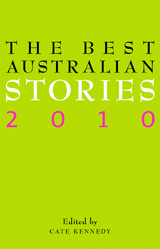
The Best Australian Stories 2010, edited by Cate Kennedy
Black Inc
Publication Date: November 2010
ISBN: 9781863954952
RRP: $29.95

One of the chief advantages of The Best Australian Stories 2010 is that it shows that Australian writing is as varied as Australia’s population, as changeable as its weather and landscape.  This collection shows that Australian literature remains as enigmatic and indefinable as ever. Its content suggests that the cosmopolitanism that in the past has had amazing writers like Christina Stead shunned from the Australian fold, is now well and truly embraced along-side more colonial visions of cattle stations and bushfires, and that any effort to define “Australian writing” would necessarily involve all of these things.

The Best Australian Stories 2010 is comprised of twenty-nine short stories, both previously published and not before printed, from authors both well-established and emerging. Kennedy has struck an admirable balance between male and female authors without it feeling like a political exercise, and much thought has obviously gone into pacing the collection. While reading it’s hard not to say, “Just one more!” because of this attention to detail.

It’s also hard not to connect the stories to one another, as Kennedy’s ability to bring well-suited stories into a collection means that they gesture far beyond themselves into the other stories in the collection, but also into Australian writing as a whole.

While there are stories in here, such as Joanne Riccioni’s ‘Can’t Take the Country Out of the Boy’, and Fiona McFarlane’s ‘The Movie People’ that are concerned with more traditional Australian landscape and colonial values, other stories like Nam Le’s ‘The Yarra’ and Sherryl Clark’s ‘To The Other Side of the World’ speak to a very modern, very high-pressure metropolitan side of Australia. All the stories in this book carry notes of a haunting and tense Australia; its inhabitants torn between yearning to belong and to run. And while the stories in this collection can be broadly connected via themes, it is refreshing to see just how diverse the concerns of these stories are.

Chris Womersley’s ‘The Age of Terror’ actually made me yell. Nam Le’s ‘The Yarra’ made me yell and want to throw the book at something because it was so true, down to his depiction of a Melbourne which I could recognize down to the river bend. Ryan O’Neill’s ‘The Eunuch in the Harem’ is impressive and original and hilarious. Paddy O’Reilley’s story is one that stood out to me as hauntingly Australian. Marcus Clarke once typified Australian landscape as “weird melancholy” and many of the stories truly had that feel – Paddy O’Reilley brings it to suburbia.

By the end of The Best Australian Stories 2010, you feel like you know what Australian writing is about, and get an idea of some of what’s happening in our literary journals, but the collection is by no means tiresome – the diversity between these covers is more than admirable.

The Best Australian Stories 2010 is a collection that we can be proud of, and one whose attention to fine form and original ideas will leave you well and truly sated.


This review appeared in the first 2011 edition of RMIT’s magazine Catalyst.

The Wild Things by Dave Eggers Review

I never read Maurice Sendak’s Where The Wild Things Are as a kid. I can recognize the book, and I knew it was popular, but somehow it was a title that I just never had much to do with.

Recently this book was turned into a film, which expanded on Sendak’s original picture-book story. There was much discussion about the film being too adult, and not in the general feel of the children’s story. I saw the film, and I agree, it’s not appropriate for children – but I don’t think it should have been. The kids about my age and older who grew up reading Where The Wild Things Are are the people who watched the film, and it was appropriate for that age group.

Lesser known is the fact that at around the same time, the picture-book was adapted to a novel, written by Dave Eggers, who also wrote the screenplay. The novel diverges from the story of the film in parts, but generally feels the same and has the same message – it’s not as dark as the film though, and I think you could almost read this novel to a kid (probably about 8yo+) and have them understand it and get something out of it.

The story is about Max, a young boy whose parents have not long divorced. Max is having trouble with his sister not caring about him any more, and his mum giving her attention to a new man, Gary. Max plays up and causes trouble – his mum tells him he’s caused “permanent damage”. While she’s referring to the house, Max sees it as emotional damage, and runs away from home in confusion. He gets in his boat and tries to steer toward the city, where his father is. Somehow though, Max drifts out to sea and lands on an island full of creatures who are as wild as Max. They make him their king, and during his time on the island, Max learns that it’s impossible to please everyone all the time, and that there are very real consequences for the things he decides to do. By leaving his home, Max learns to see the wild thing inside himself.

Written in a very simple style, Dave Eggers has written a touching story which could speak equally to adults and older children. Though the language is uncomplicated, the story is by no means one-dimensional. Eggers here absolutely disproves the rule of “writing what you know” as being the most effective way to write a moving story. He makes utterly unreal creatures more human than many of the characters I’ve read elsewhere, showing that all you really need to have is a point. And a way with words – oh, Lordy! Has Dave Eggers got a way with words! (The idea of Max being “half boy, half wind” just kills me!) He paints beautiful imagery, and is consistent with it. Metaphors appear and re-appear , ideas weave their way seamlessly through the narrative as character motivators (such as Carol’s attachment to the idea of the sun dying).

Even though the story is set in an unnamed land, inhabited by unreal wild creatures, I found myself on the verge of tears by the end of the book. Each character had an absolute purpose in the same way that real people do. I felt like I’d wandered into a firmly established and very real situation in much the same way as Max had, and there was no point in the story when I didn’t believe or care about what was happening.

I’m a bit of a Dave Eggers fan, having recently read How We Are Hungry and just about wetting myself over its brilliance, and having a fairly obsessive attachment to A Heartbreaking Work Of Staggering Genius. A children’s book adaptation though? Really?

Yes, really. Don’t let the premise put you off. Dave Eggers has written in a super-tight way, true to his usual form, and has turned fantastical characters into something very real that will stick with you.

Mistakes You’re Allowed To Make Post-Nobel Prize

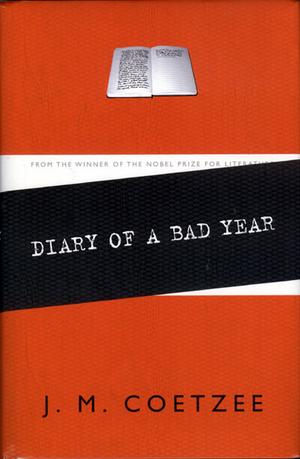
“FROM THE WINNER OF THE NOBEL PRIZE FOR LITERATURE” – there it was, in big fat caps, right across the front of the dust jacket. While I haven’t picked up many books purely for that kind of endorsement, when reading something with a grabbing announcement like that I would hope I could trust that it’s a piece of writing with some merit. At least, a little more merit than a random airport novel. I can put some faith in the fact that it will have an effect on me. Unfortunately, this faith was entirely misplaced in JM Coetzee’s “Diary of a Bad Year”.  

Published in 2007, four years after Coetzee received the Nobel Prize for Literature, “Diary of a Bad Year” is a story told through three narrative strands, which run alongside one another throughout the book. Each page, for the most part of the novel, is divided into three parts. Each part is dedicated to a different narrative voice: one is comprised of the essays of a “fictional” writer (referred to as J.C – what a coincidence! How meta!) who is writing for a German collection of essays by writers; the next voice is that of J.C himself, as told to his private diary; the last is the account told by the woman he hires to type up the manuscript of the above essays. The typist influences what the writers considers in his essays, and in his diary he reflects on his relationship with her. She talks about her relationship with her partner, who conspires against the writer.

The blurb on my copy of this book promises “three dynamic and charged voices”, and a book “about how we choose to read”. I was also promised by the jacket an “original” book. I feel cheated on all these points apart from one, and even then it loses its power by seemingly being the only point of the book.

Nabokov said that “There are three points of view from which a writer can be considered: he may be considered as a storyteller, as a teacher, and as an enchanter”. The great authors, according to Nabokov, are those who can combine all three of these things successfully.

Was I enchanted by “Diary of a Bad Year”? No. Not at all, and this was deeply disappointing. I’ve been entirely enchanted by post-modern writings by other people – Italo Calvino, Borges, Georges Perec. I don’t think post-modern writing is past its best-before date at all: Mark Z Danielewski and Dave Eggers are prime examples of well executed recent post-modernist writing. It can still be done, and done well, in new and surprising ways. They play with form and expectations, they jump into your head and fuck shit up and leave you screaming “WOAH!”.  JM Coetzee did not enchant me in this way at all.

What about a good storyteller, then? No, not that either. The three narrative voices of “Diary of a Bad Year” are very one-dimensional, very slim offerings. The essayist’s voice stands alone easily as it is from another genre.  The voice of Anya (the typist) however, mingles with J.C’s voice in such a way that it’s entirely inconsistent and unconvincing. Coetzee has tried to give Anya a distinctive voice by way of her word-play and flippancy:
“At first I was just supposed to be his segretaria, his secret aria, his scary fairy, in fact not even that, just his typist, his tipitista, his clackadackia…” (pp25-6).
While this creates a very strong voice in places, Anya’s inconsistency as a character means that she dissolves into something more like J.C’s voice, and this doesn’t seem intentional on Coetzee’s part. At the start of her account, Anya is concerned with the effect her “delicious behind”, but later considers the wider implications of the existence of an individual dimension. In the incredibly small space given to each character, Coetzee fails to tell a story that readers invest in. I didn’t care what the writer’s essays discussed, I didn’t care if the writer got it on with Anya, and I didn’t care whether Anya’s partner ripped the writer off or not. I just wasn’t affected by the story at all.

This leaves one more of Nabokov’s traits of a great writer – being a great teacher. Roland Barthes talked about the “writerly text”, which enlists collaboration between writer and reader. “Diary of a Bad Year” certainly does that – readers must work. However, Bathes talked about such texts producing what he called “jouissance” – “bliss”. The only feeling this book provided for me was frustration. As the blurb promised, it is a “book about how we choose to read”. So the point of “Diary of a Bad Year” seems to be simply to teach. As an academic, this might be expected of Coetzee. As a winner of the Nobel Prize, he now has the space to publish experimental work and actually find a market for it. I could forgive all this, if the book actually taught me something, or engaged me in some way. It did not.

I feel like the pitch for “Diary of a Bad Year” would have been enough to impart all the wisdom this book had to offer. The tricksy, clever, post-modern gimmick just isn’t enough to make the book good. It’s a good idea in terms of exploring an interesting point, but badly executed and altogether uninteresting to read, offering little to nothing in terms of storytelling and enchantment.

Review: Mama Mia by Mia Freedman

Having much respect for what Megan from Literary Life has to say, I took this book recommendation. Grudgingly, mind you. I shuffled off to the library in search of Mama Mia by Mia Freedman, the ex-editor of Cosmopolitan and editor-in-chief of a  jumble of other ACP magazines. She has also worked in television and written columns for newspapers, and now blogs.

I’m not particularly fond of women’s magazines like Cosmo and Cleo. I’m sure they’re great for some people, but for me, they just make me feel like being a woman is a game that I’m playing but I don’t know the rules for. Which is a pretty lousy way to feel. Once I got past needing Dolly and Girlfriend to guide me through puberty, I got those things out of my life. However, Mia Freedman’s Mama Mia was recommended to me as a book with countless insights to the publishing industry, so I thought I’d better give it a whirl.

It wasn’t exactly a revelation in terms of publishing tips and tricks – I’m not interested in going into women’s magazines, but in terms of dishing the dirt on big Australian names, Mia Freedman has done pretty well.

That’s not to reduce the book to a gossip-fest: far from it. Mama Mia is equal parts about Mia’s career, and her life outside of her career, as a mother and wife. It made me laugh out loud, multiple times. It made me cry. Like real, tears-down-the-cheeks crying. I didn’t expect that.

The book is brutally honest, from Mia going into labour screaming to everyone around her “I need to POOOOOOOOO!” (that was a laughing moment), to wondering over her ‘failure’ at keeping her baby alive (tears here), followed by years and years of IVF.

The ‘mothering’ part of the memoir talked to me a lot more than the ‘magazines’ – however, the ‘magazines’ parts weren’t uninteresting to me, and I was surprised to find that there was only one part of the book that I was shaking my head at. “No, no I just can’t relate to that” – Mia talked about how all women bond over clothes shopping. *spew*

The tone of the memoir is conversational, and perhaps this is why there was only this one point that I felt I wasn’t a part of.

Mia Freedman has lived a life very memoir-worthy, and she’s written a book which speaks to readers as if they’re her friends. It’s honest, it’s funny, it’s heartbreaking, it’s accessible.

Overall, it’s pretty great.

What Alice Forgot Review

Sometimes you fall out with people. You don’t choose to, but you drift apart and eventually one day they’re not there any more.

When you talk to people about it you say, “Oh, they’ve changed.”

Only, they haven’t. Or they have, but you have too. We all change, and it’s so gradual that we don’t really notice.

Liane Moriarty’s What Alice Forgot looks at this idea.

Thirty-nine year old Alice Love goes to the gym and has a fall. When she wakes up she believes she is 29, pregnant, and still madly in love with her husband Nick. Not only is she not pregnant, but she now has three children and is on the verge of divorcing Nick.

There are flowers from another man in Alice’s bedroom. There’s a mysterious card in her bag from another unknown man who talks about “happier times”. Alice’s eldest child is an absolute monster, far from the harmless “Sultana” she harboured in her belly ten years prior to her accident. Alice Love is now in utterly unknown territory. And she’s horrified to find out that the 39-year-old Alice Love is an absolute bitch: not someone she likes at all!

This story is nicely told, with the narrative shifting between three points of view. One is a third-person subjective point of view from Alice, another is Alice’s sister’s therapy journal, and the third is the utterly endearing blog kept by Alice’s grandmother. While having three points of view in the story has the potential to go awfully wrong, Liane Moriarty has executed this beautifully. 

The story gripping, showing the reader peeks of the life that Alice has forgotten, masterful in its release of information. 

Liane has written a novel that falls through your hands like grains of sand – I thought “yes, just one more chapter”…”just one more!”…each night that I sat up reading it, and chewed though the entire thing in 3 sittings.

It takes a lot for a book to make me cry. But this one did.

It also made me think for a long time afterwards about the ways people change, and I wonder what myself five years ago would think of myself now?

Neon Pilgrim Review

I’m officially on holidays, so I’m finally munching through some of the “to-be-read” pile. The first thing I picked up off that pile was Neon Pilgrim by Lisa Dempster, which I bought from the EWF Page Parlour a few weeks ago.

I should probably flag it here that I interviewed Lisa for Yartz just before the Emerging Writers’ Festival, and she seemed absolutely lovely. I’ve also been following her blogging for a while, so I went into this book with an already reasonably good opinion of Lisa and what she’s been up to. I have to say though, that this book boosted that by about a hundred percent.

Neon Pilgrim is about Lisa’s journey along the henro michi – a back-breaking trek, 1200 kilometres through Japanese mountains, all the way around Shikoku. No small effort.

I’ve never really read travel books before. Something about the term “travel literature” puts me off – I imagine middle-aged intellectuals relaying things like “the rich history” of countries with Western histories much older than Australia’s… While it’s all very interesting, it’s not something I’m keen on dedicating myself to for a whole book. And I’m sure this isn’t even what travel literature entails. It’s just what my mind has made it.

When I heard about Neon Pilgrim though, I felt like this might be something I could relate to, and get something out of reading. When Lisa started the journey, she was a 28 year-old, overweight and very depressed. Having visited Japan as a student, she had heard about the henro michi, and decided that this was what she needed to pull her out of depression.

The pilgrimage is said to be enlightening, each henro (pilgrim) is accompanied by the spirit of Kobo-Daishi, who the walk is done in honour of. The Japanese who inhabit Shikoku believe that by giving settai (gifts) to pilgrims, they too honour the spirit of Kobo-Daishi even though they cannot do the trek. So the journey itself is a respected thing, and pilgrims are helped out a great deal by those who live in the towns and cities that the henro michi passes through.

The book is written simply, there’s no complicated jargon or assumed prior knowledge of Japan or its rituals. The book includes a glossary of Japanese terms used in the book, but most of the time it isn’t needed, as Lisa makes meanings very clear.

Along the way there are fantastic crazy old men, deeply respected veterans who have done the pilgrimage hundreds of times, and kind people Lisa’s own age, who are all doing the pilgrimage for different reasons. There are bears, and spiders, and blisters. Every story along the way has its place, and the pilgrimage becomes a mesh of encounters and problems to negotiate.

I won’t say that the prose is amazing. It’s good – very funny at times, and at others you can really feel Lisa’s frustration. But I wouldn’t call it artful. Artful prose isn’t what this book is about though.

There’s an old Taoist saying, that “the journey is the reward” – while Lisa’s fitness improves, and she meets some wonderful people along the henro michi, the reward in terms of escaping depression is less tangible. I think this is one of the things I loved about the book – Lisa proves to herself that she can still get out of herself and tackle the world, but along the way she still hits that brick wall many times. She doubts herself – in fact, it’s not until temple 76 that she actually thinks that perhaps she will actually reach the end. At certain times in the journey the only way forward is to “step. Step. Step”. And I think this is how it is, and how it’s meant to be – getting through tough things like depression is like that, it’s not “cure!” and then everything’s great. It’s just one foot in front of the other.

At the end of the book there is no definitive ending. Yes – Lisa makes it to the end. But it’s only the end of the henro michi – the start of something much bigger. And I didn’t even find the open ending frustrating, I found it incredibly hopeful. While I know I probably won’t do a trek like this, I have taken a lot from the “Step. Step. Step.” attitude and the idea that accomplishing something is not the end.

Lisa Dempster, the smiley lady you will see at many a literary event, has walked 1200 kilometers and slept in some very crazy places. She has gone through some absolutely insane shit – go shake her hand next time you see her. Or go read Neon Pilgrim. Or both.

“The Ask” by Sam Lipsyte Review

I hadn’t heard anything about this book when I picked it up. Then I accepted it into my life and it started appearing everywhere, getting the thumbs up from all sorts of cool people. Having only had time to briefly peruse the blurb, I had no idea why.

By page 5 it was clear – this book is a winner. An absolute, knee-slappingly hilarious, day-changing winner.

Sam Lipsyte’s The Ask features loser protagonist Milo Burke. A failed painter, Milo gets fired from his fundraising job at the arts department of a university and his life starts going to shit. Until Purdy shows up. An ex-schoolmate of Milo’s, Purdy forces the university to get Milo back on board as one of the conditions of Purdy making a sizeable donation to the university. Milo steps back into his old job, but this time it also involves being some kind of horrible-errand-pimp for Purdy.

Sam Lipsyte has written a novel that is incredibly well-balanced. The story is understated, and the language subtle. The story unfolds so that it begins like we’ve just wandered into Milo’s life, and it ends like we just wander out. Nothing grandiose, but by no means a boring story or lack of plot either.

Lipsyte has an amazing ear for dialogue, with his characters saying absolutely inane things that all of us know we’ve said from time to time. All characters in this novel also seem incredibly adept at slinging insults and horribleness at one another, one of my favourites being when Purdy shoves a big wad of cash at Milo:
“…here’s our severance to add to your other severance. Mix all that severance together. It’s like a jambalaya of fucking severance. It’s tasty and you can stuff your fat treacherous face with it.”
Ah! Would that I could be so coherently hateful!

Milo’s son Bernie brings an incredible amount of poignancy to the novel, however he also has some of the best comedic moments:
‘Do superheroes have foreskins? Like my guy?’
  He held up his headless hero.
  ‘Yes. No. I don’t know. Probably.’

  ‘Do foreskins help you fly?’  ”

Bernie’s full of moments like this, but in typical not-quite-four year old fashion, he peppers his speeches and musings with wisdom that he doesn’t even know is there, always ready to add a nice commentary on Daddy’s action.

While The Ask is a freaking hilarious read, don’t let that fool you. There’s a truly decent story under all the knee-slapping; a nice sort of questioning of values and what it means to grow up true to yourself.

I’m glad to have spent time between the covers of this one in the last week or so; I was always glad to be there, I never wondered when the book would finish. I’ll be eagerly looking out for whatever Sam Lipsyte brings forth into the world next.

Blog at WordPress.com.

Up ↑