Search

Sam van Zweden

Writer

Tag

reading

“The Ask” by Sam Lipsyte Review

I hadn’t heard anything about this book when I picked it up. Then I accepted it into my life and it started appearing everywhere, getting the thumbs up from all sorts of cool people. Having only had time to briefly peruse the blurb, I had no idea why.

By page 5 it was clear – this book is a winner. An absolute, knee-slappingly hilarious, day-changing winner.

Sam Lipsyte’s The Ask features loser protagonist Milo Burke. A failed painter, Milo gets fired from his fundraising job at the arts department of a university and his life starts going to shit. Until Purdy shows up. An ex-schoolmate of Milo’s, Purdy forces the university to get Milo back on board as one of the conditions of Purdy making a sizeable donation to the university. Milo steps back into his old job, but this time it also involves being some kind of horrible-errand-pimp for Purdy.

Sam Lipsyte has written a novel that is incredibly well-balanced. The story is understated, and the language subtle. The story unfolds so that it begins like we’ve just wandered into Milo’s life, and it ends like we just wander out. Nothing grandiose, but by no means a boring story or lack of plot either.

Lipsyte has an amazing ear for dialogue, with his characters saying absolutely inane things that all of us know we’ve said from time to time. All characters in this novel also seem incredibly adept at slinging insults and horribleness at one another, one of my favourites being when Purdy shoves a big wad of cash at Milo:
“…here’s our severance to add to your other severance. Mix all that severance together. It’s like a jambalaya of fucking severance. It’s tasty and you can stuff your fat treacherous face with it.”
Ah! Would that I could be so coherently hateful!

Milo’s son Bernie brings an incredible amount of poignancy to the novel, however he also has some of the best comedic moments:
‘Do superheroes have foreskins? Like my guy?’
  He held up his headless hero.
  ‘Yes. No. I don’t know. Probably.’

  ‘Do foreskins help you fly?’  ”

Bernie’s full of moments like this, but in typical not-quite-four year old fashion, he peppers his speeches and musings with wisdom that he doesn’t even know is there, always ready to add a nice commentary on Daddy’s action.

While The Ask is a freaking hilarious read, don’t let that fool you. There’s a truly decent story under all the knee-slapping; a nice sort of questioning of values and what it means to grow up true to yourself.

I’m glad to have spent time between the covers of this one in the last week or so; I was always glad to be there, I never wondered when the book would finish. I’ll be eagerly looking out for whatever Sam Lipsyte brings forth into the world next.
Poetry to Pages

I’m not sure why this event was called “Poetry to Pages“… It should have been called “Poetry to Ears, Heart-Strings and Tear Ducts”, cuz that’s where it was going.

Whatever it was called, last night at Readings in Carlton, some lovely poetry reading went down.

The readers in question: Jordie Albiston, Josephine Rowe and Jennifer Harrison.

All of these ladies are quite accomplished Melbourne poets, but up until last night I’d only heard Josephine Rowe’s poetry.

Jordie Albiston read five sonnets from her The Sonnet According To ‘M’. Her poetry on a page is a lovely thing, and she herself has identified many of her “works as works for the voice”. However, listening to Jordie’s reading, I had to wonder if perhaps they were a little too much for the voice? Her poems are lovely-sounding and rhythmic, but Jordie’s performance of her pieces focussed so heavily on rhythm that I was unable to hear any words after a while, and only rhythm. Whether this is what Jordie intends is a question I’d love answered.

Josephine Rowe shared some short pieces of prose from her forthcoming novel, which feels a little like verse but I imagine will work well as an extended piece. She also shared some of her “love poems”, which she told the audience she’s trying to steer clear of lately… I wish she wouldn’t though; she does them so well! Josephine uses simple language in highly condensed, precise and confessional type pieces. It’s tight. Really tight. And she reads magnificently – it feels like she’s telling secrets meant only for your ears.

Last up was Jennifer Harrison. This lady has an absolutely impeccable ear for language. Usually I don’t like writing that talks about the land and connecting with it. I can appreciate a connection with the Earth, but so much of the writing on this subject is dry and trope-y. Jennifer Harrison does it masterfully though. She’s written about Uluru, about New Zealand, about being with nature and the outback and becoming one with it. And she’s done it in a really immediate way that puts you there. I’d never realised the lyrical possibilities of Maori words until last night. Jennifer’s poems also look at motherhood; another kind of ancient and essential connection, and she does this lyrically but not in an overly-flowery way.

Readings managed to bring together a really fantastic lineup of poets last night. This “Poetry to Pages” event will be happening on the second Monday of every month.

Reading Anxiety

Am I reading enough? I constantly ask myself.

Jacinda Woodhead at Meanland says no.

Jacinda talks about the guilt she feels when she does other things instead of reading. I get this. Somehow in my mind, reading has a privileged place which nothing else quite lives up to, meaning that anything else I do with my time creates guilt – apart from writing. That’s worthy. But the two should certainly be balanced and in much higher quantities that they are right now.

This last week I’ve had the flu, completed (to genuine satisfaction, too) three out of four assessment pieces that are due next week, organized a great many overdue things and put things in order… All of these things, including the homework, made me feel guilty for not reading. Somehow homework reading doesn’t feel like it counts. Most of it, anyway.

So Jacinda talks about all the different sources of reading she has, and it’s no wonder she hasn’t got enough time to keep up with it all. I know this feeling, and I’m sure you do too.

Jacinda talks about Google Reader – are any of you guys onto this? I’m not, but I know I have a few readers who are. I check back to a LOT of different blogs daily, so I think this would really help … but it has the potential to be very crap. So tell me, bloggosphere – to Google-Read, or not?

And Twitter – I’m well and truly into it now. I never knew I could get so much amazing independent news from one place! Honestly, there’s always something great offered to me via Twitter. I love it!
…but I also hate it. I follow 57 people on Twitter. and that adds up to a LOT of extra reading every day.

One problematic reading-source that Jacinda skips over pretty quickly is blogrolls.
You read someone’s post and they blow you away, and you wonder, “What does this person read?”  Enter the Blogroll… Some are so extensive that they take multiple visits to work through.

“I have so many books within arm’s reach waiting for my attention,” says Jacinda… Oh yes. The To-Be-Read Pile…
I thought I got smart on mine, I put many of them on my shelf. Not in a pile at all! Haha! Outsmarted, Reading Pile!
…but no. I took four of those books and put them next to my bed in a micro-TBR. I thought this would make it easier. Now when I go to bed I pick one until my eyelids won’t prop themselves open any longer. I don’t know if this has helped it or not though…

Jacinda also nods to awards lists and literary journals as incoming reading.

Besides these, I also have Classics (a very big pile and growing), books recommended by respected friends (friends who don’t read yet recommend things are ignored), review books for Yartz , and the supplementary stuff for school.

The world of literature is not shrinking. Does it scare the shit out of you?!

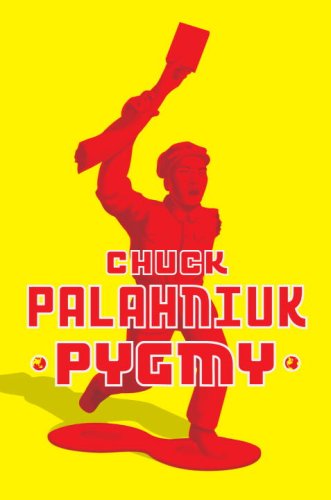
Pygmy by Palahniuk, Review

I’ve recently finished “Pygmy” by Chuck Palahniuk.

We have a good relationship, Palahniuk and I. We go way back. We’ve waded through many an existential crisis together…

…all this good work was threatened by “Pygmy”, which was released late last year. I’d picked it up and turned it over, had a quick flick, and put it back on the shelf awaiting richer days.

Last week, however, this red-and-gold clad number fell into my hands for reviewing for Yartz.

I have to say, I really came out of this one confused.

“Pygmy” reads in a much less coherent way than Palahniuk’s other novels. The narrator is from an unnamed totalitarian country, and goes to America in the guise of an “exchange student” in order to infiltrate and put into action “Operation Havoc”. He tells the story in thoroughly broken English, absolutely free of any kinds of grammar or syntactical rules. It took a while to get into, but like any incredibly stylized voice, eventually I got there. This is not what made “Pygmy” such a disappointment. The lack of coherence here came from the fact that none of the chapters in the book really fit together comfortably.

It’s reads less like the tumbling-down-stairs-at-an-alarming-rate stories that I’ve come to expect from Palahniuk, and more like an assorted collection of the most horrible episodes he could think to put in a novel.

Granted, this book is uproariously funny. Hilarious. It’s just a pity that’s the most I got out of it.

All the horribleness does have a function though. This is an amusing but incredibly biting satire of American life and the terrible potential of the wrong people having power.

Usually with Palahniuk’s novels, I dive in and get comfy, and leave feeling like I’ve gotten away with something a little bit cheeky. Not so with Pygmy.

I enjoyed reading it, found it characteristically hilarious, but Palahniuk has written much better novels and has missed the mark a bit with this one.

Popular Penguins

On the 15th March, Penguin announced the new list of 75 Popular Penguins that will be gracing shelves from July 2010 to celebrate Penguin’s 75th year publishing.

A few questionable choices… I think perhaps someone needs to tell the Penguin people that “popular” doesn’t mean “good”… But I guess all they’re claiming for this collection is that they’re “popular”. So a job well done! Having said that, on the whole, a pretty impressive selection…

You can check it out here.

What do you think? Which books should/should not have been chosen?

Teaser Tuesdays #3.

Now, I know I haven’t done much here lately. Missed me?
I’m in the process of clambering back on the horse. I’m back into school, Irvine Welsh speaks at the Wheeler Centre tomorrow, hopefully next week I’ll be having some writerly researchy experience with some people from Streat, and I’ve been writing a whole lot, so more of my own work might start appearing… Also back into Yartz filming next week and hopefully my first on-screen appearance on Monday. In the meantime, here’s today’s Teaser Tuesday post!

Teaser Tuesday is hosted by MizB at Should Be Reading.

  • Grab your current read.
  • Let the book fall open to a random page.
  • Share with us two (2) “teaser” sentences from that page.
  • You also need to share the title of the book that you’re getting your “teaser” from … that way people can have some great book recommendations if they like the teaser you’ve given!

” ‘Cyclops, the men you snatched with such brutal  force
and ate within your cave were surely not
the comrades of a coward. You have caused
much grief; and it returns to haunt you now:
you did not hesitate; hard heart, you ate
your guests within your house; therefore lord Zeus
has joined with other gods to batter you’ ”
                    -from Homer’s “The Odyssey”

DS Breaking into eReaders?

I’m absolutely flat out.

So I’m linking to something I found incredibly interesting, utterly horrifying, and somewhat amusing:

The prospect of Nintendo DS becoming an eReader.

Meanland, Reading In a Time of Change

Last night the Wheeler Centre hosted the opening event for “Meanland” – a collaborative project between Meanjin and Overland. (Apparently the organizers found “Overjin” too ridiculous).

For those of you who haven’t had the pleasure of seeing anything at the Wheeler Centre yet; it is a beautifully renovated old space on the Little Lonsdale side of the State Library. All the new fandangled lighting rigs and whatnot are reasonably inoffensive, and the public meeting space can seat a few hundred. The event last night was “booked out”, but had maybe 30 spare seats.

Sophie Cunningham, editor of Meanjin, MC’d the event, though her main role seemed simply to rehash between speakers and tell them when they’d been speaking too long. Fair enough, I suppose, when 4 speakers need to be squeezed into an hour.

 Before the event even started, I had a little to worry about: I was sitting two rows behind a particularly fetching baby who threatened to hijack the whole operation with its cuteness. I was also sitting next to a woman who was disgruntled about something, and kept doing this weird “T-ahhhhh” kind of sigh. She kept this up throughout the entire event, T-ahhhhing every time I picked up my pen, T-ahhhhhing every time someone moved half a centremetre, thus obscuring her view of the stage (she’s obviously never been short); T-ahhhhing at the very cute baby in front of us.

The panel for this Meanland event consisted of Margaret Simons, Marieke Hardy, Sherman Young and Peter Craven. The question on the table was: “What will reading look like in 15 years’ time?”. Each speaker was allotted a 15 minute window to voice their opinion.

One question that was tackled by all speakers was “what is reading?”. While the answer to this differed, there was no arguments about whether text are moving to screens via kindles, iPads and the like. The panel was reasonably varied in their reaction to this.

Margaret Simons held some hope for physical books because of their importance to children, and as cultural items like coffee table books, having “no intention to throw out my Jane Austen collection!”, while Sherman Young felt no hope or desire to fight for the physical text. While Simons was saddened by her prediction that e-readers would be the dominant mode of reading within five years, Young gave this transition a wider 15 years, and it’s a transition he welcomes wholeheartedly.

Marieke Hardy felt some romantic connection to books, and while she wouldn’t “want to finish The Great Gatsby and see a cursor,” she also seemed to accept that this is the way things are going. As the author of an “M-Book” (a book that gets sent in daily installments to a subscriber’s mobile phone), this seemed a reasonably inevitable position for Hardy.

Peter Craven… Look, I’m not even entirely sure that Peter Craven knew what the topic was. He rambled in an interesting way, but I wouldn’t say I came out with any coherent picture of where he’s coming from. He himself is a traditionalist, still writing with a pen which must be dipped and blotted, a member of Twitter only but another man’s hand. I got the feeling he’d resigned to the fact that e-readers and screens are the way of the future, but stood in very traditional shoes, bemoaning how sad it all is for the industry.

Sherman Young did make a very good point though. We’ve all resigned ourselves to this “the medium is the message” mind frame, saying that because what we consume is moving to screens, it’s being dumbed down, it’s losing its essence… But it doesn’t have to. We create the thing, and while e-readers present a great many “possibilities” for a world of uber-text, these don’t have to be inevitable.

I’m a bit torn on this issue myself. I certainly have fears for the industry and the tradition of reading. I have no greater pleasure than time at home alone with a good book and a coffee. I take great pride in my thoroughly middle-class collection of books on my huge-ass unstable Ikea shelving. And what happens to the fantastic pastime of second-hand-book shopping if e-readers take over? And how can those of us on student wages afford iPads or Kindles?

Having said all this, I won’t say no to not having to print off reams of PDFs for school, paying so much for ink, and lugging five trees worth of paper on trams to and from school.

I don’t think Margaret Simons’ prediction of 5 years of e-reader domination is correct. Perhaps Sherman Young’s 15-year prediction is closer to the mark. But there will always be something that physical books can do better than screens. And it is precisely that romanticized thing about the smell of pages and dog-eared pages and marking favourite passages. While e-readers allow for interactive, exciting, and changing texts, the private spaces that are allowed for in traditional books, that close relationship between author and reader, is utterly irreplaceable.

Review: Smoke and Mirrors by Kel Robertson

For a novel called “Smoke and Mirrors”, I must say, I was a tad disappointed by the lack of smoke and mirrors in Kel Robertson’s novel.

Now, I’ve never really read any crime fiction. When I was handed this novel, I thought “Why not? Give it a go!”

I did – maybe crime fiction just isn’t my thing. Or maybe Kel Robertson’s written a lacklustre book.

The majority of “Smoke and Mirrors” felt like preamble. There’s a bunch of sub-plots which contribute nothing to the story, and which have no conclusions. There’s some humour, which on its own merit is somewhat amusing, but in the context of the story just feels strained. There’s a kidnapping – which is the most action there is until the last ten pages. The most active thing the narrator does is have himself kidnapped.

I’ll give it this – it was a quick read. In between a busy week this thing only took me a few hours to knock over. The only problem was that I didn’t really care what happened. All that preamble put me into a lull, so that when the action finally came (which the “hero” had very little to do with, other than the fact that he showed up), I didn’t actually care what happened to anyone.

The best thing I can say about it is that it finished.

Blog at WordPress.com.

Up ↑