You should love yourself today.
I’ve been having a slow, tired, quiet, slightly sick day, and I’m about to cap it all off with work.
I just found this Randall Stephens poem which calmed me a little.
I hope it calms you too. Happy Monday.
You should love yourself today.
I’ve been having a slow, tired, quiet, slightly sick day, and I’m about to cap it all off with work.
I just found this Randall Stephens poem which calmed me a little.
I hope it calms you too. Happy Monday.
Randall Stephens is a Melbourne performance poet. You may know him from the many, many events he performs at. Melbourne has a solid group of people who keep the poetry going and exciting – Randall is one of those people. He has a stupid amount of energy, and he’s artful. He understands what it is to perform a poem, he knows inside out the things that are available to his performance. Space, volume, silence. He’s an absolute joy to watch.
Randall is a very driven guy – he’s recorded loads of audio of his poetry, he has CD’s, he travels all over Australia to tour, and every time I think I’ll go out for an evening of poetry, there’s Randall. He’s reliable, and always surprising. He blogs very regularly (very, very regularly. And all of it’s GOOD!) at his blog, Tales Told By An Idiot. Next year Randall is touring New Zealand.
He was kind enough to interview for LGWABP. I have to say, I’ve never had this much fun reading interview answers – I feel like I’ve learned something by reading it. And Randall is very quote-worthy!
My favourite quote-worthy thing from the interview? “9 seconds … seriously, that is how long a poet’s grace period is.”
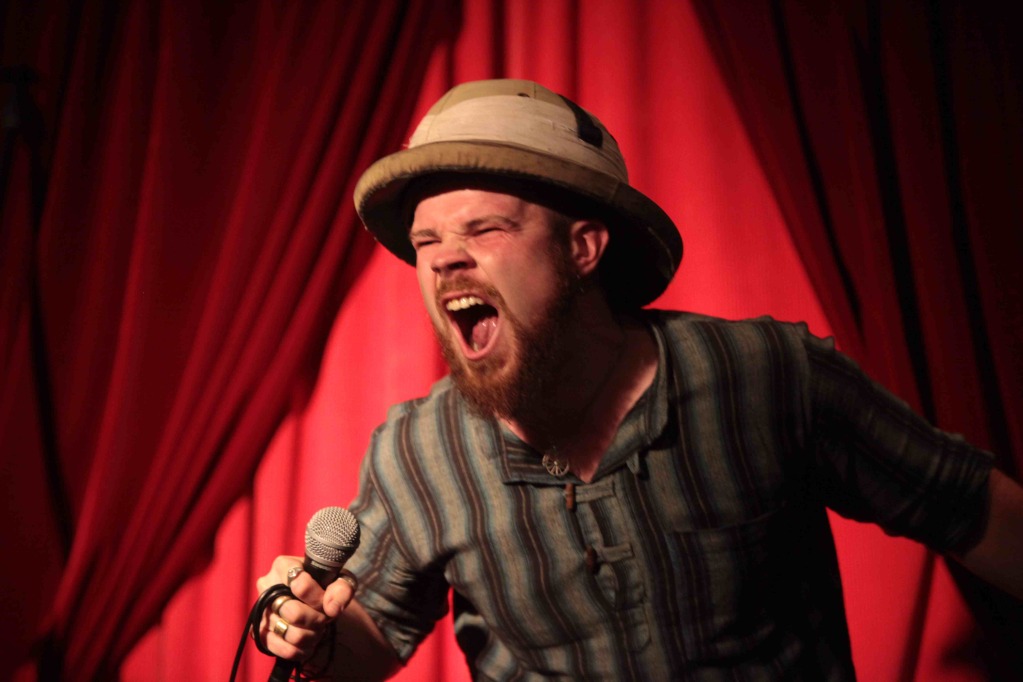
Read the whole thing below the picture of this screaming man, Randall Stephens.
– You’re a performance poet. What does that mean for you – what does it involve, and what’s the writing process like?
It means centrelink, it means getting up at 3pm for an early start to the day, shopping for new scarves, coffee in grimy cafes, complaining about the government and getting hysterical over spilt milk (well, I do actually do that occasionally –drives my housemates crazy).
But truthfully it’s weird. A lot of days I wake up nervously, expecting one of my old bosses will show to grab me by the collar and drag me back to the old work-a-day world, like the past few years doing this have all been a dream. I still have a day job – technically a night job, casual, and very undemanding (I’m doing this interview from work, as it is), so my days are usually free to allocate as I see fit.
It’s not hard like packing boxes or waiting tables. But seriously, it does involve lots of work though. Developing your work to a professional standard ~ the rehearsing and editing, the planning and co-ordinating of events with people, the tours, making the CDs, and of course promoting, this all takes lots of time.
There’s no career path to follow, no road map or responsibilities to anyone, but the flip side of that is, If I’m not booked for gigs or pushing my work forward somehow, then I’ve only got myself to blame. I think Steve Smart said this once, that the performance poet really has to do and be everything themself, unlike other types of theatre, or performing arts. You’re your own agent, publicist, writer, actor and director. No one’s paying you, patting you on the back, it’s all up to you.
Writing is still the primary thing though, and the process is write constantly, but leave things a while once written, take another look and be objective by asking basic questions: is this poem interesting or relevant to anyone (else)? Is it clear? Will it grab people’s attention with the first line/s? Does it ask or deal with questions? Does it then move along a dramatic arc? With few exceptions, that’s the process I put my work through before anyone else reads it.
Then you get feedback, for me that means the blog, and the truth is more people still see my work this way, than ever come along to my gigs. Responses to the blog help me decide what’s worth developing, what needs more work, and what’s better left un-spoken. Simply put, if there are lots of responses, I know I’m onto something.
– You write poetry which often uses comedy to make statements about society. Is this intentional, or are you just a very funny man?
I am not a funny man. Not even a little. Not really. Really a man. A little man. Or only really a man a little. Really. Man. Okay maybe I am a little. A bit. Of a man. Who’s funny.
I find things in life funny, there’s a lot that’s worth laughing about. Absurd things, observations about myself and other people. We’re a crack up, what can I say?
– How much of the performative aspect do you write into your poetry when you first put pen to page, and how much just appears during later readings?
While I’d like to think all my stuff is at least readable, primarily my poems are designed to be heard. Sometimes I might get a message from someone saying “can’t wait to hear you perform this” etc.
Starting last year, I’ve attempted to reverse this in a way, almost making the poem perform on the page, the length of a line can imply a mood, a character, the vocabulary can imply force or contentment or happiness, sarcasm, cynicism, confusion, the long breaks I leave between sections are dramatic pauses. Almost always there will be a character, a person, who is supposed to have written or dictated the words. I always want my poems to sound like they came from somewhere, they’re being said, by someone. Words just don’t somehow exist in ether, so in that sense they’re all designed for performance, if not literally by a spoken voice on a stage.
But yeah, once I do start reading it aloud things always change, what might scan well on the page is gonna put people to sleep in 9 seconds when you’re up there (seriously, that is how long a poet’s grace period is). What reads as vitriolic anger might need a more calm or muted vocal to be effective. You have to find a way to arc your performance, you can’t (or very rarely) get away with a poem that goes sad-sad-sadder, or goes from love is great to love is really great. Boring! Incidentally it’s one of the reasons why I have will continue to avoid political poetry like the plague, I just don’t see the same potential there for dramatic arcs, questions, journeys, personal discovery. For me that’s what it’s all about.
– “Being a poet in Melbourne is a pretty glorious thing.” Discuss.
Well ok, but yes and no. What Melbourne has when it comes to poetry is volume. More poets more readings, more often. I think by sheer mass, statistically we’ve produced some good poets. But around the country, and in other countries where I’ve seen poetry performed (England, India, USA and Spain) people everywhere else are doing a lot more with a lot less. Melbourne has a lot of potential opportunity here, because of those volumes. But we’re complacent, and also have a lot of shit. Shit poetry, just tired, depressing, uninvolving crap that idiots clog up the open mike with, with no real understanding –that they are subjecting people to it. I saw a convener of a new reading in Melbourne get up and stay that he kinda knew his poetry was boring, but shrugged and said he was going to read it anyway. Then he complained to me later about how know one supports him or gives him gigs.
For me, that is quintessential Melbourne poetry arrogance. As I write this, December 2010 poetry in this city is in serious decline. 5 regular readings that I knew have all shut down this year (Drunken poet, Spinning Room, Claypots, Sospesso and Ninja Slam), and frankly I think a lot of that has to do with not understanding or appreciating the gift of an audience, especially with the respecting to the venue you’re in.
Sydney, Perth and also Brisbane have great things happening, some really great and lively readings coming up, and it’s easy to observe the difference in enthusiasm and energy in those cities’ where the poetry scene is a lot more DIY, and not a line up of crusty old venues run by vain and ineffectual organisers and presenters. Oh and yeah, BAM!
– You’re going on tour in New Zealand! That’s huge! You’ve toured before; do you feel like you know what to expect from this? What on earth happens on a poetry tour?
What happens on tour? …not as much as I’d like, hehe. Steve Smart (with whom I’ve taken 7 trips with to tour this year) and I like to create a certain hedonistic mystique around our touring, and while it can potentially be pretty debauched, it’s more often really tame, If you have a lot of days between gigs, and can’t find people to hang out with (not looking at anyone, Brisbane) it can get downright boring, lonely and isolating, as any travel can be if you’re just there killing time.
Poetry touring is basically just going to another city to perform, which you can arrange through networking easily enough. Now there are lot of high profile poets in Australia who through winning slams or being invited by festivals etc, are given the opportunity to do this. Steve Smart and I on the other hand, do it all on our own, by sending emails, cornering individuals at festivals or when an interstater is in town, travelling at our own expense, finding our own accommodation.
I might look back on this one day and laugh for not knowing any better, and how hard I made it for myself. Only recently have I begin to appreciate the significance of this, when I started asking around with some of the big kids about how they poetry-toured New Zealand, how they did it/who they contacted, and the answers invariably came back “shrug, I dunno, someone arranged it all for us”. Until I discover the secret handshake, I just assumed that’s how it’s done. It was the same as when I made my CD, for better or worse, I just… went and did it.
So New Zealand… yeah big time stuff for me. I’m expecting a lot from myself on this trip, I think there’ll be many highs and lows, because this is not necessarily going to be the easiest country to find gigs in. I’ve had a whole spectrum of responses to my enquiries from loving welcome open arms to downright xenophobic rejections. My aim is win over all different types of audiences, young or old, north or south island, rural or urban. I believe that I can.
I’ve arranged gigs in the 3 major cities and a couple of towns, and made a lot of contacts through facebook etc. For the rest I will just turn up, talk to people, find out who’s who and see what I can dig up, and hope for the best.
Some Randall-Related Links:
http://www.randallstephens.blogspot.com/
http://www.youtube.com/brainthatweighsatun
http://www.wordinhand.org/home/shared-words/randall-stephens
http://www.wordplay.org.au/writers/randall-stephens/
Thanks so much to Randall for interviewing for LGWABP. He’s one of the most supportive people I’ve met in Melbourne’s poetry scene, and I appreciate how open and accepting he (and others like him) make it. Cheers!
Spring Street isn’t usually my side of town. The suits are scary. The steps at Parliament (both the landmark and the station) are so steep I want to vomit on something. The venues all have dress-codes. Despite all of this, last night I made my way down the lane way of Meyers Place to Loop Bar for the launch of the Melbourne Poetry Map: Audio Graffiti. Impossible bar to find. We stood outside for a good few minutes trying to decide if we were at the right place – there’s a severe lack of signage here. Randall Stephens’ hat was the only thing to give it away.
Turns out that more people than the venue could comfortably fit had the same idea. We piled in on top of each other, spooning strangers. It was worth it. Partly for the opportunity to spoon people I didn’t know, but mostly for the amazing words that came through the PA.
The Mebourne Poetry Map project is a tour of Melbourne landmarks, each with its own poem delivered by well-known and respected Melbourne poets. There are six podcasts and maps available to download, and each tells a different story. As you take each route, Melbourne opens up as human and alive and very very touchable. This isn’t a tourist guide – this is the beating heart of Melbourne as told by our best.
While the podcasts feature 21 poets, the MPM:AG launch last night showcased 13 of those performers. Highlights included Randall Stephens’ “What are you looking at?” and Lia Incognita’s “Typography”. While these poems are wonderful in their recorded podcast form, they really had a sparkle at last night’s performances. Randall seems to feed on audience enthusiasm, and his yelling “WHAT THE FUCK ARE YOU LOOKING AT!?” at us was electric, it grabbed attention and didn’t let it go until the end. His yells were shoved right up against quiet, lovely, intimate explanations of exactly what you are looking at.
Lia used signs to demonstrate the typography she was exploring, as a Chinese-Australian, chinese Australian, Chinese/Australian poet.
These more serious pieces were performed along with pieces that made me laugh out loud – real, blurt-laughter. Maurice McNamara talked about the terror that book sellers feel at the prospect of selling actual books to actual people. Are you sure?
The blurt-laughter-est piece of the evening was definitely Meaghan Bell’s “Union Lane References Hunter S Thompson”, in which she channels HST’s utterly terrifying technicoloured menageries into a back-alley of our own city.
The performances were strong, the podcasts are enjoyable, and I plan on downloading them and taking a walk some time soon. Check it out, get to know your city from a different angle. Props to Eleanor Jackson for producing such an original and exciting project!
 Sam van Zweden