Search

Sam van Zweden

Writer

Making Shit Real, Yo!

Today I met someone I respect quite a lot. I introduced myself, and he said “oh yes, Little Girl With a Big Pen, I read your blog.”

The name of my blog sounds surreal coming out of people’s mouths, like it’s a real thing. People out there read it. YOU! You read it!

So hey, thanks. Thanks for reading my blog, and giving me an audience, and making shit real, yo. I had a moment today where I realized that I’m doing something ace that I enjoy, and it’s getting somewhere. It’s been about a year since I started blogging, I think it’s a year in about a week’s time… Gosh.

And:
YEEEE! (RE: Recognition via blog)

10bythen

Sometimes people online have freaking awesome ideas. A while ago, Megan Burke did the Comment July Challenge. J Kaye does the 100+ Book Challenge. And now, I’ve been invited to participate in the #10bythen challenge.

The idea? Submit ten pieces by the 1st of October. It’s a big ask. A really big ask. I usually submit about 2 each month. So this will make me work incredibly hard – but I’ll give it a shot!

If you’ve got Twitter, you should join in with the #10bythen hashtag and get ten pieces out by the 1st of October!

Mistakes You’re Allowed To Make Post-Nobel Prize

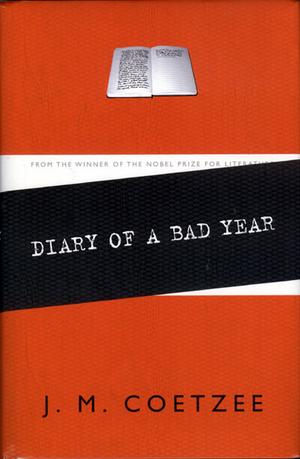
“FROM THE WINNER OF THE NOBEL PRIZE FOR LITERATURE” – there it was, in big fat caps, right across the front of the dust jacket. While I haven’t picked up many books purely for that kind of endorsement, when reading something with a grabbing announcement like that I would hope I could trust that it’s a piece of writing with some merit. At least, a little more merit than a random airport novel. I can put some faith in the fact that it will have an effect on me. Unfortunately, this faith was entirely misplaced in JM Coetzee’s “Diary of a Bad Year”.  

Published in 2007, four years after Coetzee received the Nobel Prize for Literature, “Diary of a Bad Year” is a story told through three narrative strands, which run alongside one another throughout the book. Each page, for the most part of the novel, is divided into three parts. Each part is dedicated to a different narrative voice: one is comprised of the essays of a “fictional” writer (referred to as J.C – what a coincidence! How meta!) who is writing for a German collection of essays by writers; the next voice is that of J.C himself, as told to his private diary; the last is the account told by the woman he hires to type up the manuscript of the above essays. The typist influences what the writers considers in his essays, and in his diary he reflects on his relationship with her. She talks about her relationship with her partner, who conspires against the writer.

The blurb on my copy of this book promises “three dynamic and charged voices”, and a book “about how we choose to read”. I was also promised by the jacket an “original” book. I feel cheated on all these points apart from one, and even then it loses its power by seemingly being the only point of the book.

Nabokov said that “There are three points of view from which a writer can be considered: he may be considered as a storyteller, as a teacher, and as an enchanter”. The great authors, according to Nabokov, are those who can combine all three of these things successfully.

Was I enchanted by “Diary of a Bad Year”? No. Not at all, and this was deeply disappointing. I’ve been entirely enchanted by post-modern writings by other people – Italo Calvino, Borges, Georges Perec. I don’t think post-modern writing is past its best-before date at all: Mark Z Danielewski and Dave Eggers are prime examples of well executed recent post-modernist writing. It can still be done, and done well, in new and surprising ways. They play with form and expectations, they jump into your head and fuck shit up and leave you screaming “WOAH!”.  JM Coetzee did not enchant me in this way at all.

What about a good storyteller, then? No, not that either. The three narrative voices of “Diary of a Bad Year” are very one-dimensional, very slim offerings. The essayist’s voice stands alone easily as it is from another genre.  The voice of Anya (the typist) however, mingles with J.C’s voice in such a way that it’s entirely inconsistent and unconvincing. Coetzee has tried to give Anya a distinctive voice by way of her word-play and flippancy:
“At first I was just supposed to be his segretaria, his secret aria, his scary fairy, in fact not even that, just his typist, his tipitista, his clackadackia…” (pp25-6).
While this creates a very strong voice in places, Anya’s inconsistency as a character means that she dissolves into something more like J.C’s voice, and this doesn’t seem intentional on Coetzee’s part. At the start of her account, Anya is concerned with the effect her “delicious behind”, but later considers the wider implications of the existence of an individual dimension. In the incredibly small space given to each character, Coetzee fails to tell a story that readers invest in. I didn’t care what the writer’s essays discussed, I didn’t care if the writer got it on with Anya, and I didn’t care whether Anya’s partner ripped the writer off or not. I just wasn’t affected by the story at all.

This leaves one more of Nabokov’s traits of a great writer – being a great teacher. Roland Barthes talked about the “writerly text”, which enlists collaboration between writer and reader. “Diary of a Bad Year” certainly does that – readers must work. However, Bathes talked about such texts producing what he called “jouissance” – “bliss”. The only feeling this book provided for me was frustration. As the blurb promised, it is a “book about how we choose to read”. So the point of “Diary of a Bad Year” seems to be simply to teach. As an academic, this might be expected of Coetzee. As a winner of the Nobel Prize, he now has the space to publish experimental work and actually find a market for it. I could forgive all this, if the book actually taught me something, or engaged me in some way. It did not.

I feel like the pitch for “Diary of a Bad Year” would have been enough to impart all the wisdom this book had to offer. The tricksy, clever, post-modern gimmick just isn’t enough to make the book good. It’s a good idea in terms of exploring an interesting point, but badly executed and altogether uninteresting to read, offering little to nothing in terms of storytelling and enchantment.
Teaser Tuesday

Teaser Tuesday is hosted by MizB at Should Be Reading.

  • Grab your current read.
  • Let the book fall open to a random page.
  • Share with us two (2) “teaser” sentences from that page.
  •  You also need to share the title of the book that you’re getting your “teaser” from … that way people can have some great book recommendations if they like the teaser you’ve given!

“She took a new needleful of thread, waxed it carefully, threaded her needle with a steady hand, and observed with perfect composure –
‘It is hardly likely master would laugh, I should think, miss, when he was in such danger: you must have been dreaming.’   ”

                       from Jane Eyre by Charlotte Bronte (p154, Claremont Classics edition)

It Started With a Beach Backdrop…

It’s been a big weekend. It started with a beach backdrop about 25 metres long taped to the back of a stage, and the general excitement that comes with Piranha Party – if you ever get an opportunity to see these guys, for the love of God, do it! They’ve only been around for about 6 months, but this party ska band will make your feet move without asking you and your smile will switch on. They’re heaps of fun.

This was the last night of Madonna‘s August residency at the Royal Derby Hotel in Collingwood, and what a month it’s been. I’ve seen Madonna many times, and the once-a-week offering at the Derby hasn’t disappointed. This band has an explosive energy driving their music, and total abandon to making shit work. While this week’s set was a bit short, it was packed full of pure awesome. Somehow crowds give themselves over to Madonna – foot-tapping, swaying, or all-out moshing. This gig there was even something akin to excited galloping. Madonna’s urgent effects-swirl and constant forward push pays off. While they’ve been their best in front of very responsive crowds (more so than any other band I’ve seen), even when crowds are reticent to start with Madonna blow the roof off any venue they touch. Their next gig is at the Birmingham Hotel in Fitzroy, and will be a Joe Strummer tribute night with a slew of other amazing bands – get down there, it promises to wrinkle your skin with how good it is. So good your toes might fall off. (Take spare toes.)

Saturday night was a truly fantastic gathering of RMIT Creative Writing students – we got together, someone bought cupcakes, others bought goon, we read poetry and stories out to each other, astounded as always by how great everyone’s work is.

Sunday night saw the Toff in Town pack out for Dog’s Tales, a storytelling night that usually happens each Tuesday down at Dog’s Bar in St Kilda. For the MWF it’s took up residency at the Toff for the evening, and my goodness it was lovely! I haven’t been down to the St Kilda event yet, so it was very exciting to see the set up there on the Toff stage: a wonderful “real plastic!” chair wrestled for lovingly at an MTC garage sale, and a little green lamp that I think everyone remembers from their grandparents’ study. Such an unassuming set can only mean good things, thought I.

I was right. The night had readings from both local and international artists, and a really wide variety of stories being shared, from Josephine Rowe’s ad-libbed account of her relationship with her father, to DBC Pierre’s tale of the adverse (perhaps…) effects of tequila at storytelling events, where people sprout tails and wings, and step right out of their own skin. Carmel Bird stuck out to me as an incredibly strong reader, with such an obvious love of sharing stories. I discovered Carmel many years ago, when a literature teacher slipped me a copy of Automatic Teller and I fell in love. A few years later Red Shoes confirmed my suspicion that Carmel is freaking amazing, and then it was on. I think she’s great, and absolutely loved the fact that she read as well as I imagined she would.

Kalinda Ashton read a story about a girl working in a Christmas department store hell, which provided many laughs but these were perfectly juxtaposed with some great poignant moments. Kalinda is my non-fiction lecturer at RMIT, so I’ve only ever heard her speak in a lecture setting before. Her reading is really engaging, it sucks you into the story world for the length of the piece and you forget that you’re listening. I’ll be looking out for her events in future.

This evening finished up with a story from Tiffany Murray, which absolutely knocked my socks off. It was brilliantly honest, and Tiffany made me want to quit my course and move to the UK to study under her. I wish I could tell stories half as wonderful as hers!

This bonza weekend finished by scooting around the corner from the Toff to Shanghai Dumpling House (the one with the pink walls in China Town, not the laneway one! I don’t like the laneway one. I know others do. They haven’t discovered the pink walls one yet). $27 dollar feed for two people – a great way to finish a weekend!

Poetry Just 4 U

Officially dubbing this past week “success-a-palooza”.

Today marks the start of the Melbourne Writers Festival, which runs until the 5th of September.

I’m excited to have gotten tickets for Dog’s Tales, a night run by Chris Flynn which is usually on at the Dogs Bar in St Kilda, but for the MWF will spend a night at the Toff in Town. My dazzling non-fiction teacher Kalinda Ashton will be performing, as well as one of my favourite authors Josephine Rowe, and the woman who introduced to me the idea that short stories can be truly magical, Carmel Bird. Should be an incredible night!

Apart from this, I have some exciting MWF-related news: some of my micropoetry has been accepted for the RMIT Poetry 4 U program, which can be followed on Twitter throughout the festival, as well as selected pieces running across the LED screens at Federation Square between 12pm and 2pm daily throughout the festival. I’ve seen some of the entries from last year, and there was some great work, so follow the project or head down to Fed Square one day to check it out!

The general public are also invited to participate via Twitter, just add the #poetry4u hashtag to any nanofiction or micropoetry you might want to put out there.

Have a great festival!

Being Important

Today Benjamin Solah has posted an interview he did with me about being a student writer.

Give it a squiz. Maybe you’ll decide to become a student writer too. Life is great here.

You Are Being Judged

Public transport is rife with things worth judging. Clothing, one-sided phone conversations, the extent of end-of-the-day pit stains. What you’re playing on your iPhone – whether you have an iPhone at all! Personally, I like to look at business-men’s socks and judge them by the prints –the more ridiculous the better. My favourite were black ones with cigarettes on them. With all this judging going on, you’d think that surely people would be aware that they’re being judged by their commuting books. But from what I see people reading, perhaps not.

A friend recently told me that he covers “embarrassing” books with brown paper, in order to not be judged while reading on public transport. I laughed at first, but then realised that there’s certain things I don’t read in public either. By this I don’t just mean that I prefer things that can be consumed comfortably on five-stop trips. I also mean that I refuse to be seen reading any self-help or dieting books on the tram. I won’t be caught with Twilight, or Dan Brown, or a well-thumbed copy of “Eat, Pray, Love”.

Don’t get me wrong – I read bad books. I’m a firm believer in knowing what it is that you hate, and this has meant I’ve read a lot of crap. It helps to know how not to write. Never, never in public though. I read Dan Brown at very private moments, where I could snigger and blurt offensive things, and throw the book at the wall whenever I needed to. I never risked my reputation by taking it on a train, tram or bus. Greasy hair I can do, but if someone saw me wrapped up in YA vampire stories, I’d never forgive myself.

I can delight in the more bizarre – I used to constantly see Alan Brough on the 1 or the 8, reading maths books. I respect this, because not only was I baffled by how smart he is, but also by the fact that he was able to be that smart while rocking around on a tram! Flaunting your intelligence, especially if you’re Alan Brough – winner! Flaunting your stupidity? Not so much.

People of Melbourne, THINK before shoving the latest Stephanie Meyer book in your bag. Please don’t expect me to sit next to you while you wish you could overcome adversity as successfully as the latest Jodi Piccoult heroine. Don’t think I won’t scoff if you’re busy learning exactly how they cracked the Da Vinci Code. If you’re brushing up on foreign affairs a’la “Zoo” I am judging you, and harshly. If you then try to talk to me about what I’m reading, you just can’t – it’s too late. I’m already convinced you’re utterly vapid, totally air-headed. A fool of the highest order.

Not because you’re reading Mills and Boon, but because you have so little self-respect that you did it on public transport.

Ricochet

Have you heard about Ricochet Mag?

It’s a new literary journal, which publishes emerging writers. Their first issue went live today, and it contains my poem, “The Tick-Tock Polka”. Go check it out, there’s some great work in there. And keep an eye on their blog, they post all sorts of helpful things about getting published and deadline reminders and whatnot.

Blog at WordPress.com.

Up ↑