Search

Sam van Zweden

Writer

Give Me Your Horror Stories!

My previous post earlier today led to a post on Literary Life in response.

In it, Megan shared a horror story of lending a book to a colleague who broke not one, but all of the no-no’s of Book-Lending Etiquette.

While it’s a horrible thing to have happened, I really enjoyed reading Megan’s horror story.
So I’m interested. What’s your book-lending horror story?

Book-lending Etiquette

I’m feeling nervous today. I’ve just lent out another book – I always do this with very mixed feelings. I want someone to read this book so very much that I give it to them, I say “Just get it back to me whenever you’re done”. At the same time, I know that I loved this book, and that it could all go wrong.

I once lent a book about stealing to a friend, who stole it. I once lent the stupidly expensive and very smart “House Of Leaves” to a friend who didn’t read a lot, for some reason I took him as more interested and respectful than he was. That one came back with half a cover and pages dog-eared.  I lent “A Hundred Years of Solitude” to someone I worked with, who later denied I ever gave it to him.

So now when I lend people books, I’m worried about what might happen. I only ever lend, now, to people who I trust very much. It’s been going well recently, but I haven’t been burned in a while.

What is the expected etiquette when borrowing a book?

For me, I don’t dog-ear other people’s books. I can dog-ear my own, but unless there’s a seriously clear history of dog-earring, I don’t do it to anyone else’s books.

Natural wear-and-tear is to be expected, and I can make room for that. But I make sure I put other people’s books in my bag very carefully. They don’t get put next to abrasive substances. I don’t put it anywhere that the cover will get ripped off.

Above all else, though – I make sure they get their book back. It’s a simple process – I read, I let them know that I’m reading to quiet any fears they may have about never getting their book back, and then when I’m done reading I return the book.

In the same condition it was in when it was lent to me.

Surely that’s not so hard!

So this is why I’m feeling nervous. I’ve got multiple books out in the world with multiple people – I worry for their safety. Some of them I know are entirely safe. Others, I have no idea.

Coming home and The End Point

That’s it. Semester over! This semester was big. Really big. Fourteen novels for just two of my subjects and that’s only the stuff with covers. At least two reams of paper, lots of ink, hours and hours of reading off my screen because I couldn’t afford to print any more. Twelve weeks of sacrificing the reading I actually wanted to do, to make room for things that were mostly worth reading, but not always what I wanted to do.

But that’s over now! It’s holidays! It’s lovely weather! The real reading can begin. I can cross billions of things off my “to-do” list, and work through the huge stacks of books that I’ve been buying but not had space or time to read. I can make sense of my writing desk, make some narratives happen, rather than torturous essays comparing texts which should never, ever be compared (Camus’ The Outsider and Jean Rhys’ Wide Sargasso Sea being the most recent hideousness).

So here I am, back at home in the blogosphere. I can blog whenever I like, I can dedicate that section of my brain to planning posts as I live. I can work my way through my poor, neglected Google Reader feed! Oh poor Google Reader…

Today I read a piece that really got my attention, which was re-tweeted by Angela Meyer. The article, “Where Did The Web Go?“, talks about a lot of things that got my attention.

First point of interest: A quote from Stephen Mitchelmore: “Finding a way to talk about the reading experience is, I’ve realised, the greatest pleasure of writing; where it ends is of no importance.” I love this quote. Stephen’s talking about how it doesn’t matter if your online literary efforts never really take off, because that’s not the point. The point is to find a way to talk about your “reading experience”. Reading is a strange thing in a similar way to writing – it’s a necessarily lonely activity, but there’s a definite pleasure in finding ways to share that loneliness. For me, LGWABP is a major way that I do that. I’m not sure that I always (…ever) provide insightful contributions, but I enjoy doing what I do. Stephen’s right – it is “the greatest pleasure”.

Second point of interest: “Choose what you want your site to be, and then do it” – I like this. Sometimes I feel like my blog misses the mark because I’m not sure what I’m doing with it. Successful blogs have something that is specifically theirs, whether that’s a layout, a tone, a bunch of memes, whatever. They own it.

Other than these two superficial things that caught my eye, the article itself is actually a great contribution to the discussion of the role of online media, in particular online literary criticism. Check it out.

The Literary Legacy of a Trip I Never Took

My father and stepmum recently got back from a 3-month holiday. We caught up yesterday, and they gave me some presents from around the world – they did well.

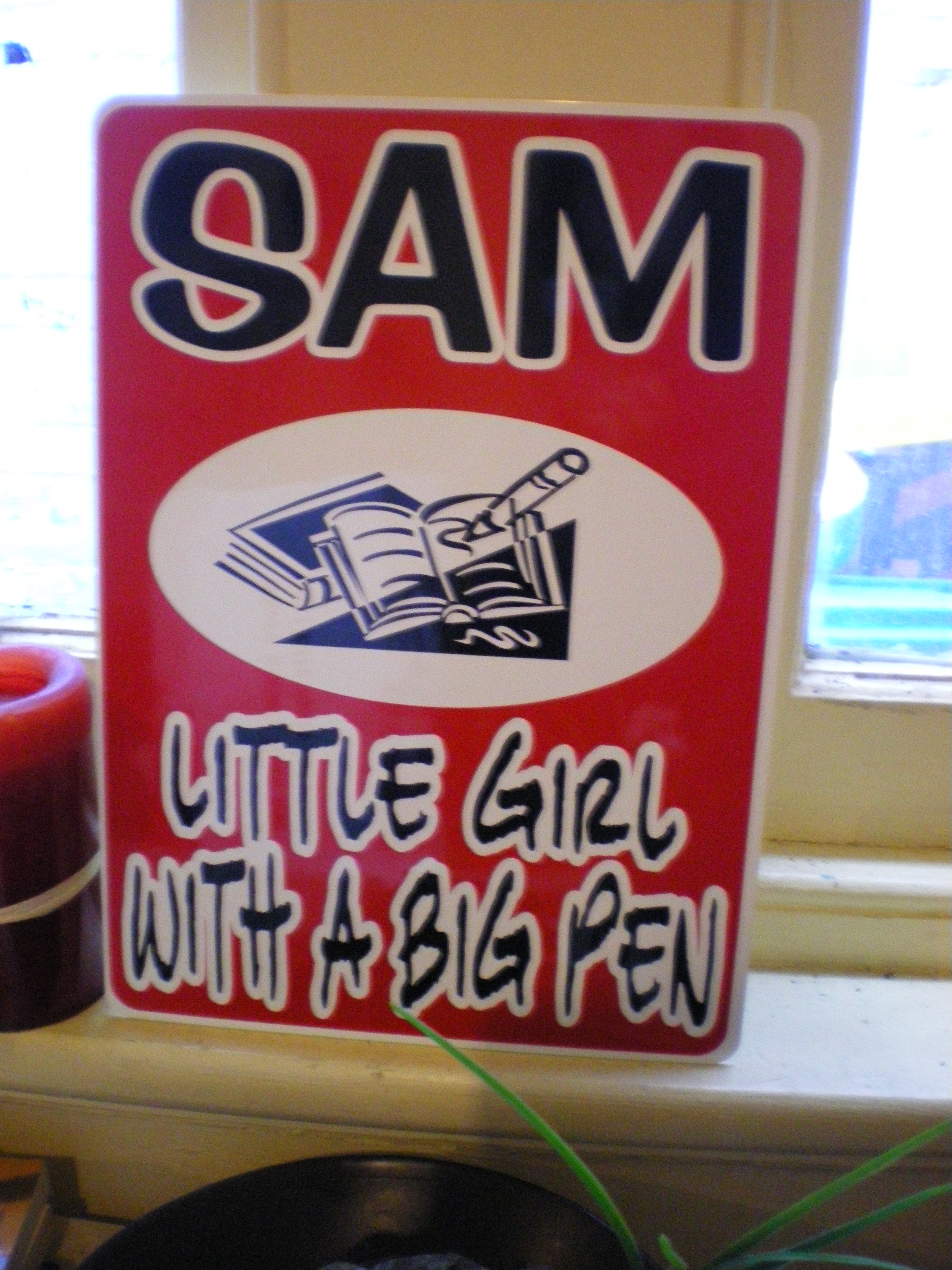
This sign now sits in my study looking endlessly cool. It marks my space as mine. This is where the genius happens!

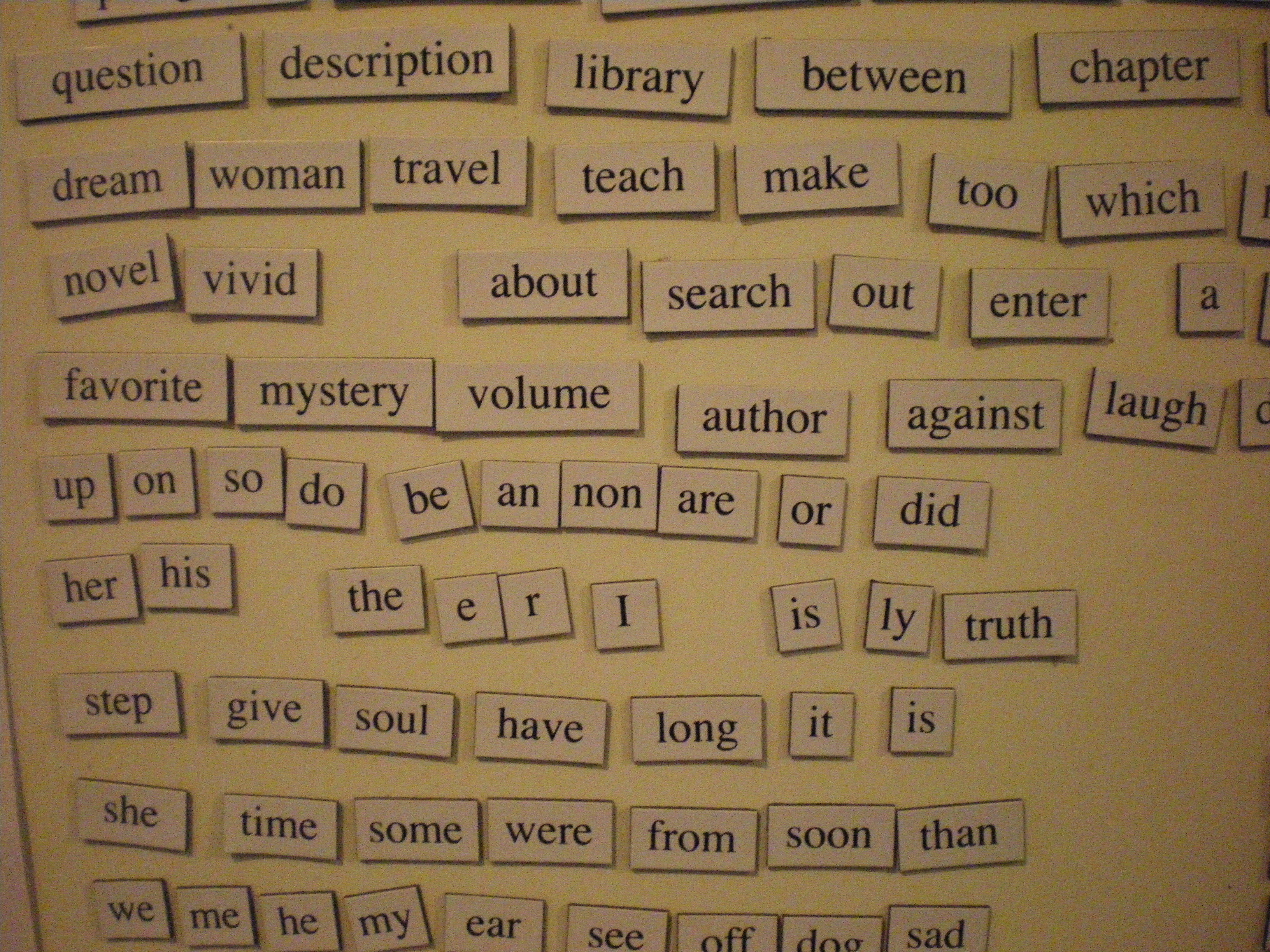
Also a fantastic gift – magnetic fridge poetry! These are those little words that stick onto your fridge, and you can arrange them as you please, making fantastic little poems with a limited set of ideas. I spent about an hour at the fridge last night messing around.

Results that are still on our fridge:

“explore the cracks
in every spine
this villain could never tell
of beautiful poetry
beneath human monsters”

“always create
inspire another wisdom through fiction”

and

“empty
above science I can wander
and begin whispering magic”

a Aren’t they great? Get yourself a set, they’re fun, and they’ve provided me with a real excuse for walking out of my study and into the kitchen when I should be writing – I’m making poetry! I want to build up a big set of these, because I know there’s other sets (this one being the ‘book lover’ one, containing words like ‘page’, ‘chapter’, ‘hero’, ‘villain’ etc), and have a huge choice of words. With a small collection, though, it’s a lot of fun to get all Oulipo and see what you can do with a limited set.

Thanks, travelling family!

Remembering

I used to do plays when I was younger. The roles I had usually only required me to remember choreography, maybe a line or two. The one play that had a larger speaking part wasn’t too bad, because it all seemed to have an internal logic which forced me to easily remember what to do, where to be, what to say.

Memorizing poetry, however, is something new to me. I was thrilled by the discovery that I perform better without a page in my hand. My hands move freely and they keep rhythm, they provide markers for the words to sit on, making it all easier to remember. I’m glad of this, as a hazard of reading poetry seems to be shoving a page in front of your face, disconnecting yourself and the audience.

How to remember in the first place though? I wrote out the piece on my computer, and read it over and over. I eventually stopped looking. Then I said it aloud to myself as I went about everyday things. In the shower. On the way to the tram. For the most part, this worked.

I put a call-out on Twitter for any tips anyone might have for memorizing. Veronica Cybluski was very helpful, providing the following ideas:
1) Find a beat or rhythm.
2) Stick a copy of the words around the house so you see it everywhere. Laminate it and put it in the shower.
3) Record yourself reading the piece, and listen back to it, possibly just before bed.

The laminating idea appeals to me. I heard once about people who record themselves reading their pieces at double-time, and learn them at that speed. That way when they’re on stage and have a brain-freeze, what feels like a big pause to regain their train of thought is actually only a slight pause.

My simple “repetition, repetition” theory worked well enough, but I’ll be trying everything mentioned above eventually to see how I can best remember my poetry for performance. Pieces really are stronger when you get rid of that page.

What’s your trick for remembering your work?

“My Thing”?

Some writers have a certain thing about them. You know what to expect of their work.

I expect my own work to be a bit unstable in this way. I’m a young writer, I’m still trying to find my voice. I’ll most likely work my way through many clichés before I find it. I’m fine with this.

I didn’t expect my work to have its own thing yet. This morning I had a strange conversation with my partner, who was talking to a friend about my work. The friend asked what kind of writing I do.

D’s reply?

“Depressing”.

Depressing? Really? Oh dear. I know he said it with respect, he’s one of my most helpful ears to test things on. He’s honest.

But I don’t want to be that! There are writers I no longer want to read because they produce the same story over and over. While I know that I’m young and producing a reliable stream of crap, I also thought my writing had a certain amount of newness. I thought I told more than one story, had more than one tone.

Depressing? Excuse me while I have an existential crisis!

Teaser Tuesday

Teaser Tuesday is hosted by MizB at Should Be Reading.

  • Grab your current read.
  • Let the book fall open to a random page.
  • Share with us two (2) “teaser” sentences from that page.
  • You also need to share the title of the book that you’re getting your “teaser” from … that way people can have some great book recommendations if they like the teaser you’ve given!


“Nothing was missing. There was nothing at all to say officially except: ‘Ah, Captain Matthews, I thought you should know that someone apparently broke into my apartment and left a Barbie doll in my freezer.’ ”
From Darkly Dreaming Dexter, by Jeff Lindsay. (p124)

Admiration/Inspiration Thursday with Steph Bowe

If you haven’t heard this name by now you must be hiding under a rock. Also, if this is your first introduction to Steph Bowe you’ll now become accutely aware of just how EVERYWHERE she is at the moment.

Steph Bowe is a sixteen year-old Melbourne novelist. Her first novel, Girl Saves Boy has just been published through Text. It was greatly anticipated, and has been met with huge amounts of enthusiasm. I was one of them – I was anticipating. I am enthusiastic.

Girl Saves Boy is a sophisticated novel about two teenagers both struggling with some huge issues. I admire Steph not only for achieving so much at such a young age, but also for being such a brave writer. She tackles big issues which many YA novels would be too superficial to touch. She even uses unusual character names, and you really need to have great characters to convincingly fill the shoes of people with names “Big Al”, “True” and “Jewel”. Steph pulls it off.

I also saw Steph speak at a panel this year at the Emerging Writers Festival, and she’s incredibly switched on. I get a lot out of reading her blog, Hey! Teenager of the year, where Steph posts a whole range of things from reviews and interviews, which she executes very well, through to inspiration posts (which is where the original idea for this one came from, so thanks Steph!) and posts reflecting on her position in the writing world. I think these posts are the ones I appreciate the most – Steph talks about how publication isn’t an end-point, and she doesn’t get too swept up in the fanfare – she’s certainly never become arrogant because of her success. Her reflective posts are something we can all think about, no matter where you are in your writing career.

I managed to have an incredibly brief chat with Steph (a number of things conspire against me at the moment, but that’s another post):

You’re a sixteen year-old novelist. Quite a celebrated one, at that – how does all that fit in with your regular life?
I do school by correspondence, which means I’ve got a whole lot more time than someone going to school for  seven hours every weekday, and I’m also pretty disciplined and self-motivated. My life now is the same as it was a year ago, except I just have more pressures and responsibilities. I perpetually feel like I’m behind the eight ball, and it’s difficult to stay on top of my various commitments – when you’ve got lots of schoolwork and writing and appearances and family stuff going on, it’s very difficult to find time to go out and relax or just do nothing – but my life is obviously still very normal (with the exception of the fact that I don’t go to school), and I’d say other teenagers feel similarly overwhelmed. Life is very busy!
 
How do you feel about the fact that there’s been so much attention to your age? Do you feel that, as a teen novelist, you’ve got a better feel for what readers your own age are looking for in a book? I certainly noticed that your book doesn’t dumb down or get superficial, like you have confidence in your readers.
I think as long as a writer likes and has respect for their audience, they’re capable of writing books for them. If you dislike teenagers, irrespective of your age, you’ll probably talk down to them in your writing. But you can be eighteen or eighty, and if you respect teenagers, you can write for them. The teenage experience hasn’t changed a whole lot over time – it’s about big emotions and feeling things for the first time and figuring out who you are. I just tried to write the sort of book me or someone like me would enjoy. I think the attention to my age can be annoying (people saying ‘oh, it’s a good book FOR A TEENAGER!’ drives me insane – you either like or dislike a book, the author or their age shouldn’t come into the equation), but I think it’s been helpful in that people, especially young people, have become interested in my age because of it.
 
Congratulations, by the way, on writing such a wonderful book! I just finished reading it, and I was really impressed by what you’ve done. You tackle some really heavy stuff in the book – mortality and guilt, blame, teenage sexuality and adolescent confusion. You’ve certainly taken on some things that are much bigger than what other YA novels seem to tackle – was this important to you?
I think that all teenagers are confronted with and think about these kinds of issues, and I think reading books are a really good way to explore experiences you might never have. And so for me, writing this was sort of 1) telling this story I had stuck in my head that wouldn’t leave me alone, and 2) really thinking about these issues and figuring out stuff for myself. I think there are quite a lot of YA books that tackle big issues, and others have lighter content, but they all express something worthwhile and can be enjoyable and/or thought-provoking for those reading them, whether they’re teens or adults.
 
And what kind of process did you go through to write this book – you’ve got some stunning detail in there that would have required a pretty intimate knowledge of issues, so did you spend some really hardcore time researching?
I’m actually not a particularly big fan of research, so I didn’t do a lot – I had to have a basic knowledge of what I was writing about so that I’d be confident having that detail, but at the same time the book is a lot more about the characters and emotional content than cancer or anorexia – I didn’t want it to be an issues book, but there are issues in it. The process started with months of the ideas growing into my head, and then once I knew what I wanted to write about, I researched a bit. And from there I wrote it, researching a bit more when I was trying to relate to the characters experiences and make them as believable as possible.

Thanks to Steph Bowe for answering my questions, go read her blog and buy her book. They’re both pretty awesome.
Voiceworks Launch!

It’s come around so quickly! Tomorrow night (23rd September), Voiceworks is launching issue #82, “Hunger”.

It’s at Bertha Brown, from 6pm. Head on down!

Featuring work from Sophie Clark, Dom Amarena, Krystin Low, Peter Dawncy, Trish Griffiths, Katherine Pollock, Eli Glasman, L. Phillip Lucas, Samuel Williams, Sam van Zweden, Amber Beilharz, Jack Madin, Anna Westbrook, Erin Lockington, Emily Dacy-Cole, Adam Carr, Jessica Seymour, Aaron Benson, Jenna Sten, Marco Antonio Ruiz, Suzannah Marshall Macbeth, Kavita Bedford, Vince Chadwick, Jessica McCausland and Tammy Law.

That’s right, that’s my name right in the middle there. So come on down, grab a copy, have a chat and a drink, and celebrate my first piece in PRINT! Real pages. With my words on them. Real pages that you can turn with your actual hands. NUTS!

Hope to see you there.

Blog at WordPress.com.

Up ↑