Search

Sam van Zweden

Writer

A Story for a Public Holiday…

It is unclear what Leo does, but Camilla suspects that the machinery has something to do with it. Leo’s property is full of machinery. Leo is an old Dutchman, all white hair and mystery. Camilla knows very little about him, only the machinery, and a taxidermy eagle in the corridor of his house, and 8 or 10 sheep he keeps on his small patch of land here in Queensland.

Camilla is 6 years old, and a diminutive 6 year old at that. Her father helps at Leo’s property, though the nature of the jobs is beyond what Camilla cares about. She likes to spend the time at Leo’s looking at the eagle (only later does she realise that its eyes are the unsettling bit), and teasing the sheep.

Today, Camilla is “herding” the sheep with her sister while their father helps Leo. They hold sticks that are as tall as they are, slapping the ground to scare the sheep into action. Camilla’s sister will later insist that they were hitting the actual sheep, but this is not how Camilla will remember it.

Amongst the sheep is a large ram called Bubby. He has a black face, and comes up to Camilla’s shoulder, she guesses, though she hasn’t gotten close enough to properly tell. He is the only male in the pen.

Hitting the ground with their sticks, the sisters send dust flying into the air. The female sheep move into a huddle in the corner of the pen, and the sisters think they are doing a great job. They could be farmers. Then Camilla sees Bubby.

Bubby stands at the far end of the pen, his eyes gleaming at her. He lets out a sinister baa. Camilla looks for her sister. She’s nowhere.

Bubby walks at first. Then he gathers speed, and when he reaches Camilla he knocks her straight down. There is dirt in Camilla’s eyes. All she sees is a black blur, and feels an immense pressure on her chest. Bubby rears on his back legs like a startled horse, coming down heavy on Camilla’s chest. The dirt, the pressure, the oily smell of wool, the dry taste of dust.

“CAMILLA!”

Camilla’s father runs into the pen. With the kind of force only an angered parent can produce, he drives a blundstoned foot into Bubby’s flank. He literally kicks the sheep off his daughter. It doesn’t send the hefty animal far, but it is off Camilla.

Later, Camilla will be somewhat casual about the memory. She will not be fond of sheep, and she will remember how it felt when her father told her to walk the few blocks home. But when she recalls the event, it will not be one of trauma, it will just be a story, like any other story, from her childhood.
Failing Better

I was introduced to this rad Samuel Beckett quote the other day, and I love it.

“Ever tried. Ever failed. No matter. Try Again. Fail again. Fail better.”

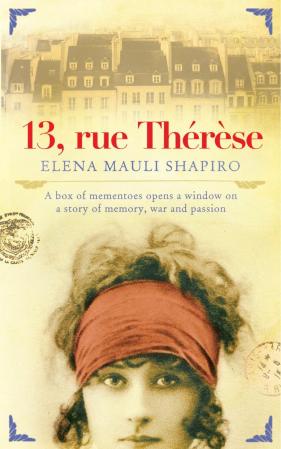
13, rue Therese Review

13, rue Therese by Elena Mauli Shapiro
Headline Review
ISBN: 9780755374229
RRP: $29.99

Sadly for Elena Mauli Shapiro, a clever gimmick alone does not make a book good. Being an absolute sucker for gimmicks – particularly visual ones – I was disappointed to find that this ambitious debut novel failed to pull me in.

As a young girl, Shapiro came upon a box of pictures, letters and keepsakes belonging to a Louise Brunet. As an adult, she has fictionalised the owner of this box, using its contents to tell a story. This idea appealed to me and turned out to be quite sweet.

Set in the first half of the twentieth century, 13, rue Therese is frame structured by Trevor Stratton, an American scholar who comes across the keepsake in his office drawer. As Stratton goes through the box, we are shown his “findings” through “documentation”. The artefacts form a visual component, along with Stratton’s recounting the owner’s story. This is a tale brimming with sex, impulsiveness, confusion, death and all in equal parts.

The images throughout are engaging, anchoring the otherwise scattered narrative. I like to see an author brave enough to play with form in her first novel; unfortunately, it doesn’t take long to realise that this is pretty much the best this book has to offer.

It’s hard to figure out whether the confusion in the text is intentional or not. Having spread the story over parallel time lines, past and present chronology often became mixed up. The book’s objective is to show that times collide and stories muddle, but I felt that much of the confusion was unnecessary – more the result of bad structural planning than sweet, mingling storylines.

Shapiro’s decision to have a man narrate what is an incredibly personal tale of a woman discovering and enjoying her sexuality in the 1920s, seems strange. At times she uses masculine language that seems incongruous with this tale of female consciousness and sexual awakening. There are many word choices which at times seem grotesque and distracting, breaking the story’s flow. Louise – through Stratton – talks about her “waning menses”, “her hysterical womb” and her anger becomes a “silent female storm”. Shapiro deserves points for pulling it off what was certainly a difficult narration, though it did suppress what could have been a much lovelier story.

Where Shapiro opts for simplicity, the prose shines. A man who wishes for a female child but has produced only boys, “his life is continuously saturated in boyness”, is a prime example, but unfortunately this isn’t enough to instil order and coherence to the messy narrative.

This debut novel from Elena Mauli Shapiro has a great visual gimmick and this may just be enough to get you to the end. Moments of great writing are there, but overall the execution is somewhat fumbled.

–> This review first appeared in Issue 2 of the RMIT flagship magazine, Catalyst. 

Miles Franklin Brouhaha

This morning the shortlist was announced for the 2011 Miles Franklin award. This award honours novels “portraying Australian life in any of its phases”. The award itself is a point of debate for the great Australian novels ignored due to its criteria – Christina Stead’s The Man Who Loved Children, despite being written by an Australian, composed of mainly autobiographical material, and maybe an Australian attitude, would be unable to contend for the prize because it was set in America – of course, this text was published before the award began, but it’s the most readily available example from my dead brain this morning. Many novels written by Australians would fit this same bill.

But this year there is talk for a different reason. The short list released this morning is very much that – short.

It is only three works long:
Bereft by Chris Womersley
That Deadman Dance by Kim Scott
When Colts Ran by Roger McDonald

For a comprehensive and updating run-down of said ‘brouhaha’ check out Angela Meyer’s post, which will also no doubt generate some decent discussion in its comment section.

The general unrest seems to be about the narrow scope of the definition of “Australian life”. As mentioned before, many great novels have been discounted from the running for this award in the past, but never before has the shortlist been as short as just 3 titles – and those three titles favour the rural male voice in a historical setting. The criteria for the award is narrow to begin with (and fair enough – it’s an important goal, to be writing about Australian life), but at what cost? This year’s shortlist might suggest that the preferred depiction of “Australian life” is narrowing still.

–> No judgement is being passed here on the texts themselves – I haven’t read any of them yet, but have heard they’re great. Speculation is on the nature of the award itself and this year’s incredibly short shortlist.

–> How great is the word “brouhaha”? Damn straight, I put it in a sentence!

LATER:

I just found this post by Jennifer Mills, which makes some interesting points in the debate, including this brilliant one:

“I think that the prevalence of such stories is a result of living in a colonising culture which still has fractures along its frontiers. Yeah, we need diversity in our voices. But we also like to scratch the itches of our culture and i don’t think writers are the sole determinants of where their cultures itch.”

Best Australian Blogs People’s Choice is OPEN!

It’s ON!

The Sydney Writers’ Centre Best Australian Blogs People’s Choice voting has opened. It started last night (unfortunately I only just got home, so I’m already 21 hours behind!), and runs until 5pm on Thursday 5th of May.

The winner of this awesome competition wins a HUGE pack of workshops and courses at the Sydney Writers Centre which can be completed online or in person. And who doesn’t need a bit of learning in their life?

So go on. Show me some love. Tell everyone you know to do the same. Your support would mean so much to me!

You can vote here.

They’ve started a #bestblogs2011 hashtag on Twitter for those of you in the twitterverse who want to keep abreast of things, and the SWC have promised to email out updates of the winners when they know. There’s STACKS of blogs on the voting page, so go check out some of the competition while you’re at it – I have, it’s fearsome!

My First Domestic Business Trip

I do a lot of market research surveys online. A lot of them ask about travel – where to, why, when, how. Generally my answers are about travelling for leisure, usually with one of my parents or a group of friends.

Today, ladies and gentlemen, my answers change! Today I embark on my first trip “for business”!

I have to do a piece of “immersion journalism” for a literary non-fiction subject at school. Originally, I was planning on getting a bike and making it my sole means of transport, bit of a project ala Sarah Wilson. Even getting my hands on a bike proved too difficult for the time frame I’ve got, and I figured if it was that difficult without having even started, perhaps the idea itself wasn’t feasible for the assignment. I will be doing it some time, when I have my own bike and time (probably over the holidays) – it’ll be interesting. But for this assignment, not ideal.

So my project changed to kitchens. In particular, the kitchen at the Commercial Wine Tavern in Rochester, which my brother runs. Both my father and my brother are/were chefs in high-end, big business kitchens – some of it I understand, some of it I live by (“What’s said in the kitchen stays in the kitchen!”), but there are definitely things I’ve never got about it. It’s a stressful job, people generally don’t stay in commercial kitchens all that long – if it’s so stressful, why come back night after night? Is it like writing is for me, where it’s generally a little shitful, but in the end I’m happy with that I’ve produced? Is it creative, or a power thing? Both? Is it the adrenaline?

This is why I’m off to Rochester today, and I can officially say that I’ve taken a weekend trip for business. I’m a little terrified that I’ll get there and discover that there’s no story. But maybe it will just be something I wasn’t expecting.

Writing What You Know

“Write what you know!”, that’s the advice. That’s how we end up with a lot of the same characters, and they’re much like ourselves or people we know. “Write what you know” is scary – why would anyone want to read about my life? Disaffected youth – unless you’re an amazing writer or have an amazing twist, surely that’s just same/same, yeah? No, what I know is boring!

Henry James (in “The Art of Fiction“) wrote that “writing what you know” can be almost anything, as long as you’re “one of the people on whom nothing is lost!”. Even so, it feels like I’m writing something pretty imagined or untrue if my experience of a thing only extends as far as having seen it from a distance. For James, this is okay. But he, too, says that writing what you know is the way to go.

For a long time I did this – I wrote the same poem over and over, I wrote characters who were my age and in my relationships. Nothing differed very much – I spent a long time producing similar work. When I broke from this, I swung the other way – writing characters very unlike me, in situations which required a lot of research. Sometimes this worked; some of this stuff I’m proud of. Some of it is also just plain rubbish.

This semester, I have to pitch and submit an extract of “My Novel” (such an optimistic thing to call this nebulous being) for a university subject. I started to plan out a novel about a character I’ve had on the back-burner for some time. He’s a structural engineer who’s obsessed with the possibility that if his buildings aren’t sound, people could die. He’s a solid character, I do like him. He’s based loosely on someone I know (so this would count in James’ definition of “what I know”), and I am interested in writing him, eventually. However, in trying to start planning a novel about this guy, I realised it didn’t ring true. I was writing yet another story I wasn’t sure about, that was trying too hard to be NEW! I realised that by avoiding “What I know” in the strictest sense, of characters like myself or my immediate family, I’ve been denying some amazing material from my own life.

My family history is mostly a mystery to me. It’s a light that shines (dimly) only as far back as my grandparents on Mum’s side, and to my father on his side. Even within that limited space, I have the makings of a novel. It’s a matter of being comfortable with the fact that it warrants writing, and it will make a good story. Deep down I know it will, but I’ve been so afraid of being the stuck, clichéd writer who can only write what they know, that I’ve avoided it and gotten stuck in the other extreme.

I’ve talked to both my parents about writing our story, or some fictionalised semblance of it, and they’re both fine with that. What comes next, I suppose, is about the ethics of writing what you know. This question, I suspect, is much harder to answer.

On a panel called “Mining The Personal” at last year’s EWF, Benjamin Law talked about how he handed everyone in his family a red pen and a copy of his manuscript before it went anywhere. I think this is the most honest approach, and one I’ll certainly be following myself. But how do I wrangle the material in the first place?

What do you think about the ethics of writing (fictional or non-fictional) personal stories?

Bowen Street Blues

I have trouble stilling my mind in order to take in what’s around me, but after a few minutes I manage to push myself back and just be in this space.

I am tucked into the stairwell of building 9, which leads onto Bowen Street and looks onto the basketball courts. Of those boys and men I have joked that they are “majoring in basketball”, but I haven’t ever watched them properly. It seems like a strange kind of suspension out there where nobody is anybody; everyone just plays ball. They aren’t black kids or white kids, or engineering students or sound engineers, or guys in branded clothing or those who aren’t. One guy falls down and another offers a hand to help him up before laughing and lunging for the ball. The basketball courts might be in RMIT, but in a way they aren’t here at all.

These courts and the basketball majors are the only constant in this part of Bowen Street, and I feel a bit connected to them when I force myself still and silent for this exercise.

Everything else moves – people on the way to classes with half-read photocopies in hand, a girl stands next to me and her pocket explodes in sound – she yells something into her phone and hands up without waiting for an answer. A parade of AV students wheel carts of expensive gear across cobbled stones.

Every third person is on their phone. all trying desperately to connect in this hurried place, ignoring those around them. Only the basketball players seem to have got it.

Some Things Are Too Good To Not Share

…like Joel McKerrow’s video which went up on Youtube on Monday. The video is of one part of a much longer poem. It is broken into sections, with each section apologising for a different “part” of Joel. In this video, he apologises for the white part of himself.

It’s a truly beautiful piece, which I first saw performed at the Centre for Poetics and Justice launch. Joel is so earnest, so honest, this confessional will bring tears to your eyes. And the video does it justice, though I’m unsure who’s responsible for the video itself. I can’t say much more about it; watch it – you’ll understand.

Blog at WordPress.com.

Up ↑