Search

Sam van Zweden

Writer

39 down… 962 to go!

It’s really, really hard not to spend all my money on books. Working in a book store means I’m now eyeing off categories I normally wouldn’t even go to, and “trying to broaden my product knowledge” is just as good an excuse as any… In two and a half weeks I’ve bought four books. It sounds pretty controlled, but if I did that all the time I would be both poor and swamped, so from now on I’m resolving to buy things only when I have saved up the cash by putting it aside from my living and debt-paying-off expenses.

One of the many books I’m stopping myself from buying is the very cool 1001 Books You Must Read Before You Die. It’s exactly what the title suggests. In a great act of genius and self-control, I looked up the list online instead of spending the $50-odd on the book that will probably sit around for a fair while.

I’ve read 39 out of the recommended 1001. I was discussing today how much more achievable the other books in the same series are. …Songs to Hear Before You Die is pretty easy, at the average three minutes per track. …Movies to See and Albums to Listen To, likewise, at about two hours, three maximum. As a pretty slow reader, it’s going to take me a lifetime to finish that list. Or, by Estelle Tang’s calculations, about a third of a lifetime. Having said that, I’ve saved the list to my computer, and I’m going to work on crossing off a bunch more of those books in future. Many of them are on my shelf waiting to be read… So I guess we’ll see if that “39” goes up any further toward the end of the year.

If you can be bothered going through the list – how many have you read?
Just Can’t Do It

Sorry, fantasy fanatics. I just can’t do it.

I try, but I don’t find fantasy enjoyable. I just finished Obernewtyn, and all I could think about was how awful and expository the prose was, and how frustrated I was about having to learn the rules of the world. I was literally in pain when I got to the end of the book. The best I could say for it was that “It’s full of imagination!”

…Which is great, and if that’s what you enjoy, that’s great. Power to you. I just can’t do it.

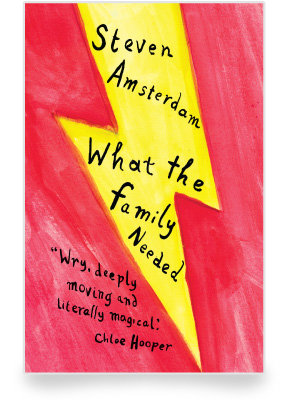
Review: What the Family Needed

What the Family Needed, by Steven Amsterdam
Sleepers Publishing, 2011
ISBN: 9781742702117
RRP: $24.95

I loved Steven Amsterdam’s incredibly popular novel, Things We Didn’t See Coming. I think what I enjoyed most about it was Amsterdam’s knack for putting characters in situations that a reader must find foreign, and thus exciting and engaging, while still keeping his finger on the pulse of reality. Even though we can only guess at what it would be like living in a post-Apocalyptic world, we know what it is to be human, and Amsterdam writes that so well that we accept the Apocalypse as the premise.

His latest offering, What the Family Needed, likewise takes some really average human beings and puts them in extraordinary situations, forcing the reader to seriously ponder, What would that be like?

The story follows one particular family over many years, starting when the children are under ten years old, through to when they’re about fifty. This family goes through the regular traumas that all families do: births, deaths, marriages, and all the rest. The thing about this family is that they all develop super-powers. One can fly, one has amazing strength, one can match-make like Cupid. Despite all their amazing abilities, these super-powered people still have problems.

While this kind of premise would usually turn me off a book, I had no idea that was even what I was getting myself into when I picked this one up. I was going by my love of Things We Didn’t See Coming. And I’m glad I went with it, because Steven Amsterdam breathes life into this well-worn idea. What would you do if you had super-powers?

What Amsterdam does is exactly what he did in his previous novel – he keeps firmly in touch with reality, despite a wacky premise, and the true humanity in this book is what made it such an enjoyable read.

At times the moment when characters realise they have powers seems a little thin – but I’m not entirely sure what I would want for these moments to seem more credible. I’ve never developed the ability to fly, so I have no idea what that would be like. The more important bits are where characters exercise their powers and try to improve their lives with them. What matters is the exploration of how human we’d still be, even if we could do anything we wanted.

So Delightful

This clip’s been doing the rounds on book blogs, so chances are you’ve already seen it, but it’s so delightful that I thought I’d share it too.

Pretty sure this is what happens at work when I’m not around.

Procrastination

A friend, Mark Welker, created this fantastic video, titled “A Novel Day”. I can relate. Huge kudos to Mark for making something so spot-on.

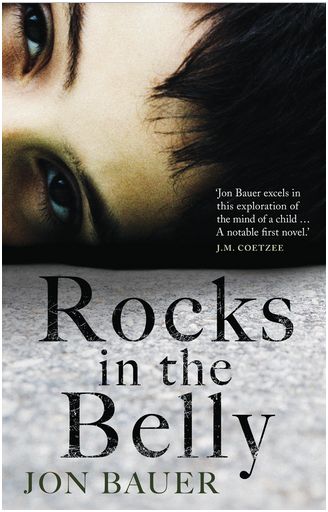
Review: Rocks In The Belly

Rocks in the Belly, by Jon Bauer
Scribe, 2010
ISBN: 9781921844539
RRP:  $24.95

I’m a slow reader, but I ripped through Rocks in the Belly. It’s the kind of book you think about even when you’re not reading it. This novel is impressive in so many ways.

The story is about a child whose mother fosters boys. She bonds with one boy in particular, pushing her biological child  to the point where he can’t deal with the prospect of having his mother love a foster child more than himself, and he acts out. The novel explores the moral and emotional aspects of that situation, and the fall out of the 8 year-old boy’s actions.

The structure of the novel is unique – it’s told in two different voices. That’s not particularly new – authors have been playing with multiple points of view for yonks. What I found interesting, though, was that the two voices are of the same character. We hear of the childhood trauma in present tense from the focalization of the eight year-old boy, while alternating chapters are from that same boy as a twenty-eight year-old returning to his childhood home to care for his terminally ill mother. While I’ve read plenty of books that use different voices, I’ve never read any books that use two different voices from the same person at different stages in their life. Bauer has executed it really skillfully, tying these two voices together convincingly through distinctive sentence structures, in-jokes and personal tics.

There’s a lot of grey area in this book, and not in a purposely vague way. The main character (who remains nameless throughout the whole novel – mechanically, surely, pretty impressive) has this huge internal conflict, constantly trying to redeem himself from being a “bad” person. All characters in this novel engage in some pretty morally ambiguous actions, and one of the main themes of the book seems to be to examine that question – what do you have to do to be a “bad” person, and then what does it take to undo that? Indeed, can any of your actions make you a “bad” person, or are we all a little bit bad anyway?

The language Bauer uses is truly beautiful. At no point did I check out and skip over chunks of description (as we all do when we don’t care) – I didn’t want to miss a thing. The language is so gripping, and so fresh, that I was hooked from the prologue, where we are offered the haunting insight that the main character’s childhood haunts him “in much the same way my fists haunt my hands”. This kind of rich language is laced right throughout the novel, and it never upstages the action. The two are perfectly balanced, so that unless you’re reading like a writer who’s consciously looking for these things, you don’t even notice what’s happening other than the book being is really great.

It’s not often that I give anything 5-stars on my Goodreads account, but this got it. It’s been a long time since I’ve found myself this emotionally invested in a piece of fiction, while also being really switched on to the language and its masterful execution. Jon Bauer’s Rocks In the Belly is a new favourite.

Aiming for Total Immersion

I’m studying writing, I spend my spare time reading and writing, I write a blog about literature and reading… and now I work in a book shop, too.

On Tuesday I went in for an interview, and by Tuesday afternoon I was hired. I’ve only worked two days, but already I’m hooked. I get to talk to customers about what they might like to read. I get to spend time learning about books and authors and writing – and that’s a legitimate thing to do in my spare time. And even the busy-work of this job is sickly fun for me – shelving books. I love categorizing books! And so I think I’ve found a job I’m happy in.

And I’ve found another way to immerse myself more totally in the world of reading, writing and books.

Teaser Tuesday

It’s been a while between drinks for Teaser Tuesdays. Let’s try again.

Teaser Tuesday is hosted by MizB at Should Be Reading.

  • Grab your current read.
  • Let the book fall open to a random page.
  • Share with us two (2) “teaser” sentences from that page.
  • You also need to share the title of the book that you’re getting your “teaser” from … that way people can have some great book recommendations if they like the teaser you’ve given!


“It doesn’t matter where you go, or what you do with your feelings, your truth lies in wait. My childhood haunting me in much the same way my fists haunt my hands.”

from Rocks in the Belly, by Jon Bauer (p1).

Reading As A Priority

In his essay, Why Literature, Mario Vargas Llosa talks about how it’s a bit disgusting that reading is regarded as an indulgent pass-time. Literature is important, says Llosa, not just as a means of escape or relaxation (though these are still some of the many great functions of reading), but as a tool which promotes an engaged and lively society. And for writers, reading is especially important – how can we expect to be great writers if we aren’t also great readers?

As at the start of every year, there’s been a lot of goal-setting happening over the last few days. My online writing group has seen everyone’s goals updated, and one person’s goals in particular really interested me. It involved adding more structure to their writing day – something I’m always trying to do. I was inspired by the fact that a full writing day for them involved three hours of reading and four hours of writing on any given day. This struck me as similar to the “Writer’s Diet” (which I saw attributed to John Birmingham, but now can’t find anywhere) – this involved four hours’ reading and four hours’ writing daily. Ambitious, yes, but a totally worthy goal. I’m not saying that to be a good writer you need to read for x hours, and write for x hours, or you’re falling short. I’m just saying that for me, and for a lot of people I know, these kind of goals usually result in tangible improvements in our work.

So part of my writing goal this year is to make reading a priority again. Toward the end of 2012 it became something I did in spare time, on public transport or lunch breaks, or to unwind before bed. While all these things are still optional and will probably still be good reading time for me, I’m making reading an important part of my writing day.

Having read about 60 pages this morning in two hours (slow reader, yes), 100+ Books seems more achievable than ever, my “to be read” pile is cowering in terror, and I will be the most informed writer I can possibly be. Without understanding writing from both perspectives (reader and writer), I can hardly expect to get any better.

Blog at WordPress.com.

Up ↑