Search

Sam van Zweden

Writer

The Accidental Discoveries

picture property of MWFSome of the best discoveries in life are the accidental ones. Cf:

1) My reading chair. It’s being delivered on Wednesday, and I happened upon it completely by accident. We were on the way home from the furniture stores we had intended to go to, and we saw this place and pulled in. Luckily, because it’s the most comfortable thing I’ve ever sat on.

2) Peanut butter sticks lunch wraps closed beautifully. Practical and delicious.

3) Many unheard-of support bands over the years. Come for the headline, decide to rock up early for a drink and the support and discover someone brilliant. Oops…yay!

4) Creative Non-Fiction. Before studying at RMIT, I didn’t know this existed. I’d written things in this style before, but I didn’t know it. The brilliant David Carlin got me really excited about it, and helped me start writing it in a focused, intentional way. And ever since, I have kept leaning further and further toward it.

In one of Sunday’s sessions at the Melbourne Writers Festival, I was lucky enough to see David Grann. I didn’t know I was lucky enough to start with – I saw a New Yorker session while I had spare time, and managed to squeeze in. I’d never heard of David Grann, not being a regular New Yorker reader.

David Grann’s one of those super-lucky people called “Staff Writers” who are funded by magazines with money (rare enough in itself) to write long form non-fiction. They’re paid to really research things, by travelling and interviewing and really immersing themselves in what they’re writing. I’m endlessly jealous of these people – I want to be them. David Foster Wallace was paid to go on cruise ships and to lobster festivals. I want that job. Then again, a MWF pass is a kind of similar idea, is it not? It’s a good start, at least.

The MWF panel looked at the idea that obsessions are really good for literary non-fiction (excuse the shifting genre name, it’s got so many!), and that magazines like The New Yorker are willing to indulge the obsessions of writers who prove themselves. David Grann proved himself, and was allowed to go bashing about in the Amazon to research some obscure explorer that nobody had ever heard of. Again –  I want that job.

What I liked most about Grann’s session was that he mentioned that he hadn’t always meant to be a non-fiction writer. In face, he tried really hard for a while to be a fiction writer, but when he came across creative non-fiction (employing literary techniques to tell true stories), it just made so much sense. “It solved many of my problems as a fiction writer,” he said. By bringing together fiction techniques and true material, Grann found his niche.

I’ve been feeling this way. For such a long time I fought the idea of primarily writing non-fiction. The creativity of being a fiction writer seemed to be absent from journalism and the like – but it doesn’t have to be. The accidental discovery of creative non-fiction has been one of the happiest accidental discoveries of my life. And it’s encouraging to know that a well-respected New Yorker staff writer like David Grann went through the same thing to get to where he now is.
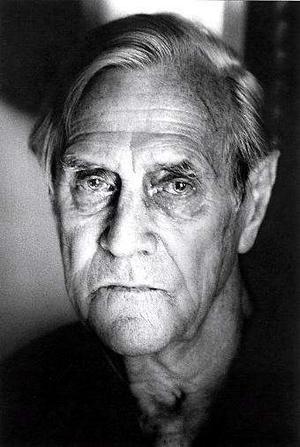
On Patrick White’s Face

Badge from MWF websiteThe launch of the Melbourne Writers Festival should have involved Simon Callow, and Dickens, and the Age Book of The Year, but for me it was all about Vicks steam inhalations, antibiotics, my couch and Gourmet Farmer. On Friday the story was much the same, and so my MWF didn’t get started until yesterday morning. Bright and early, I battled my flu-brain and made it in time for David Marr’s lecture about Patrick White’s face.

The specificity of this lecture is what got me there. I only have a fleeting knowledge of David Marr (now someone I’ll be trying to see again), and have never read any Patrick White (oh, put down your pitchforks!), but I found the idea of the lecture intriguing. Can a face hold a person’s story? What can we tell from a picture?

“Reading” visual material is something I’m deeply interested in. My partner is a photographer, and I am working on a memoir which draws on old photographs as a means of creating and understanding stories. In attempting to read old photos of myself, of my family; trying to read photos I don’t recall being taken, this process has made me really consider what it means to read a photograph. Going into Marr’s lecture I wondered – can a person’s story be written on their face in a way that can be directly read? Is it just about having the keys to unlock its secrets?

Marr looked at photography and paintings of White throughout his life in chronological order, starting with a picture of “Paddy White”, very young, and very endearingly dressed as the Mad Hatter. Moving forward through White’s life, Marr spoke about White’s obsession with having himself visually documented. White wanted to demystify his face, to make sense out of it. He wanted to see what it held, and to see what meaning creative people (artists, painters, photographers) could draw from it. Even to Patrick White, his face was a mystery.

Some stories show themselves clearly on White’s face. Certainly, stress could be seen around war-time. It can be seen when White was affected by medications, and when his teeth were pulled for dentures. What is less readable is the stuff that makes White’s story truly interesting and worth hearing – the stories around the photographs. This is where Marr’s expert knowledge comes into play. Marr knows that the reason White looks so outrageously pissed off in one picture is because he found the photographer attractive. That he disliked another for being “too German” (particularly his hands, apparently). That copies of many White portraits were seemingly cursed, being punched, chopped up, stolen, lost, or otherwise removed. So maybe photos can’t just be read. Perhaps the whole process is far too dependent on the kind of knowledge that experts like David Marr have about the subject of the photographs.

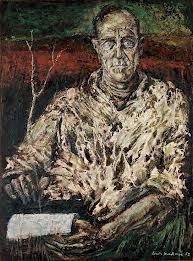
Marr spoke of White’s “London Face”, the mask of pretension that White would use in photographs – in White’s most enjoyable portraits (and those that White felt most accurately showed his inner being), that “London Face” is nowhere to be seen, and we are confronted mostly by White’s incredible eyes. Eyes that Louis Kahan (whose portrait of White won the Archibald Prize in 1963 – pictured left) called “the eyes of a seer”. Sure, all great writers seem to really see, but White’s eyes seem to almost speak back, telling some of the stories they hold.

One idea that interests me in reading a photograph is Roland Barthes’ idea of ‘punctum’: that thing that could be inconsequential, but which snags the eye and keeps drawing you back. That exists in White’s portraits – it’s often his eyes, but it also often manages to be another part of his face. And perhaps this is the key to artists’ life-long love affair with White’s face, and White’s own continual pursuit of finding the meaning in this thing that faced him in the mirror every day.


At 4pm today (Sunday, 26th August), a session called “Remembering Patrick White” will continue this discussion of the life behind this face. David Marr is part of the panel, and he’s a brilliant speaker. 

Big Decisions – Picks from the MWF Program

Some festivals are easy to plan – there’s often only one thing you want to see at any given time, sometimes there’s even gaps in your timetable. But the Melbourne Writers Festival makes planning hard. There are things I want to do from morning to night. There are things I want to sell my belongings to attend. There are things I want to kidnap participants of in order to create a free seat because tickets have sold out (looking at you, Lee Gutkind workshop!).

It’s taken me a long time of staring at the program, writing notes and planning before I’ve been able to come up with a longlist of events I’d like to attend. And this program’s some kind of hidden-gem receptacle; I keep missing things and discovering more later. Admittedly, the MWF website is a little hard to navigate. They seem to have tried to cover every possible browsing style, and have ended up with something not super user-friendly. In order to plan your weeks at the Melbourne Writers’ Festival, your best bet is to browse events by date, with pen and paper at the ready.

For this post, I’m only going to cover the first week of the Melbourne Writers Festival: the program is just too huge, and what I’m interested in just too numerous for me to cover it all adequately.

The festival kicks off this Thursday night with Simon Callow’s keynote address at the Melbourne Town Hall. This starts at 7pm, and tickets are still available. I love opening nights for the way they really get people excited about the festival to come. Come along, soak up the vibe. Whet your appetite.

I don’t want to talk about Friday the 24th. I have to work, and my heart breaks a little when I look at the program and see what I can’t attend, so let’s not even have that conversation.

At 10am on Saturday the 25th, the Morning Read series begins – this series of events is really cool. Angela Meyer kicks off the day with writers reading and talking about their work. Just to get you curious before the day begins…

At the same time, (TIMETABLING GODS, WHY DO YOU MOCK ME?!) Alison Croggon and David Marr are doing an “illustrated lecture” about Patrick White’s face, and I want to attend precisely because I don’t get it. It sounds like a fantastic story-telling exercise – can all our faces tell our entire story? Looking at White’s face here (pictured), it certainly is expressive. Is his face being read from one picture? Professional photographs, happy snaps, or a combination? How many different mediums? My curiosity is in overdrive on this one.

If neither of these events is to your taste, perhaps you could drop in to hear the lovely Francesca Rendle-Short, Paddy O’Reilly and others covering just about everything about “the writer’s journey”.

Some events are accidentally awesome, as I suspect “A Particular Eye” might be. Penny Modra (hosting this event) spoke at the Emerging Writers’ Festival as part of one of the Industry Insider events – she was so utterly endearing that I’m now going to make an effort to go to her events. She’ll be talking to illustrator Badaude, about using overheard snippets and borrowed characters in her work. I don’t know Badaude’s work yet, but Penny Modra’s got me there, so I’ll be looking into it before the event.

I do love to hear about why and what writers read, so “Why I Read” is another must.

The New Yorker series has been a big talking point of this festival, and one event I’d love to get to is the “Critic As Artist” one. Blogging and reviewing are strange beasts, as they’re seen as “on-the-side” type of work. Similarly, critics seem to be viewed as lower on the ladder than writers and creators of the primary works. I’m a firm believer that the best critics are the ones you’ll read even without an entry point to the work they’re analyzing, so hopefully this event will give some food for thought.

Particularly relevant to my WIP, and for anyone writing non-fiction, is the event (at the same time as above, again) “Friendly Fire”, which brings Marieke Hardy, Benjamin Law and Sloane Crosley together to talk about using material from their own life as writing fodder.

On Saturday night I have a family function to attend, but in my absence you should all head along to the launch of The Big Issue‘s fiction edition. I know the good people at The Big Issue have been working really hard on this, and am super proud of my schoolmate and friend Rafael S.W for getting his work in there among so many other amazing names. And yay, Big Issue, for representing emerging writers so proudly!

Also on Saturday night is Liner Notes, where writers will be interpreting David Bowie’s Ziggy StardustDoesn’t get much better than that.

On Sunday morning, I’ll be running my first 5km for charity. But I’ll be at the festival (exhausted and glowing) afterwards. Someone needs to go see David Carlin talking to Robin Hemley for me, as I think I’ll be a bit late. Events I’ll be getting to on Sunday the 26th:

Verandah 27 is launching in the Yarra Room at 11.30. Go, get some amaze-works!

Drusilla Modjeska and Andrea Goldsmith pair up to talk about Modjeska’s latest work, The Mountain. It will be interesting to hear from someone who’s moved between fiction and non-fiction the way that she has.

To be absolutely honest, the rest of Sunday will be taken at my leisure. I plan to wander in and out of sessions as my energy allows, before coming home for a nap and then back into Richmond to see Pennywise. What a day!

Most weekday sessions are part of the school program – if you’re a teacher or student, go check out the program. There’s a heap of amazing stuff, including workshops with Alice PungMorris Gleitzman talking about his change-of-pace books about the holocaust (the latest of which, After has just been released), and Melina Marchetta introducing a screening of the brilliant film adaptation of Looking for Alibrandi, and talking about the process of adaptation.

This is it for the first week for me. I’ll bring you my picks from the other half of the program next week. If you see me at the festival (small girl, large pen), come say hi!

Exciting News!

Often in this writing caper I’ve been overwhelmed by just how generous more experienced writers are. I was first introduced to this incredible generosity through Lisa Dempster, in her role at the Emerging Writers’ Festival. Lisa’s been kind enough to extend countless opportunities my way, and she’s always had a lot of faith in my capabilities – often more faith than I have in myself.

Just now (I’m a bit slow on the up-take, moving house means 2 weeks internet-less!) I’ve seen the amazing news on Bookseller and Publisher, that Lisa has nabbed the spot of Festival Director for the Melbourne Writers Festival! Even better, it’s a 3-year position. This is the same amount of time as Lisa reigned over the Emerging Writers’ Festival, and in that role she really went from strength to strength, building on what was already in the festival as well as introducing a lot of new, exciting ideas about what a festival can be and do. Lisa will take over from the current MWF director Steve Grimwade.

So congratulations, Lisa. I can’t think of anyone who deserves this position more, and really look forward to seeing you shine in this role.

Penguin Specials Launch

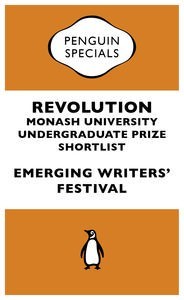
Last night I was lucky enough to ride on the coat-tails of my more successful friends (congratulations again, Jo Day, Veronica Sullivan and Tully Hansen!) into the launch of the latest Penguin Specials range of ebooks. The launch was for a whole bunch of new shorts available in digital form. The good people at Penguin have included the shortlisted and winner of the Monash Prize as part of the Specials range, and it’s available on Amazon, Kobo, iTunes, etc etc – all the platforms. Of course, you’d expect a company the size of Penguin to be inclusive of all the relevant platforms when they publish digitally. Less expected is the fact that they’ve given this awesome opportunity to emerging writers – nice work, Penguin!

I’m starting to get used to the faces at the writing events I go to, but when I left the Moat last night I was feeling a little star-struck and small fry. The launch included readings from Sonya Hartnett (tiny! Who knew?!), Robert Drewe, and Tully Hansen. With some familiar faces, many I hadn’t met yet (like… famous people), and the sampler of the publications doing the rounds on iPads, it was a really fun night. Free wine helped. It’s also really nice to know that being published digitally doesn’t mean the publishing company won’t splash out and celebrate your awesome achievement. The writers included in this series of Penguin Specials have a lot to be proud of.

Penguin seem to have their heads screwed on about what the strengths of ebooks are with their new and upcoming releases. There’s a new imprint coming for romance books, which is a smart move – there’s a huge market there, because it allows all the things ebooks do well anyway (cheap, portable collection), but also opens up the possibility for people to read romance/erotica in public, or to read around family and friends without having reading choices scrutinized. Also, the readers I know who are into romance are pretty voracious about it, and finish one book needing to slip straight into the next one. Ebooks make this a little easier than a trip to the book store. I’m not super-excited for myself about the romance imprint, but I certainly think that Penguin are onto where the money’s at, rather than just making their entire catalogue available and hoping for the best. (Though… I think perhaps for the most part they do this anyway?)

What’s relevant for me as a writer, and for all writers of short stories, is that short stories are now being published in single volumes, per story. Portability is a great strength of eReaders, and to make short stories available for this platform plays to this strength. A short story is a great way to spend time on public transport, and unlike a novel, you can possibly finish it in one sitting. For a long time people have been mourning the lack of publishing opportunities for short stories outside of journals – collections just don’t sell the way that novels do. Hopefully this (and, of course, things like Smashwords, where many authors publish single stories) are a way for short story writers to regain those opportunities.

The Specials are available now, and for a short time the sampler (including Tully’s amazing work, and extracts from others) is available for free.

A Month of Reading

It’s been a big month, though not so much for reading.

I’ve started my final semester of uni (completing my Bachelor of Arts – Creative Writing), and gotten my teeth sunk into my major project, which is a memoir. I’ve been contacted by the wonderful people at Giramondo, who very kindly sent me a book to review. And I’ve been accepted as an Emerging Blogger for the Melbourne Writers’ Festival, later in August.

So the reading has been a bit slower than usual. Also, all my books are all packed up in green bags, in preparation for moving house on Saturday. Tip to book-lovers: green bags are perfect to move books. They’re strong, they’re re-usable (unlike boxes, which you spend months trying to get rid of afterwards) and they fit most paperback books two-across.

The two books I did read this month were fantastic.

Ruth Fields’ Run, Fat B!tch, Run is a no-nonsense guide for people who want to start running, which is what I’ve recently done. Fields’ secret weapon is The Grit Doctor, who (with a heavy pinch of salt, this isn’t a sexist or self-hating book!) whips your arse until you’re hot. This guide is great for those who need a bit of extra motivation, and it’s genuinely hilarious. I laughed all the way through it, and when I finished, I got up and went for a run.

Charlotte Wood’s Love and Hunger blew me away. As a writer, and someone who has a really strong connection with food (both my brother and father are chefs), this book really moved me. Love and Hunger is a strange memoir/recipe book – Wood tells stories about food, about what food does and can do. She tells stories about food’s potential to heal and strengthen relationships, food’s emotional meaning and its connection to our self-identity. At the end of each chapter, Wood shares recipes that are relevant to that chapter. Strangely, the pairing of these stories and recipes made me far more hungry and motivated to cook than any photo-heavy gastro-porn that’s available at the moment. There are no pictures in this book, just the stories and Wood’s ability to write a recipe well work better than any fancy photography ever could. Food is not just sustenance, and in this beautiful book, Charlotte Wood well and truly teases out all this idea has to offer.

What did you read this month?

Books Bought:
A Hologram for the King, by Dave Eggers
Wildwood, by Colin Meloy and Carson Ellis
Land of Stories: The Wishing Spell, by Chris Colfer

Reading Copies:
My Hundred Lovers, by Susan Johnson
The Memory of Salt, by Alice Melike Ulgezer (thanks, Giramondo!)

Gifted:
Whores for Gloria, by William T Volmann

Books Read:
Run, Fat B!tch, Run, by Ruth Field
Love and Hunger, by Charlotte Wood

Currently Reading:
Our Father Who Wasn’t There, by David Carlin

Emerging Blogger, Coming Through!

An exciting announcement! I’ve been accepted as one of the Emerging Bloggers for the Melbourne Writers’ Festival (in partnership with Emerging Writers’ Festival). Myself and four other bloggers have been granted the amazing opportunity to go along to the Festival and soak up all the writerly and readerly vibes, and blog about it all. So fear not, I’ll be taking you with me all the way!

Below is the piece I submitted to apply for this opportunity. I hope you enjoy it, and I’m looking foward to sharing the Festival with you here. Keep an eye out before the festival for my picks, and if you’re a Festival attendee and you need a date, hit me up. We can hang.

Only Connect: 

Think about the last really good book you read. Really good books grab hold of something inside us and don’t let go. The best books are the ones that are close to impossible to articulate in terms of why they are so great.

Give it a go – in that last great book you read, what about it stuck with you? Was it the author’s use of rhythm, alliteration or pastiche? If you’re a really critical reader, perhaps you do take note of the author’s knack with minimalism, or their broad use of literary allusion. But you remember these things because they provoke some sort of feeling inside you.

While we may live in a post-modern world, where the author is dead and reading any cultural artefact becomes a individualist free-for-all, good books don’t exist in a vaccuum. Good books come about through that invisible bond between the reader and the writer. By spinning this story and sending it out into the world, the author has followed EM Forster’s mandate to “only connect!”. There is a lot of wisdom in the idea that a reader’s experience impacts the meaning that they draw from a text, but that text doesn’t come from nowhere.

I’ve just finished reading Charlotte Wood’s Love and Hunger. The book is a foodie memoir, made up partly of Wood’s memories of foods and the stories that go with certain foods for her, and partly of recipes that go with the stories she tells. Upon finishing this book, I needed to sit in silence for a while, having had something inside me moved. I needed to be still and interrogate my emotions to figure out what about this book had so grabbed hold of me. I realized that the reason I was so affected by Love and Hunger was because of my own closeness to food, with two chefs in my immediate family. The bond that Wood makes clear between food and stories is something I relate to entirely. In reading this memoir, I felt a connection with the author, despite never meeting, never talking, never interacting beyond the pages of her book.

Finding a good book involves handing yourself over entirely to what you’re reading, trusting the author’s attempt to connect with their readers, and doing your part as a reader by interrogating your emotions. Turn inward and look inside yourself for the answer; the connection.

Getting My Femme On

Today there’s an interview with me up on Lip Magazine, talking about Feminism and how it doesn’t have to be angry. 

I was a bit shocked when Ruby asked me to be part of the column (“Feminist of the Week”), but when she explained that the aim of the interviews are to show that feminists are really just normal women and breaking stereotypes, I was happy that she’d asked me to participate. Reading the other Feminist of the Week interviews, they’re all really strong women. And if I can be seen as anything, I’d love it to be a strong woman.

Side Effects of Being A Writer

There are many side-effects of being a writer, but I’m talking specifically about one: imagination. This works in two ways, one good and one bad.

Catastrophizing:
I tend to catastrophize. My imagination gets away from me, and I fill to the brim with anxiety about anything and everything. Going to a party: people will think I’m awful, I will say terrible things, I will make bad impressions and get into trouble! I’ll look like an idiot! I’ll never have any friends, ever, because I couldn’t talk to anyone at this one party, and then I’ll die alone with cats and cross-stitch (<– these things are cool seperately. Together, risky.)  My imagination gets carried away, and I picture the worst possible outcome to all situations, and assume that this will happen to me.*

Daydreams:
Daydreams are far more fun and happy than catastrophizing. Yesterday D and I got accepted for a house we applied for. We’ve been at our current place for three and a half years, and it’s gotten to the point that I actively really dislike the property. It’s cold, it’s damp, the kitchen’s downstairs and the loungeroom upstairs, it takes a week to dry our washing, it’s mouldy, I’m scared my books and D’s camera gear will get eaten up by mildew, or that we won’t get our bond back just because the place is old (see? Catastrophizing!).

Anyway, the new place is a dream. Maybe this is just a result of comparing it to our current place, but I’ve been daydreaming wonderful things about it. In these daydreams, I’m a domestic goddess, all because I have an entryway complete with coat pegs and shoe-rack, benches and loads of cupboards in the kitchen, and a separate laundry where I can iron and dry washing (currently happening in the study and bedroom, respectively). The study has a door! And cupboards! And there’s space everywhere, and I will put books in all of that space. Last night I actually dreamed about where the couch will go. We’re not into the new place until the start of August, but my daydreaming will get me through until then.

So while my imagination helps me write pretty stories and be all creative and rad, it also affects my personality and non-writing thoughts. Writing and creativity aren’t self-contained things, they’re who I am. They’re present always.


*Even in the case of this blog post. “Over-sharing much? Nobody cares, you’ll lose readers,” says brain. Shut up.

Blog at WordPress.com.

Up ↑