Search

Sam van Zweden

Writer

Category

Uncategorized

Jane Eyre film review

JANE EYRE
Released: March 11, 2011
120 mins
Directed by Cory Fukunaga

On what terms can we judge a film adaptation of a well-loved book?  Surely the film is an artistic work in itself and should be judged on its own merits? However much I like this sentiment, I think that there’s no way of utterly separating the source text, and that to judge a film adaptation of a book on its own terms means, at least partly, to judge it in reference to that book. Cory Fukunaga’s 2011 adaptation of Charlotte Bronte’s (1847) Jane Eyre is certainly a decent film, but when placed in the context of the much-loved book and the many, many film and television adaptations, it doesn’t fare quite so well.

For those who have never read the novel, what follows is a brief outline of the story:
Jane Eyre is a poorly-treated orphan girl, sent by her aunt to Lowood, a girls’ school where she is treated badly. Years later, Jane leaves Lowood to teach a young girl in the home of Mr Edward Rochester. Though he originally presents as cold-hearted and cruel, Rochester and Jane form a close bond. This is strengthened through the strange happenings at Thornfield Hall, where disembodied voices and shadows float around, fires start from nowhere and violent attacks happen in the middle of the night. Rochester eventually proposes marriage to Jane, who accepts, but is heartbroken when she finds out that Rochester had already taken a wife fifteen years ago – a wife who turned out to be insane, and who Rochester kept locked in his attic. Jane flees Thornfield Hall, running across the moors, and eventually finds a home with kind people who allow her to live an anonymous post-heartbreak life.

Jane Eyre being such a seminal text, I’ll assume that what follows are not spoilers – the people Jane happens upon after traipsing across the moors for days and nights are, coincidentally enough, her cousins. This part of the book is particularly dense and boring, but it serves a purpose. We all feel a bit relieved when she returns to Rochester, refusing to marry her dull, overly pious cousin.

Rochester, meanwhile, has had his mad wife to contend with. She has burned down Thornfield Hall, committed suicide, and Rochester is now alone and crippled. Jane returns to him after hearing his voice calling on the wind, and a touching reunion follows.

Fukunaga’s Jane Eyre starts off on the wrong foot entirely by messing with the chronology of Bronte’s story. The cousins are no longer cousins, just helpful strangers (more realistic, certainly), and Jane’s appearance at their house is the beginning of the film; the point from which we flash back to tell most of the story. This gives the not-cousins far more importance than they need and is a strange starting point.

This is a very short telling of this story – many renditions of Jane Eyre have been television mini-series, and Bronte’s book itself isn’t exactly a quick read. At 120 minutes runtime, there simply doesn’t seem enough time to properly build relationships. When Jane’s only childhood friend died, I felt nothing. Not even “Oh, that’s a pity”. It didn’t feel at all like an event which would impact Jane and her way of thinking for the rest of her life – and if it’s portrayed in a way that I don’t care enough about, why even include it in the film? If liberties can be taken with other parts of the story, why not this one?

Relationships which matter more than Jane and Helen are equally as unconvincing – the main problem seems to be that the plot consists solely of main events, with none of the glue between to make it all believable. Take Jane and Rochester, the central pair. Other than a little “falling-in-love” montage after Rochester has confessed his love for Jane, the two only interact at traumatic times and even then in a stilted way – the depth of their feelings for one another doesn’t seem possible after the amount and nature of interaction suggested in the film.

Aside from qualms with the screenplay itself, Jane Eyre is mostly well-executed. It is cast well, with incredibly strong actors. The lovely Australian Mia Wasikowska is made to look suitably plain as Jane, which is quite a feat. Her acting is subtle, and she embodies the small yet strong-willed proto-feminist Jane perfectly – one of the best portrayals of the character that has been done. Michael Fassbender as Rochester is a bit of a re-imagined Rochester, but one which is permissible – he is far less stern than Bronte’s Rochester, possessing the same quick wit but also an overarching sense of humour and kindness. An altogether more likeable Rochester than any I’ve seen or read before.

I was disappointed by Fukunaga’s approach to the gothic elements of the story, as they’re so central to Bronte’s novel. There seems to be, in the film, no sense of menace behind any of the strange and supernatural-feeling occurances at Thornfield Hall. All the bumps in the night occur in isolation, with no music or particularly eerie lighting – perhaps Fukunaga was aiming for a realistic kind of menace, but it seems to have fallen flat.

The locations and sets are all overwhelmingly pretty and convincing – the moors, of course, are the only thing Jane could possibly walk across with her heartbreak, but the old houses that were used, particularly Thornfield Hall, is decked out with great attention to detail and a lack of exaggeration. The rooms of Thornfield Hall are grand, yes, but exactly no grander than they should have been for a man of Rochester’s standing – the rugs are the right size, the glass wear is nice but not too nice.

Within this particular screenplay of the story, Fukunaga has produced a good film. However, the writing itself leaves characters not fully formed, and questions as to the sense of the action hover over it. It works on its own turf, but up against the whole Jane Eyre oeuvre, a little disappointing.
A Month of Reading: May

Maybe some context would be nice this month…
This month I got super-excited because Chris Currie (the man behind impressive blogging project, Furious Horses)’s novel came out. I met Linda Jaivin at a writers’ event, and she’s hilarious and wonderful. I finished up the last of my school assessments and discovered a love of Frankl along the way. I went on a family weekend away to Bendigo, which has two rather impressive used book shops. I made a life decision: myself and my photographer-boyfriend are the next Susan Sontag/Annie Leibovitz power couple. Or Patti Smith/Robert Mapplethorpe, perhaps. Depends how waifish I’m feeling on the day.

All these things have inspired…

A MONTH OF READING: May 2011:

Books Bought:
Where I’m Calling From, by Raymond Carver
A Room of One’s Own, by Virginia Woolf
The Bell Jar, by Sylvia Plath
The Satanic Verses, by Salman Rushdie
Kafka on the Shore, by Haruki Murakami
Film, by Sean Condon
The New York Trilogy, by Paul Auster

Books Borrowed/Received:
Library:
Man’s Search for Meaning, by Viktor E. Frankl
Losing The Last 5 Kilos, by Michelle Bridges
Another Bullshit Night In Suck City, by Nick Flynn
Eat Me, by Linda Jaivin
On Photography, by Susan Sontag

Borrowed:
Cloud Atlas, by David Mitchell

Books Read:
Man’s Search for Meaning, by Viktor E. Frankl
Eat Me, by Linda Jaivin
The Ottoman Motel, by Chris Currie

Currently Reading:
Consolations of Philosophy, by Alain de Botton
Another Bullshit Night in Suck City, by Nick Flynn
Cloud Atlas, by David Mitchell

–> question: is it interesting to know what’s going OUT from my book shelves too? My bookish “outfloox“, if you will?

An Instant

I don’t reflect enough, really, on these things that I learn, and it’s not until I try to explain them to someone else that they start to make sense. ARTICULATE.

David Foster Wallace is filling me with a deep sense of despair right now,
“we are all trying to see each other through these tiny key holes.” Is that all it is, am I only ever able to get that tiny squeeze of you? I’d ask for more but I can’t fit a question like that through a key hole.

I’ve been reading something, and it’s impulsive and brilliant. It makes me think.

I have meta on the mind, form form form match it all up with the content, I’m struggling with originality.

This is the impulse that I’m trying to explain, a flash, an instant where I decided I’d like to post something to my blog. It happened in the time it took me to blink, probably less, and it’s taken me ten minutes to write down. There’s probably no possibility, really, for communication.

And Then It Said What I Was Thinking!

I love it when books contain the thing you’re thinking about them. A bit of cheekiness on the author’s part:

“I’ve never quite understood the difference between erotica and pornography, have you? I mean, is erotica merely porn with literary pretensions? Or is something pornography if written by a man but erotica if penned by a woman?” (Linda Jaivin’s Eat Me)

Failing Better

I was introduced to this rad Samuel Beckett quote the other day, and I love it.

“Ever tried. Ever failed. No matter. Try Again. Fail again. Fail better.”

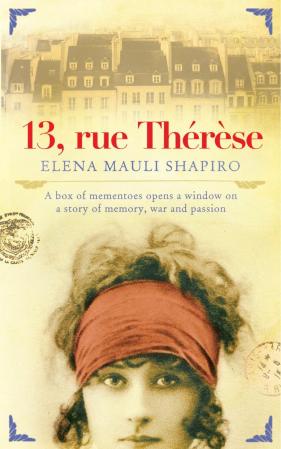
13, rue Therese Review

13, rue Therese by Elena Mauli Shapiro
Headline Review
ISBN: 9780755374229
RRP: $29.99

Sadly for Elena Mauli Shapiro, a clever gimmick alone does not make a book good. Being an absolute sucker for gimmicks – particularly visual ones – I was disappointed to find that this ambitious debut novel failed to pull me in.

As a young girl, Shapiro came upon a box of pictures, letters and keepsakes belonging to a Louise Brunet. As an adult, she has fictionalised the owner of this box, using its contents to tell a story. This idea appealed to me and turned out to be quite sweet.

Set in the first half of the twentieth century, 13, rue Therese is frame structured by Trevor Stratton, an American scholar who comes across the keepsake in his office drawer. As Stratton goes through the box, we are shown his “findings” through “documentation”. The artefacts form a visual component, along with Stratton’s recounting the owner’s story. This is a tale brimming with sex, impulsiveness, confusion, death and all in equal parts.

The images throughout are engaging, anchoring the otherwise scattered narrative. I like to see an author brave enough to play with form in her first novel; unfortunately, it doesn’t take long to realise that this is pretty much the best this book has to offer.

It’s hard to figure out whether the confusion in the text is intentional or not. Having spread the story over parallel time lines, past and present chronology often became mixed up. The book’s objective is to show that times collide and stories muddle, but I felt that much of the confusion was unnecessary – more the result of bad structural planning than sweet, mingling storylines.

Shapiro’s decision to have a man narrate what is an incredibly personal tale of a woman discovering and enjoying her sexuality in the 1920s, seems strange. At times she uses masculine language that seems incongruous with this tale of female consciousness and sexual awakening. There are many word choices which at times seem grotesque and distracting, breaking the story’s flow. Louise – through Stratton – talks about her “waning menses”, “her hysterical womb” and her anger becomes a “silent female storm”. Shapiro deserves points for pulling it off what was certainly a difficult narration, though it did suppress what could have been a much lovelier story.

Where Shapiro opts for simplicity, the prose shines. A man who wishes for a female child but has produced only boys, “his life is continuously saturated in boyness”, is a prime example, but unfortunately this isn’t enough to instil order and coherence to the messy narrative.

This debut novel from Elena Mauli Shapiro has a great visual gimmick and this may just be enough to get you to the end. Moments of great writing are there, but overall the execution is somewhat fumbled.

–> This review first appeared in Issue 2 of the RMIT flagship magazine, Catalyst. 

Best Australian Blogs People’s Choice is OPEN!

It’s ON!

The Sydney Writers’ Centre Best Australian Blogs People’s Choice voting has opened. It started last night (unfortunately I only just got home, so I’m already 21 hours behind!), and runs until 5pm on Thursday 5th of May.

The winner of this awesome competition wins a HUGE pack of workshops and courses at the Sydney Writers Centre which can be completed online or in person. And who doesn’t need a bit of learning in their life?

So go on. Show me some love. Tell everyone you know to do the same. Your support would mean so much to me!

You can vote here.

They’ve started a #bestblogs2011 hashtag on Twitter for those of you in the twitterverse who want to keep abreast of things, and the SWC have promised to email out updates of the winners when they know. There’s STACKS of blogs on the voting page, so go check out some of the competition while you’re at it – I have, it’s fearsome!

Some Things Are Too Good To Not Share

…like Joel McKerrow’s video which went up on Youtube on Monday. The video is of one part of a much longer poem. It is broken into sections, with each section apologising for a different “part” of Joel. In this video, he apologises for the white part of himself.

It’s a truly beautiful piece, which I first saw performed at the Centre for Poetics and Justice launch. Joel is so earnest, so honest, this confessional will bring tears to your eyes. And the video does it justice, though I’m unsure who’s responsible for the video itself. I can’t say much more about it; watch it – you’ll understand.

Hey, E M Forster!

Hey, E.M Forster, never realised what a funny man you were. Let’s be friends? Me, You, Borges, (as you’re both now my new “any two people, living or dead”), dinner date soon, yah?

Blog at WordPress.com.

Up ↑