Search

Sam van Zweden

Writer

Category

Events

On The Importance of Planning

This is a delayed post from my time at the Future Bookshop. Written during my 10,000 word day, this post took me to the finish line, and was the exhausted pinnacle of a day where I learned an awful lot about myself and my writing process.
I’ve just spent a whole day (10am-10pm) writing. I’ve written a combination of my novel/memoir, blog posts, and a first draft for a future article I’ve got an idea for. I’ve never spent this kind of a stretch of time writing before, and I’m absolutely stuffed. I expect to spend a fair amount of time just staring at a blank wall when I get home. I’m now in my final fifty minutes of writing, and I want to reflect on how badly I’ve planned my day, and how much more smoothly my day might have gone if I’d planned it effectively.

Indeed, this blog post is the result of hitting a dead-end after running my well of ideas dry for my manuscript and blog post and article ideas. True, I didn’t have a lot.

Before today’s writing session, I wrote down about five or six scenes I thought I’d like to write for my book. I just wrote down one sentence reminders of what the scenes were (“Hospital glass window”, etc). I also wrote down some blog post ideas (“Review: Summer Without Men, Hustvedt”). What I failed to take into account, however, was that I just might not feel like writing these things. As we all, no doubt, know from writing classes or workshops, it’s really incredibly hard to write something you’re not interested in. In fact, even if you’re not a writer – you probably know this feeling from your history of writing essays and papers when you’ve been given a list of topics that are all pretty boring.

What I’m trying to say here is that it can prove invaluable to plan out your time effectively. When you lose steam on one scene, move to the next one: and have a list that will be difficult to exhaust. If you’ve got a really long list, it’s unlikely that you’ll hit the end of it.

I also looked at my Now Write: Non-Fiction book last night. I thought about writing down some of the exercises, but I didn’t. I also thought about bringing the book in with me, in case I got stuck. I thought that would be just too naff, and so I also didn’t put the book in my bag. I just wrote my little list composed of a handful of ideas, and when I started writing I ran that list out pretty quickly.

One piece of advice I really should’ve thought about is Patrick O’Duffy’s idea of reaching 30,000 words by breaking the novel/book/piece of work down into 30 x 1000 word chapters. Write the skeletons of those chapters. If all you need to do (all, like it’s nothing) is pad out the prose, flesh out characters with detail and emotion, your job becomes a whole lot easier. Patrick outlines a heap of great ways to keep the words coming in his post, Welcome To Write Club.

However, I did not do this. My five or six scene ideas ran dry. I remembered one particular idea from Now Write: Non-Fiction, and I ran with this for quite a while. I got almost a thousand words from that exercise.

I considered googling “Now Write: Non-fiction prompts”. In fact, I tried to do this. But the great irony of the Future Bookshop is that there’s no or very patchy, dodgy wifi here. It drops out constantly, and today it’s been on the blink far worse than any other day I’ve spent at Future Bookshop. Of course! The one day I wanted to use the powers of the interwebs for good, to further my productivity, it decides to not work at all. Every other day when I’ve wanted to find a lolcat or read about some useless fact or other, or check my email twenty times in twenty minutes, or Tweet furiously about the security guards here at NGV (a singularly interesting/boring breed, by the way. Interesting/boring being a strange tension). And so I counted on my imagination to prompt where my writing went to next.

The imagination is a fickle beast. “The Muse”, as some might call it. It comes and goes. So when I put lots of flowery prose into something to fill up time or words, and I still came out dry, then I had to change tack. I had to move to another project, another way of writing, another scene. I had a document running in the background just to keep me writing. By the end of the day this document was at almost 1,800 words. My usual Morning Pages measure at about 750 words of faffing about, getting cobwebs out of my head in order to start the day fresh and clear. Today’s document acted as both a palate cleanser and a KEEP-WRITING! prompt.

Effectively planning comes in handy not just for marathon writing days, but for all writing days. I am currently about two weeks into my school holidays for Winter. They’re seven or eight weeks long. I haven’t fallen into a routine yet, but when I get time I know how it goes.

I wake up, and I read something inspiring. I read something non-fiction, so that I’m constantly learning, even when I’m not in classes that force me to learn (or not). I follow this up with some fiction, because you get better at writing by exposing yourself to lots of awesome things and just… absorbing. So that’s what I do, I absorb the work of someone far better than myself and hope that it wears off on my own work.

I then write for a few hours. I engage in what Aden Rolfe calls “Speculative Administration” (in his Business of Writing speech for EWF) – planning markets for my work, planning where I’d need or like to be in future, scoping out how much time I realistically need and what kinds of work I need to do to get to where I’d like to be at the end of the year. Or whatever the goal may be. Short-term and long-term planning. Both are important.

But lest I sit around staring at a blank page or end up writing a blog post about how important it is to plan your writing days constructively (even factoring in this “speculative administration” – planned pondering), I’m putting it out there, backed up by two weeks of largely unproductive holidays and a 10,000 word day that relies on this blog post.

Plan your days well, young scribe. Plan them well.

A 10,000 Word Day

Having watched many amazing people participate in The Rabbit Hole during the Emerging Writers’ Festival, I’ve no shortage of respect for those who can write large amounts in relatively short periods of time. Part of it is about the ability to continue producing work continuously, so the brain-power, but the other part is something else entirely, it’s about being able to sit still and do one thing for that long. It’s admirable, and I’d like to join the club of people who challenged themselves and surprised themselves with what they could do. I joined in for a few hours during The Rabbit Hole, but I’d like to give a really long haul a shot.

So here I am today, at the Future Bookshop (at NGV Studio) from 10am to 10pm. There will be a break in the middle for a meeting at 12.30, then straight back into it. The aim: 10,000 words in 12 hours. Possible, right? That’s 833 words an hour. Minus the time I’ll be at this meeting, so let’s count on just over a thousand words an hour. That’s achievable.

…Or is it?

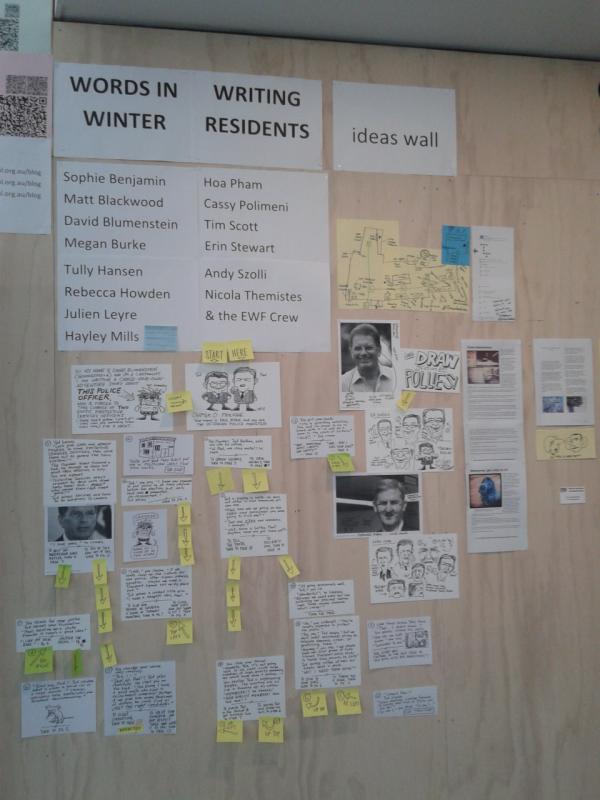
I’m starting the day at the work table – not letting the posture go to shit until at least after lunch. Later in the day I’m allowed to crash in a beanbag or couch, but for right now – posture’s the bomb. There’s a lot of foot traffic coming and going through the Atrium, where the freakin’ huge Saturday Book Market is on. I’ve already started making deals with myself – at 5,000 words, I can go buy books. I’ve put a sheet of paper up on the ideas wall to track my progress, with check-in times for my wordcounts throughout the day.

I have troops on side, Lisa Dempster currently in a couch by the window, and Karen Andrews working furiously on an iPad beside me. No doubt they’ll help keep me going, and vice versa.

I’ll keep you updated via Twitter and Facebook, and I’ll do another post about the experience tonight or tomorrow!

The Many, Changing Faces of the Future Bookshop

Tuesday:
The first day I came to Future Bookshop, it was quiet and cold. I snuggled down into a bean-bag, glad for somewhere so comfortable to kick back and write. I was surrounded by people I know, working on projects I know about. I felt well and truly embraced in a creative womb.

Saturday:
I came down to the Future Bookshop on Saturday night to try and get some serious writing done. And the really awful weather means that I can sit in this big, glass space and look at the outside and be glad I’m not out there. I was expecting the same quiet space that I’d chilled out in during the week, but when I walked in there were about fifteen people between the ages of fifteen and sixty-five. This troupe had with them a guitar, and they all sat very close together. Occasionally two or three would break off and come sit at the table with me, and brainstorm. I gave little smiles to them, but nobody smiled back or introduced themselves. They were all happy enough doing their brainstorming.

This circus-creativity was big and interesting, and it made me think – is this the future of the bookshop? If content is all moving online, does the space of the bookshop become a place where people meet to discuss that content? Or to plan it? Does bouncing ideas work as affectively online, or is face-to-face still the best way to do it?

Tuesday:
Another Tuesday, another Future Bookshop stint. Today there are four writers in residence in the NGV Studio space, all working together at the tables.

Megan‘s writing a blog post, and asking us for input. It’s nice to be able to contribute in real-time, without having to wait between emails or inboxes. It’s nice to be able to connect with a blogger, but not via their comment section. In Future Bookshop, Real Life and blogosphere mingle.

There are lots of children walking through the space – we’re next to the Kids’ Corner here – and looking around in wonder. I can’t imagine what the QR code wall looks like to a child – I’m supposing something like one of those Magic Eye puzzles made up of colours and patches of pattern.

The work wall keeps growing every time I’m here. It now contains a choose-your-own-adventure comic, blog posts, an interactive fiction gaming map and the beginnings of a discussion of self-publishing.

The Future Bookshop is an ever-changing beast, Bookshop 2.0, where the people inside it shape its content. Just like the digital space.

Rabbit Hole Wrap-Up

Having taken a few days to sleep and get back into the rhythm of everyday life (still not quite there yet), I’m feeling ready to look back at the Rabbit Hole experience.

For those who don’t know (WHO ARE YOU PEOPLE?!?!?!), the Rabbit Hole was a three-day writing marathon, in which participants aimed to write 30,000 words each, run as part of the 2012 Emerging Writers’ Festival. With four teams (Brisbane, Melbourne, Hobart and online), plus people playing along from home, we had upwards of 80 people all furiously writing between the 1st and 3rd of June.

As intern for the Emerging Writers’ Festival, I managed the Melbourne and online teams. For me this meant lots of work prior to the event: finding hosts, writing copy for programs and participant call-outs for blogs, figuring out a budget, organizing venues and websites/groups/emails, finding writers crazy enough to participate (surprisingly, we had waiting lists for both teams as long as my arm!), organizing milestone marker bonuses and catering. Plus the event was being run in Queensland (the Queensland Writers’ Centre are the creators of the event, the EWF were lucky enough to collaborate on the event) and Tasmania too, so there was a lot of emails between the three states to get everything running smoothly.

Enough about my awesome internship which gave me lots of opportunities and responsibilities and skills… Oh, there I go again!

Team Melbourne hunkered down with Jason Nahrung, who was well dedicated and not only kept up the banter online and within the room (see: explosions of applause for writers, initiation of #haveapencil, participants showered with chocolate) but he also joined in the writing and had his head down and fingers flying across the keyboard just like the participants. The glow of laptop screens lit up the Wheeler Centre workshop space (apart from Nicola Opt’Hoog, who did the challenge longhand!), and healthy rivalry between participants meant that everyone chased everyone else’s word-counts as they went up on the whiteboard.

Team Melbourne had a cheer squad composed of writers from other teams, states, and people around the EWF who weren’t even participating in the Rabbit Hole. One such writer (Owen Vandenberg, bless his heart) even cooked biscuits, vegan ones, in his home, and dropped them off to help fuel the writing bunnies. (Example Tweet from the moment of realization of said cookies: “Oh my god… there are oreos INSIDE these goddamn choc chip cookies. What kind of magical genius is this??? Who is responsible? #rabbithole”). Too cool.

The Melbourne weekend finished with two writers crossing the 30K mark. Even those with word-counts on the lower end of the scale had around 10,000 words – I don’t remember the last time I wrote that much toward any one project. I sat myself next to the snacks desk (it was the only available seat, I swear!) and got to overhear all the great water-cooler conversations about strategy (Pomodoro, biscuits, chapter outlines), and what everyone was working on. Aside from the amazing amounts of work produced, the networking and sharing of creative excitement was what made the event so great.

The online team (who called themselves Team Awesome until the 2nd of June, when it was changed to Team Amazeface in light of smashing goals and word-counts) was led by Patrick O’Duffy, whose intense energy and never-ending supply of writing-related lolcatz kept everyone enthusiastic.

Events that are run entirely in a digital space are becoming more common – the EWF ran Twitter Fest again this year, which included daily panels on a range of subjects, plus EWF digital was a whole side-festival in itself. I’m part of “The Subcommittee”, an online writers’ group of sorts. I’m getting more and more comfortable with things happening entirely in digital space, but it never gets any less cool. So as you would imagine: Team Awesome/Amazeface was cool for its digital novelty. It was also cool for its bunch of amazing writers, who managed to make some exciting organic stuff happen, similar to the water-cooler sharing in the face-to-face team.

In planning an event, there’s only a certain amount of planning you can do, and then the event happens. In its happening, it takes over and… well, it just happens. Without prompting, the online team started sharing their words at regular intervals during the day. They also shared bits of their lives, and so the team-members got to know one another and  sympathize with things like cravings for heat packs: one member got one, and then everyone did. I couldn’t plan that kind of closeness.

The sharing of work fit nicely into the blog that Patrick and I set up for the online team as a milestone reward for hitting the 20,000 word mark. Hopefully it gives you, dear Reader, a taste of what was being produced over the weekend.

Probably the most rewarding thing to come out of the weekend was how many people commented that they’d achieved more than they expected to, or thought they could. People surprised themselves – isn’t that freakin’ awesome?!

Mine isn’t the only wrap-up post or reflection on the Rabbit Hole experience, so here are a heap more, if you care to check them out. They’re from Rabbit Hole participants all over the country.
– Megan Burke at Literary Life live blogging Day 2
– Patrick O’Duffy blogs his experience of the Rabbit Hole
– Duncan Felton blogged his first 1000 words and keep-going strategy
– Miriam Zolin blogged her preparations for the Rabbit Hole
– Phill English (Toothsoup Phill) reflected on his experience
– Jodi Cleghorn shared her planning process and tips
– Amanda Druck updated us on her progress

Thanks once again to the Queensland Writers’ Centre for letting us in on such an exciting event – writers all over the country got so much out of the weekend, and I had a blast being involved!

…And of course, thanks for EWF for having me on board as an intern – I’ve made amazing friends, learned a lot about myself and gained a heap of new skills (making badges! spreadsheets! QR codes!). I’m sure this won’t be my last post about the EWF experience though, so more gushing in later posts.

But WHY does it WORK?

Last night I joined in writing for the Rabbit Hole for about 3 hours. Today I’ve been largely pottering around with the online team on Facebook and Twitter, providing munchy provisions for Melbourne, and coffee for myself. Sitting so close to the snacks table again today is dangerous, dangerous stuff.

Last night I managed to write over 2,900 words. Given that this was in three interrupted hours (catering wench is most important in this venue!), I’m really happy with my output. And I managed to write some scenes I’d been avoiding or struggling with for ages.

Last night I woke at 3am, and lay in bed thinking for a while. Almost 3000 words in three hours is really good for me. I wrote more in three hours than I have in the last week. So why does the Rabbit Hole work?

Possible answers:
– No procrastination tools. There’s no housework to be done,  no TV to watch and no to-do lists to make you feel guilty. The things that normally crop up to help writers avoid their writing are all stripped away.
– Public Censure. In a room full of people pounding away at the keys, you feel a bit shit for not doing the same when you know very well that you’ve got no excuse, and you signed up for this.
– Competitiveness. That girl just hit 3,000 words. What?! Yeah. Right. Need to get there too.
– What you owe to yourself. Knowing that you’ve got this opportunity, and that these opportunities are rare helps drive home the fact that you owe this to yourself.

These are my top theories. If you took part in the Rabbit Hole, or you have in the past, and you can think of other reasons, let me know. I’m interested in nutting out why I can write this amount here, but not at home alone. Am I just lacking discipline?

She Works Hard for the Money (But There’s So Much More)

Something that’s come up multiple times across the Emerging Writers’ Festival is the idea that we shouldn’t be so focused on money, and I’ve really appreciated that people are raising this point. I think it’s really important.

While there’s definitely space to be concerned about being ripped off, there’s also a need to get some perspective. As an emerging writer, I’ve had to do a fair amount of writing/working for free- but I don’t feel ripped off at all, because what I’m getting out of those experiences goes beyond money.

For example, interning – I’ve met countless wonderful people, learned about what I’m actually capable of as a person, discovered new possibilities for myself and my career as a writer. Interning is one of those experiences that can potentially pay itself off non-monetarily, in things like networking opportunities and transferable skills. You know those skills that everyone wants, but that are impossible to get without getting a job? Interning’s a great way to get those skills!

Last night at the Industry Insider panel on Indie Publishing, Sophie Black (from Crikey) made note of the fact that she appreciates that low pay-rates need to be subsidized by giving the piece(s) the time they deserve editorially, helping to make them the best pieces they can be, and arming the writer with new skills and knowledge beyond just getting paid.

So while it’s important to value your work, and make sure you’re getting what you deserve for it, also be aware that what you get for your work might not just be about money. With so many indie publishing places hard-up for cash, it’s not always going to be possible to get a high pay-rate for your work. That’s not to say that these places should be turned down or not considered – “What you deserve” might include transferable skills, networking opportunities, a forum for your work, or extra attention to making your work the best it can be. Look past the money, with the bigger picture in mind, and look at what an opportunity really has to offer you.

Day 5 and Still Running!

Today is day 5 of the Emerging Writers’ Festival, and I thought I’d do a quick wrap-up post of the things that have made an impression on me and what’s been great about the festival since my last post, and what my experience has been as an intern.

My last post was just after the launch. Since then has been a Masterclass, the Artists’ Party, and the Town Hall Writers’ Conference.

During this time I needed to finish a heap of assessments, and I tell you what – there should be a dangling carrot like the festival at the end of every semester – there would be so much less procrastination! I didn’t want to be stuck at home working, so I was super-productive and have managed to get everything finished a whole day early. I’m going to hand it all in this afternoon, and I’m OUT of semester one! And I can finally say “Yes, I’m coming up to the festival hub for drinks!”

The Business of Being a Writer Masterclass I worked, but the whole thing was coming over a PA, so I could hear everything that was going on. I’m actually kind of upset that I’d missed out on these classes in previous years – all the things I’d been confused about or wondering about the business side of this was covered in this class. Things like invoicing, setting rates, what to do once you’ve got an ABN, copyright. Everything. I highly recommend this class for everyone next year.

My favourite idea that came from the masterclass was Aden Rolfe’s idea of “Speculative Administration”. Freelancers, he said, necessarily have to spend about 15% of their time engaging in this “Speculative Administration” – things like researching markets, applying for grants, seeing what competitions and deadlines are coming up, thinking about where you’d love to be published. As a result, freelancers can only ever use 75% of their time on the other work. This isn’t necessarily a bad thing, it’s just something to be aware of.

Friday night’s Artists Party was loud and amazing. I’m continually thrilled by how many amazing people are involved with the festival, and how everyone is ready to chill out and have a chat. We’re not friends already? Alright, cool, who are you? Let’s be friends.

Over the weekend was the Town Hall Writers’ Conference. I worked on Saturday morning, catching the Seven Enviable Lines panel. Favourite lines – “Procrastination: Don’t do it.”. “Never, ever take fear-based advice”. And “Don’t be a jerk”. This “Don’t be a jerk” thing was echoed all weekend, and I think it’s really important in a community as small as Melbourne’s. You’re going to come across the same people again and again, so for the love of God, don’t burn bridges! That’s not to say don’t be critical – one of the things I loved about the weekend conference was the way that many people were brave enough to disagree and really thrash out ideas. Critical is okay. Critical is constructive. Just don’t be a jerk.

After a MASSIVE Friday/Saturday-AM working, I decided to go home to get a heap of this homework done. Everything’s due today and tomorrow. While leaving the Town Hall program to do homework sucked, I really wanted to be able to rock up on Sunday and see some great panels – including one by my mentor for next semester, Francesca Rendle-Short. More on that mentorship post-EWF, no doubt.

Anyway, I intended to come home and be very productive. Instead, I came home and collapsed in an exhausted puddle. I slept for five hours. When I eventually woke, I felt much better, and ready to tackle assessments. I put on headphones, and the newly-discovered Vitamin String Quartet (perfect for studying!). And I powered through almost all of that assessment work.

Which meant I could catch panels on Sunday! I feel like I tweeted the panels to death, so you no doubt already know the highlights. I will say though, that I really loved the digital writing panel, and how it made me feel excited and more energized about this here blog. Post-festival I’ll be around at the Future Bookshop, writing up a storm, and I intend to use the time (at least in part) to re-commit to LGWABP. Time commitments before me still mean I’m a busy woman, but I can see my way to posting more regularly. So thanks, especially to Carla Sammut (@easyasveganpie), for getting me excited again.

Oh, also – just a quick shout-out to my amazing brother, who recently joined Twitter. He’s a fantastic chef, and he’s joined Twitter to follow restaurants and chefs. And bless him, I’ve been tweeting #ewf12 pretty hardcore over the last week and it’s gonna continue, and he hasn’t unfollowed me. Thanks, Chris! x

The last exciting thing is ewfDigital! It went live last night, and it’s all up and functioning and exciting today. It looks freakin’ awesome, and there’s a heap of content up there. I’ve only managed to look at about half of it, and going back just now I see that today’s panel stuff has gone live too. ewfDigital allows people who can’t make it to Melbourne for the festival to engage through videos, blogs and Twitter. Not only is there content going up from panelists, but you, as the audience, can create your own content in response to the stuff that’s up there. Just like question-and-answer time at the end of the panel, where you have the right to respond. Only better. Way better.

Right now I’m off to a briefing for the Future Bookshop, and tonight I celebrate with my best mate and wine and an Industry Insider panel about emerging critics and Lord of The Fries after. I’ve finished assessments! Let me loose on the festival!

It’s Here!

Last night saw the launch of the 2012 Emerging Writers’ Festival. It was a brilliant show, complete with bum-dancing, crumping in a row-boat, chair persons almost crying while thanking Lisa for an amazing 3 year captaincy, and the incomparable Tully Hansen winning the Monash Prize. Congratulations too to Michelle Li for taking out the Monash component;  we were lucky enough to hear some of her entry last night, and it was lovely.

I’d like to apologize in advance to my partner, my body, my diet, my house, my washing pile, my skin… My mum, who won’t hear from me for a few weeks… My final assessment for not getting the attention it needed pre-festival and now will be completed in an exhaustion fug… If last night was any indicator at all, by the end of these eleven days, I’m going to be so happy, but incredibly tired, too.

As I tweeted late last night – my life right now? Fuck yeah! Sometimes everything just comes up aces, and that’s exactly what’s happening right now. Good one, life!

Today I’ll be working at the Business of Being a Writer Masterclass, and meeting a heap of brilliant people no doubt at the artists’ party this evening. I will never stop being astounded by how many great people are involved in the festival.

Yeah, and this is just day 2. Imagine how gushy this is going to get by the end of the festival! #loveattack

Opportunities a Plenty

Being involved with EWF more closely this year has opened my eyes to the amazing amount of opportunities they have available for writers, outside the festival itself. There’s a bunch of deadlines coming up, so I thought I’d just do a heads-up for anyone that might be interested in these opportunities. I’d encourage people to apply, because EWF’s a fanastically supportive atmosphere, and a wonderful starting point. Having this stuff on your resume is so helpful, and in terms of experience it’s priceless. And some of these are lucrative. Woot.

–> The Monash University Undergraduate Prize for Creative Writing. Most prizes are almost impossible for an undergraduate emerging writer to win. They either require a publication history, or a whole book, or a completed manuscript, or… a bunch of stuff a lot of undergrads just don’t have. The Monash Prize has a large bundle of money to give to its winners, it’s for previously unpublished writers (see website for specs on this), and entries are reasonably short pieces of writing. Winners are also being published as an ebook by Penguin. Entries close April 23rd.

–> Words In Winter Writer’s Residency. A two-week writing residency at “a high-profile CBD location”. The theme is a future of writing, which is a pretty hot topic at the moment. If you’re concerned with digital story-telling, blogging, ebooks, self-publishing, or anything that’s wrapped up in the idea of the “future of writing”, then apply for this residency. There’s ten spots available, and EWF’s offering a publishing opportunity post-residency. Applications close April 20th.

–> Australian Poetry’s fantastic Cafe Poets program is launching their next round as part of the EWF in May. The program puts poets in cafes as writers-in-residence, giving the poet a space to work, free coffee, and an outlet: contact with the public. Applications close April 24th.

With all these opporunities available, you’ve got no excuse not to make stuff happen. Give it a go! Entries for all these close very soon, so get writing!

Blog at WordPress.com.

Up ↑