Search

Sam van Zweden

Writer

Category

Book Reviews

Review: After the Snow, by S.D Crockett

Check out that cover artwork. It’s pretty nice, huh? Unfortunately I’ve been seeing an alternative cover floating around that’s nowhere near as pretty, but here’s hoping that we get this pretty thing in Australia.

After the Snow by S.D Crockett is a work of young adult fiction, set in an ice-age some time in the not too distant future. The main character, Willo, is left alone in the mountains when his parents are forced out of their family home, and the book follows Willo’s search for his parents and his growth from a boy to an insightful young man.

The story is told in first person from Willo’s point of view. Willo’s voice is really distinctive – his vocabulary is limited (think Jack from Room), and his worldview is very particular to his rural life as a “straggler”. He’s a skilled hunter and craftsman, and a brave young man. Willo has a lot of peculiarities that make him utterly endearing and relatable character. For example, Willo has saved a dog’s skull and fashioned it into a hat. When he wears this hat he is influenced by “the spirit of the dog”, and this spirit guides him throughout the book.

This kind of imagination on Crockett’s part is really refreshing. While I’m not an expert on YA fiction by any stretch of the imagination, I think my lack of general enthusiasm for the genre comes from the tendency for YA authors to sell their audience short: having a young audience does not mean you need to dumb down your narrative or emotional content. Crockett shows faith in her readers by presenting them with Willo’s difficult voice, and his complex emotional journey. This respect for the audience’s maturity and insight is the crux of what’s so exciting about this novel for me. It also makes the novel really enjoyable not only for young adults, but for readers of all ages.

The other lovely thing about this book is the language. It’s a strange and brilliant feat to make less language seem more. Despite Willo’s limited and peculiar voice, Crockett makes it fresh with language that jumps off the page with its poetry. There was a lot of stopping to write lovely bits in my notebook as I read.

I’m looking forward to the release of this one so I can spruik it to everyone. Starting here. The book’s due out mid-February, which is almost upon us, so keep an eye out.
Just Can’t Do It

Sorry, fantasy fanatics. I just can’t do it.

I try, but I don’t find fantasy enjoyable. I just finished Obernewtyn, and all I could think about was how awful and expository the prose was, and how frustrated I was about having to learn the rules of the world. I was literally in pain when I got to the end of the book. The best I could say for it was that “It’s full of imagination!”

…Which is great, and if that’s what you enjoy, that’s great. Power to you. I just can’t do it.

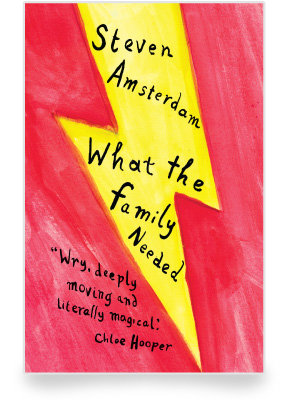
Review: What the Family Needed

What the Family Needed, by Steven Amsterdam
Sleepers Publishing, 2011
ISBN: 9781742702117
RRP: $24.95

I loved Steven Amsterdam’s incredibly popular novel, Things We Didn’t See Coming. I think what I enjoyed most about it was Amsterdam’s knack for putting characters in situations that a reader must find foreign, and thus exciting and engaging, while still keeping his finger on the pulse of reality. Even though we can only guess at what it would be like living in a post-Apocalyptic world, we know what it is to be human, and Amsterdam writes that so well that we accept the Apocalypse as the premise.

His latest offering, What the Family Needed, likewise takes some really average human beings and puts them in extraordinary situations, forcing the reader to seriously ponder, What would that be like?

The story follows one particular family over many years, starting when the children are under ten years old, through to when they’re about fifty. This family goes through the regular traumas that all families do: births, deaths, marriages, and all the rest. The thing about this family is that they all develop super-powers. One can fly, one has amazing strength, one can match-make like Cupid. Despite all their amazing abilities, these super-powered people still have problems.

While this kind of premise would usually turn me off a book, I had no idea that was even what I was getting myself into when I picked this one up. I was going by my love of Things We Didn’t See Coming. And I’m glad I went with it, because Steven Amsterdam breathes life into this well-worn idea. What would you do if you had super-powers?

What Amsterdam does is exactly what he did in his previous novel – he keeps firmly in touch with reality, despite a wacky premise, and the true humanity in this book is what made it such an enjoyable read.

At times the moment when characters realise they have powers seems a little thin – but I’m not entirely sure what I would want for these moments to seem more credible. I’ve never developed the ability to fly, so I have no idea what that would be like. The more important bits are where characters exercise their powers and try to improve their lives with them. What matters is the exploration of how human we’d still be, even if we could do anything we wanted.

Review: Rocks In The Belly

Rocks in the Belly, by Jon Bauer
Scribe, 2010
ISBN: 9781921844539
RRP:  $24.95

I’m a slow reader, but I ripped through Rocks in the Belly. It’s the kind of book you think about even when you’re not reading it. This novel is impressive in so many ways.

The story is about a child whose mother fosters boys. She bonds with one boy in particular, pushing her biological child  to the point where he can’t deal with the prospect of having his mother love a foster child more than himself, and he acts out. The novel explores the moral and emotional aspects of that situation, and the fall out of the 8 year-old boy’s actions.

The structure of the novel is unique – it’s told in two different voices. That’s not particularly new – authors have been playing with multiple points of view for yonks. What I found interesting, though, was that the two voices are of the same character. We hear of the childhood trauma in present tense from the focalization of the eight year-old boy, while alternating chapters are from that same boy as a twenty-eight year-old returning to his childhood home to care for his terminally ill mother. While I’ve read plenty of books that use different voices, I’ve never read any books that use two different voices from the same person at different stages in their life. Bauer has executed it really skillfully, tying these two voices together convincingly through distinctive sentence structures, in-jokes and personal tics.

There’s a lot of grey area in this book, and not in a purposely vague way. The main character (who remains nameless throughout the whole novel – mechanically, surely, pretty impressive) has this huge internal conflict, constantly trying to redeem himself from being a “bad” person. All characters in this novel engage in some pretty morally ambiguous actions, and one of the main themes of the book seems to be to examine that question – what do you have to do to be a “bad” person, and then what does it take to undo that? Indeed, can any of your actions make you a “bad” person, or are we all a little bit bad anyway?

The language Bauer uses is truly beautiful. At no point did I check out and skip over chunks of description (as we all do when we don’t care) – I didn’t want to miss a thing. The language is so gripping, and so fresh, that I was hooked from the prologue, where we are offered the haunting insight that the main character’s childhood haunts him “in much the same way my fists haunt my hands”. This kind of rich language is laced right throughout the novel, and it never upstages the action. The two are perfectly balanced, so that unless you’re reading like a writer who’s consciously looking for these things, you don’t even notice what’s happening other than the book being is really great.

It’s not often that I give anything 5-stars on my Goodreads account, but this got it. It’s been a long time since I’ve found myself this emotionally invested in a piece of fiction, while also being really switched on to the language and its masterful execution. Jon Bauer’s Rocks In the Belly is a new favourite.

The Happiness Project, by Gretchen Rubin

I’m great at making resolutions. Not New Years’ Resolutions, I just make them all the time. I’ll exercise more, I’ll be up at a certain time, I’ll do a writing exercise every day, I’ll read a hundred books a year… I’m really great at breaking the resolutions that I set for myself.

In The Happiness Project, Gretchen Rubin makes lots of resolutions for herself, and what I like about the book is Rubin’s systematic approach to making herself follow through on her promises.

The basic premise of the book is that Rubin makes a mission of studying happiness, and spends a year making systematic resolutions that will supposedly make her happier. Following Benjamin Franklin’s idea of perfecting himself by focusing on various virtues, Rubin focuses on a different facet of her happiness every month.

It sounds trite, but I found this book inspirational. There was a lot of stuff that Rubin tries that I took on board. I found myself energized by how specific her resolutions are, and in putting some of them into practice for myself I’d have to say that I think specific, accountable resolutions are the key. Rubin doesn’t just decide to focus on lifting her energy in January of her happiness project; she breaks this focus on “vitality” down into achievable, concrete ideas: “go to sleep earlier”, “exercise better”, “toss, restore, organize”, “tackle a nagging task”, and “act more energetic”. She does this for a different virtue, every month for a year.

By breaking down her aims into these little specific ideas, Rubin has instilled in me a weird kind of tendency to think in mantras. By the end of the book, she recognizes that she does this herself. I’ve started trying to employ the resolution to “act more energetic” – and whenever I find myself tempted to be lazy, that phrase pops into my head. “Act more energetic!” – truisms are helpful.

While I found this book on the “memoir” shelf in the book store, it would probably fit just as well under “self-help”. It’s a funny little book though: Gretchen Rubin’s just an average woman. Before starting her happiness project, she’s pretty happy – she simply decides that her happiness is important, and that she should know what it’s all about, especially in preparation for the possibility of bad times in the future. So it’s not any kind of misery memoir of overcoming the odds and finding happiness. Gretchen Rubin’s not depressed, she’s not hard done by, she’s not even very unhappy. She’s utterly regular. I liked that about the book.

I wasn’t so sure about the way the book treads the line of being overly positive. I know that sounds ridiculous, reading a book about happiness and being unsure about how positive it is, but perhaps because of the utter normalcy of Rubin’s life, I sometimes felt like the obstacles she overcame weren’t very convincing as genuine obstacles. But I guess that’s how life is. Sometimes achieving something isn’t very dramatic, but the fact that you get there in the end is important.

There’s a terrifying endorsement on the back of the book: “An enlightening, laugh aloud read” – from Christian Science Monitor. Don’t let that scare you off. The book isn’t trite, and it isn’t hardcore self-help. It’s a regular lady’s story about figuring out who she is, and what makes her happy. Rubin’s overly-organized approach to that task really appealed to me, and I’d have to say I picked up a lot of good ideas from this book. We spend so much of our lives trying to be “happy” – Gretchen Rubin recognized her own happiness as a priority, and wrote a really enjoyable book about it.

Cherry Ripe

I picked up my copy of Cherry Ripe at the closing-down sale of City Basement Books, when they left Elizabeth Street. I got it for only $1. For this reason, it’s sat on my shelf for quite a while, and I’ve felt no pressing need to read it quickly in order to get my money’s worth. And having been written quite some years ago (1985), I didn’t feel the need to read the book or else fall behind in my reading. So now, about a year after I bought the book, I’ve finally gotten around to reading it.

The story is of three generations of women in Tasmania, mixing the real and fantastical in a way that makes the line blur – pure Carmel Bird.

I’m a big fan of Bird’s short fiction, “Automatic Teller” being one of my all-time favourite short story collections by a single author. I’ve only read one of her novels (she’s written about ten), Red Shoes. I loved Red Shoes for its amazingly rich narrative, a really intricate combination of wonderful story-telling and some really great research into myths and traditions.

While I’ve read it later, Cherry Ripe was a precursor to Red Shoes, and it certainly has that same feeling of being incredibly well-researched, and a strange mash-up of realism and magic. Like the hugely entertaining glossary in Red Shoes, Cherry Ripe is also a kind of vehicle for magical stories which sit outside the main story itself, and these stories are delivered through Aunt Agnes. She hands stories down to subsequent generations, telling of girls flying off cliffs from grief, and girls who drink vinegar until their blood runs dry. Having said that, even the action in the main story is quite fantastical – a girl eats a daffodil to show her love for a nun, and the Sacred Heart and a Fairy Queen commentate on the lives of the women.

The book is heavy with knowledge and iconography – much of it to do with tradition, femininity and religion. As a writer, I struggle to even begin to think about what the research for this novel would have looked like.

The book is a quick read, with large print. The chronology jumps around, and the reader never becomes bored with where the book is going, because the logic of the book doesn’t act in a forward-moving motion, it jumps around all over the place, linking the experience of one generation of the women with that of another, and jumping backward when reminded of another image or scene.

Though descriptions are dense (“Pearly just cred louder, big long tears, confetti runny rainbow teardrop tears”), they are also economical in a way, with every word working hard for its place on the page. Carmel Bird is a veteran of the art for a reason – she has such tight control over her words.
I regret that it took me a year to read this, and had I known it was going to be so enjoyable, I would have paid more than a dollar for it.

The Best Art Feels Like Playing

“DAWN: Oh, I dunno, Nadine. Sometimes that’s good. I like his work, it’s fun. The best art can feel just like playing…”

In Death of a Ladies’ Man, Alan Bissett has written a novel that feels just like playing. I enjoyed this novel so much, though, because that’s not all it feels like. It’s so easy for those post-modern, tricksy texts to be fun, and that’s all. But Death of a Ladies’ Man is also serious, and relevant, and familiar, and well-written.

The novel is about ladies’ man Charlie Bain: divorced teacher with a promiscuous sex obsession. The characters are real and rounded, with Charlie always acting in ways that are true and honest, even when you squirm and wish he wouldn’t.

The prose sparkles – multiple times while reading I needed to grab my notebook to write down phrases that caught me offguard:

Close up on her eyelashes: like the skinny, regal legs of synchronised swimmers.

All Charlie saw was the bruise. Bruise! it said. Bruuuuuuise. Like a comic-book ghoul.

Alan Bissett has shown bravery with his form, with the novel presenting as something of a pastiche of film scripts, catalogues, first, second and third person narratives, shifting points of view and time. The thing I enjoyed most was that this playfulness of form perfectly matched the content. Experiments with fragmented typography match the drug, alcohol and sex experiments Charlie engages in, and his increasingly fragmented state of mind.

Even the difficulty of shifting narrative points of view is admirable: somehow Bissett manages to tell past episodes in second person present tense, and present episodes in past tense third person, mixed up with some first person interior stuff toward the end. This sounds impossible and mashed-up and wanky, but it really works.

Mostly, I laughed. This last week I’ve been sick in bed, having had my tonsils out, and Alan Bissett has kept me from going insane. It’s not a feel-good novel, far from it, but it’s got a definite dark hilarity to it, and despite its touching on some truly heavy stuff, it all still feels like playing.

Writer/Reviewers

I don’t have time or energy to do this discussion the justice it deserves today, but it is a topic I’m deeply interested in, not just as something that’s relevant to me, but as something that has pretty serious implications for reading and reviewing culture as a whole:

Should people who are writers also be reviewers? (Particularly in a literary scene as small and as close as Melbourne’s, where everyone knows everyone) Is a reviewer’s expression censored somewhat for fear of making enemies amongst their peers?

Over on Literary Life today, Megan has posted about her stress about this issue. The post (sorry, Megan, but…) is a bit of a stress-rant, but the discussion which follows is well worth a look-in.

The post comes at a particularly relevant time for me, as I’ve just submitted my next review for Catalyst, and it’s reasonably negatve. It’s of a book from a debut novelist, which is a category of writer who usually get softer reviews so as not to crush any dreams. But it’s also from a French/American, and I was a bit disgusted with myself when I was writing the review, finding myself thinking, “This woman won’t meet me.” Because of this, I somehow gave myself permission to say just what I was thinking – while I made sure all criticisms were grounded and just, I didn’t go to the pains that I would for a Melbournian or Australian writer to say these things very softly. Don’t get me wrong – I don’t generally censor myself in writing reviews about people I know or have the capacity to know in the future, and if there is an existing relationship I’ll always flag it for total disclosure. However, the way I deliver negative criticism is something I’m much more aware of for these people, than remote authors who are (in the case of classics) dead, or else so remote to my sheltered existence (as with the upcoming review of Elena Mauli Shapiro’s novel) that they probably won’t read the review or ever meet me.

Is this sort of self-preservation bias acceptable? Avoidable? Should writers be reviewers at all?

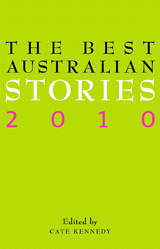
Review: Best Australian Stories 2010

The Best Australian Stories 2010, edited by Cate Kennedy
Black Inc
Publication Date: November 2010
ISBN: 9781863954952
RRP: $29.95

One of the chief advantages of The Best Australian Stories 2010 is that it shows that Australian writing is as varied as Australia’s population, as changeable as its weather and landscape.  This collection shows that Australian literature remains as enigmatic and indefinable as ever. Its content suggests that the cosmopolitanism that in the past has had amazing writers like Christina Stead shunned from the Australian fold, is now well and truly embraced along-side more colonial visions of cattle stations and bushfires, and that any effort to define “Australian writing” would necessarily involve all of these things.

The Best Australian Stories 2010 is comprised of twenty-nine short stories, both previously published and not before printed, from authors both well-established and emerging. Kennedy has struck an admirable balance between male and female authors without it feeling like a political exercise, and much thought has obviously gone into pacing the collection. While reading it’s hard not to say, “Just one more!” because of this attention to detail.

It’s also hard not to connect the stories to one another, as Kennedy’s ability to bring well-suited stories into a collection means that they gesture far beyond themselves into the other stories in the collection, but also into Australian writing as a whole.

While there are stories in here, such as Joanne Riccioni’s ‘Can’t Take the Country Out of the Boy’, and Fiona McFarlane’s ‘The Movie People’ that are concerned with more traditional Australian landscape and colonial values, other stories like Nam Le’s ‘The Yarra’ and Sherryl Clark’s ‘To The Other Side of the World’ speak to a very modern, very high-pressure metropolitan side of Australia. All the stories in this book carry notes of a haunting and tense Australia; its inhabitants torn between yearning to belong and to run. And while the stories in this collection can be broadly connected via themes, it is refreshing to see just how diverse the concerns of these stories are.

Chris Womersley’s ‘The Age of Terror’ actually made me yell. Nam Le’s ‘The Yarra’ made me yell and want to throw the book at something because it was so true, down to his depiction of a Melbourne which I could recognize down to the river bend. Ryan O’Neill’s ‘The Eunuch in the Harem’ is impressive and original and hilarious. Paddy O’Reilley’s story is one that stood out to me as hauntingly Australian. Marcus Clarke once typified Australian landscape as “weird melancholy” and many of the stories truly had that feel – Paddy O’Reilley brings it to suburbia.

By the end of The Best Australian Stories 2010, you feel like you know what Australian writing is about, and get an idea of some of what’s happening in our literary journals, but the collection is by no means tiresome – the diversity between these covers is more than admirable.

The Best Australian Stories 2010 is a collection that we can be proud of, and one whose attention to fine form and original ideas will leave you well and truly sated.


This review appeared in the first 2011 edition of RMIT’s magazine Catalyst.

Blog at WordPress.com.

Up ↑