Search

Sam van Zweden

Writer

Author

Sam van Zweden

Doors Close, Doors Open

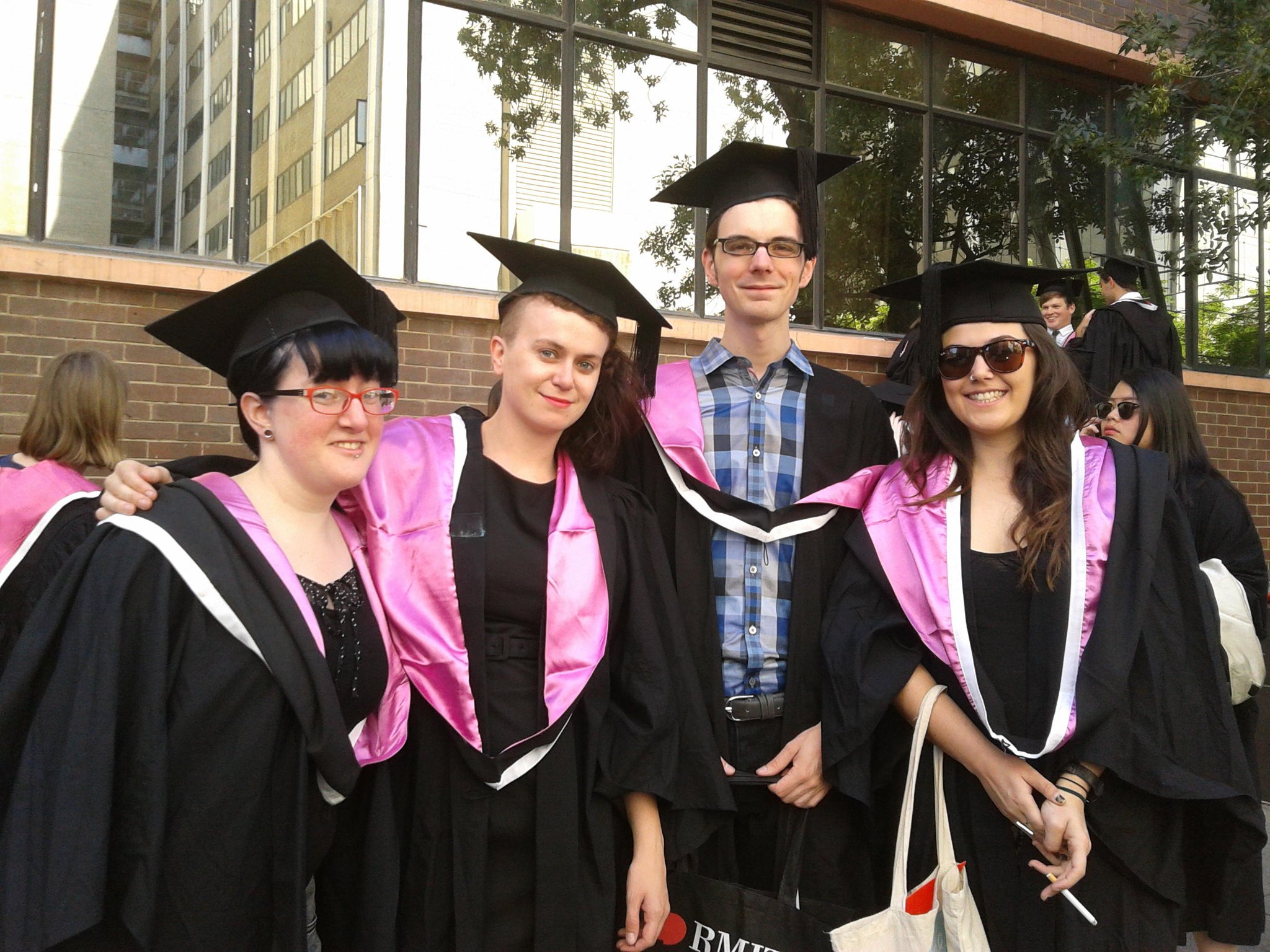
Left to right: myself, Jo Day, Tully Hansen and Veronica Sullivan. Writers I’ve been totally lucky to study with, and whose success I’d place bets on.

Last night I graduated. I robed up, and spent hours in stinking hot Etihad Stadium, and got my giant certificate: “Bachelor of Arts (Creative Writing) with Distinction”.

Done and done!

I’m so glad I made the decision, three years ago, to move to RMIT – and that they were willing to have me! It’s easily one of the best choices I’ve made. I’ve really grown as a writer, and have been so generously supported by my teachers and peers. I’ve had industry opportunities I probably wouldn’t have had otherwise. I’ve been encouraged to follow my passions and obsessions, and I now find myself quietly confident that, while still somewhat aimless, I have a general direction for my future.

I’ve learned a lot about myself: how I work best, which topics I find easy or difficult or fun or challenging to write about, what kinds of practical applications for my work I am interested in. I know now, so much better than I did three years ago, who I am and where I’m headed.

It’s a strange place to be this morning. It’s official: I’ve finished my undergraduate career. I’m now looking in the face of postgraduate study. I’ve got an application pending at one institution, and have deferred an offer from another until 2014. I’ll make up my mind which of those suits me better after my year off. I plan on spending this year saying “Yes!” to everything. This means that today, my first day as a graduate, is being spent writing an application for a mentorship, and thinking about a possible project for a fellowship application.

While my time as an undergraduate has finished, I’m seeing possibilities stretching out in front of me, I just have to be gutsy enough to take them.

How Do I Choose Books?

Today when I went to the library, I was approached by a training librarian who asked some questions about how I choose my books.

It’s a pretty simple question, yes, but it’s also hard to answer, and it made me stop and think. Poor librarian, I’m sure she was after a simple answer! I think what I gave her was something along the lines of, “I look at displays to see things I wouldn’t otherwise consider, for anything eye-catching, but otherwise I keep a list of books I want to read and I work my way down the list”. She asked a follow-up question about whether I find authors I like and spend extended time reading more of their work. My answer, sadly, is that often I don’t have time to do this. I do a lot of reading toward my writing, whether means research for articles or the blog, or reading works like my own WIP to get a sense of context or some inspiration – not to mention assigned reading for uni. Now that I’ve finished uni classes until 2014, though, I probably will have a lot more time to do things like getting properly obsessed with one author and spending weeks in their back-catalogue.

All this has me thinking about the extended answer to the librarian’s question – how do I choose my books?

There are two main sources: work and word-of-mouth.

Work:
This source is made up of books I’m sent by publishers or publications for review. I always dreamed of having a Meyer-esque Tower of Hope, and my desk is slowly starting to develop one. Of course, now that I’ve got one, it’s impossible to reach the bottom of. These books usually take priority, depending on whether there’s a deadline (magazines) or not (blog). 

The Mini-Moleskine:
I have a teeny tiny Moleskine that fits in the front pocket of my bag. It’s the size of my palm. And it contains a list of all the books I have been recommended by a friend (or at least, the ones I intend on chasing up), or read an interesting review of, or not understood a reference to and felt silly so need to read in order to increase my literary nous, or … so many things lead to a book ending up in my little notebook. I stole this idea off Veronica Sullivan, when I saw her scribbling away in a baby notebook at the library. This system ensures that I don’t miss anything. And it feels so good to cross a title off the list!

It’s also a great grab-bag of surprises – the list currently contains about 150 books I still haven’t read, and by the time I get around to crossing the title off I may have forgotten why I wrote it down in the first place, just that I knew I wanted to read it. This makes a lot of the titles a really pleasant surprise.

It also decreases reading anxiety. It reduces the hugeness of all I haven’t read to a finite list of things I need to chase up – like a never-ending “To Do”. Yeah, it’s old-school to do it in a book, but I like it. It’s a handy habit. No, I’ll never reach the end. But I’ll always be adding things and crossing things off. I’m never stuck for what to pick up from the library – just open up the book and pick one!

And then there are the other sources:

Necessity:
The last source of my reading material comes from necessity. Today’s library trip was to look for gift ideas for Christmas: recipes. Of course, I ended up with two accidental books, because there’s always the Can’t Say No category. I saw Julie and Julia just staring at me from the shelf, and I couldn’t leave it there. I need some indulgent holiday reading!

So those are my sources for reading material. How do you decide what to read next?
A Month of Reading

1st of December means the first day of summer. The last month of the year. 24 days until Christmas. 30 days until New Years Eve.

Here’s what I read in November. What did you read?
Books Bought:
Marionette, by Jessica L Wilkinson
Every Love Story is a Ghost Story: A life of David Foster Wallace, by D.T Max
Lucky Peach Issue 3

Reading Copies:
January First, by Michael Schofield
Bloodhouse, by Darcy Dugan Michael Tatlow
Mr. Penumbra’s 24-Hour Bookstore, by Robin Sloan

Books Read:
Little Spines, RMIT Creative Writing Anthology
Street to Street, by Brian Castro
Six Weeks to OMG, by Venice Fulton
Both Flesh and Not, by David Foster Wallace

Currently Reading:
Timepieces, by Drusilla Modjeska

Crazy Price

It’s difficult to keep up with all the many, many publication outlets for poetry, short stories and essays. This is why Black Inc’s “Best Australian…” (Stories, Essays and Poems) each year is so handy. There’s bound to be a bunch of stuff you’ve missed, that your net just doesn’t catch, and it’s great to work through these collections. Like all collections, there are always biases, and some of the same names pop up over and over, but they are pretty great.

This little #loveattack was prompted by this morning’s Christmas Bargain email from Readings – each day in the lead-up to Christmas, Readings are doing an online-only deal on a different book. Today’s is the set of all three “Best Australian…” books for $50. Even with my discount from work (25%), I can’t get them that cheap. So I’ve ordered mine, and would urge you to do the same.

Guest Post on The Emerging Writer Online Journal

Today I’ve got a piece up over on the Emerging Writer Online Journal. It reflects on the process of coming to see myself as a nonfiction writer, and how the recent NonFictioNow Conference made me think even more.

The Emerging Writer Online Journal is a fantastic opportunity for emerging writers. Karen, who edits the journal, is keen to hear pitches for just about anything concerning writing, the writer’s life, process… Etc. It’s a great way of getting your name out there, of having a paid writing gig, and of building up your publication folio. I can’t recommend this organization highly enough, so go make the most of their generosity!

The Line Between Book and Life: On Public Personas

One of the panels on the Thursday of NonFictioNow was called Writ Large: On Living The Lives We’ve Made For The Page. The panel featured Cheryl Strayed, Ira Sukrungruang, Mira Bartok and Barrie Jean Borich – all memoirists, talking about how they negotiate writing from life, and continuing to live that life when it’s been written.

Are we always wearing masks? Are we always mediated?

One thing that emerged as a common experience for all of these writers is that of having readers confuse the constructed, written memoir with the actual, lived life.

“[Readers] don’t see the book as an artifice,” said Sukrungruang, “they see it as your life.”

All of these authors had been approached by readers and spoken to in a way that implied that there was no gap between author and work; between the story and the world. This kind of simplistic view of memoir (that it’s a process of slapping life down on a page) is simplistic, and worrying. It concerns me that readers are expecting verbatim information – it’s fraught for so many reasons. Writing is a creative process, it’s filtered through perspective and memory, it’s forcing something non-linear or sensible into a linear narrative with… a point. As a writer, I am aware of this when reading any piece of writing that comes from life.

In a later conversation with fellow blogger Alice Robinson, we considered what kinds of personas we create online for ourselves. I feel like this blog is reasonably transparent, and that there isn’t a large gap between myself (lived) and myself (written). But there is a gap, no denying it.

I’ve had people recognize me before. “Oh! You’re Little Girl With a Big Pen!”

…Am I?

This Writ Large panel really made me think about where that gap lies for me. I won’t bother to explain it here; those who know me well no doubt can see the space far better than I myself can.

It could be a site of tension, if I let it be. I refuse to let it be that though, I just know that it’s something I’m very interested in. I find the decisions I make in crafting myself interesting, both in blogging and in my current memoir project. I also find it interesting to hear about how people understand those decisions, and whether the divide between public and private, written and lived personas is a problem.

Maybe it’s similar to the way that we all wear different masks in different situation. No situation is maskless, life being a constant performance. It’s just that when it’s written, it’s more static and dissect-able.


NonFictioNow Day 1

“Collage can save your life,” said David Shields in yesterday’s NonFictioNow keynote speech. He was only half-joking.

For Shields, collage opened up a world of possibility, remixing thought and material to say something entirely new.

“I found a way to write that seemed true to the way I was in the world,” he said. This is a big statement, so ripe for interpretation. Fragmented? Borrowed? Repurposed? How are you in the world, David Shields?

One thread that kept returning throughout the day was that of not forcing form upon a work, and how freedom with form can be a revelation for both writer and content, and I think this is part of what Shields was getting at in his morning keynote.

In the panel Writ Large, Mira Bartok, Cheryl Strayed, Ira Sukrungruang and Barrie Jean Borich talked about (among other things), how their stories seemed possible only as nonfiction, though most of them had moments of doubt: would fiction more easily reach the emotional truth of a situation? Would the label of ‘nonfiction’ result in hurt for people involved in their stories? This was especially relevant for poor Ira, who found Facebook in the months leading up to the publication of his memoir, and was met with communications from people he thought he’d never see again in his life.

Likewise, later in the day Bret Lott’s paper was thoroughly brilliant, especially when Bret made a square-peg-round-hole analogy about nonfiction as form. Form needs to come about from necessity, not function. A square peg doesn’t know that it’s square, nor the round hole that it’s round. The folly lies not with the hole or the peg, but with the person who insists of forcing them to fit one another.

NonFictioNow strikes me as a little strange, probably because I’m having a lot of new experiences. I’ve never been to a writing ‘conference’ before, filled mainly with academics (I can’t figure out if NFN is mainly academic because of the types of people attracted to the form, or because it’s run by universities), with what seems like a majority of international guests, both speaking and attending. I’ve never been surrounded by so many open notebooks while listening to a writer – usually it’s just me and an old lady. But here, most people are jotting things down. What does this indicate? Is nonfiction more easily taught and learned? Do we have more confidence in the ability to strengthen skills in nonfiction, whereas fiction writing is seen as some kind of strange alchemy?

While the conference is very full of international guests, I’m so proud to be Australian and RMIT alumni. Seeing the absolute capability and admirable brains of people who’ve taught me, or who I’ve worked with, is great – America still seems like a strange universe where nonfiction is a much more possible form, but this really underscores the bravery and strength of Australians who are pushing the boundaries and trying new things.

The days are long, and I feel myself starting to get sick, but I’m loving it. I’m about to head back into the conference now, and I’ll bring you more in the coming days.

Making Decisions

Today’s post is brought to you by the theme, “Making decisions”. It seems to be something I’m struggling with today.

I woke up at 4.30am all full of words, so I snuck out of the bedroom and sat in lamplight scribbling away for about an hour before heading back to bed. It was something of a breakthrough in a piece I’ve been avoiding writing, because I have such high expectations of myself, and for it. Having just read back over my notes from last night(/this morning), I was struck by how entirely hyperbolic and essentially unhelpful this wee-hours ‘breakthrough’ was. What’s defeating me, in getting this piece written, is that as soon as I start writing it, I start to close down the many possibilities of what this piece can be. I’m sharing this angst with you because I know that I’m not the only writer who suffers from this paralyzing fear of writing unintelligent drivel.

Realization: writing something and then pitching it is endlessly easier than pitching something and then writing it.

The other decisions I’m struggling with are about which events to attend. NonFictioNow starts tonight with its opening show at Storey Hall. The big decisions start tomorrow, after David Shields’ keynote speech, which will be the highlight of my program. Normally, writers’ festival events cover broad enough topics that I only desperately want to attend one event, two if the timetabling gods look unkindly upon me. But with NonFictioNow, I’m finding that most timeslots have two events or more that I want to attend, because it’s all about nonfiction!

Oh, decisions.

It’ll be less difficult to decide what to blog about in the coming days, as I’ll be furiously note-taking for the rest of the week, and covering as much of NonFictioNow as is humanly possible!

Teaser Tuesday

It’s that time of the week again!

Teaser Tuesday is hosted by MizB at Should Be Reading.

  • Grab your current read.
  • Let the book fall open to a random page.
  • Share with us two (2) “teaser” sentences from that page.
  • You also need to share the title of the book that you’re getting your “teaser” from … that way people can have some great book recommendations if they like the teaser you’ve given!


“But the American generation born after, say, 1955 is the first for whom television is something to be lived with, not just looked at. Our parents regard the set rather as the Flapper did the automobile: a curiosity turned treat turned seduction.”
– David Foster Wallace, Both Flesh and Not, p42.

Blog at WordPress.com.

Up ↑